Suggestions for Talking About Religion

If I might offer a few suggestions for talking with others about religion? 🙂
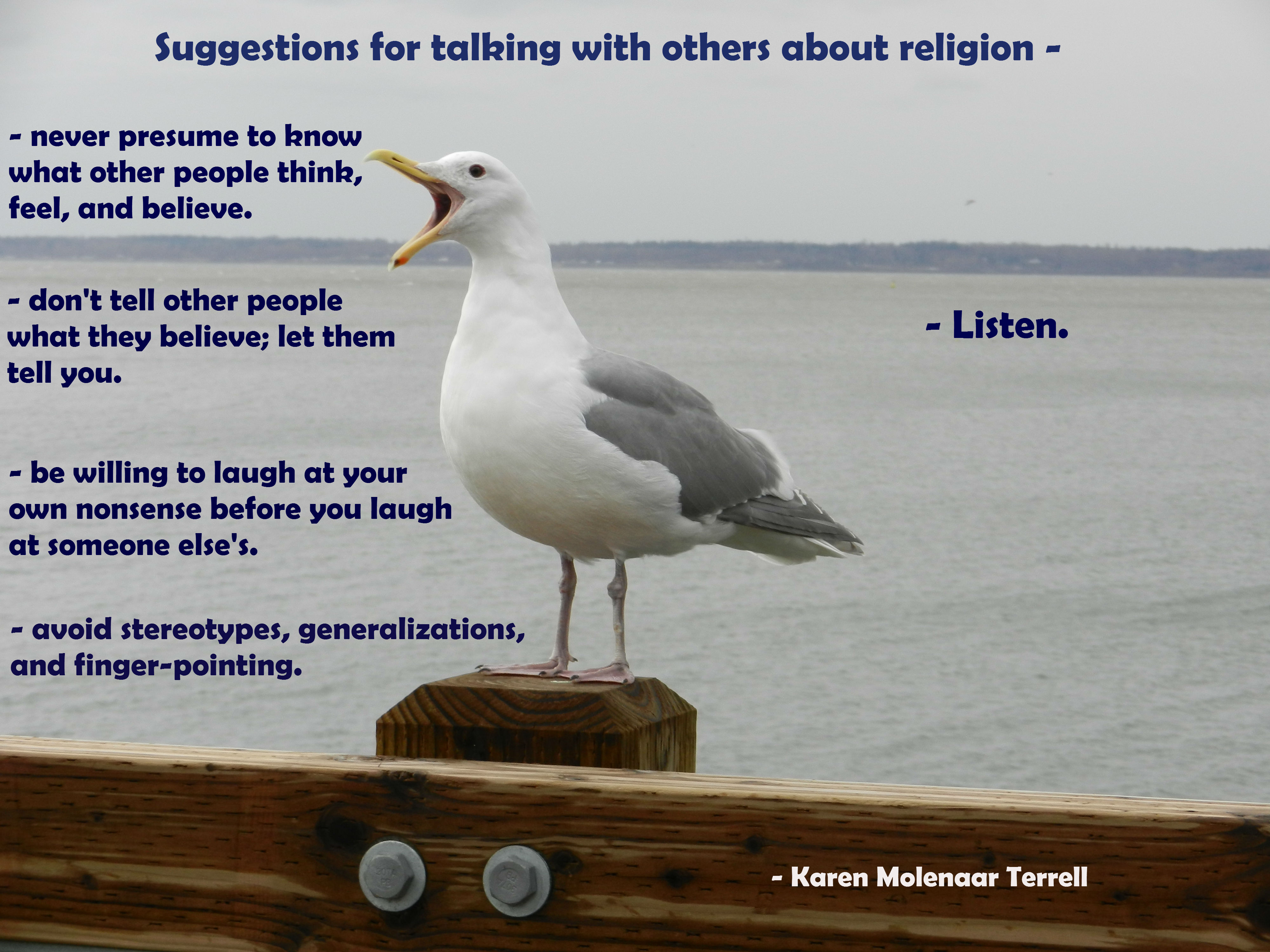

suggestions for talking with

Suggestions for talking with…

We should remember that the world is wide; that there are a thousand million different human wills, opinions, ambitions, tastes, and loves; that each person has a different history, constitution, culture, character, from all the rest; that human life is the work, the play, the ceaseless action and reaction upon each other of these different atoms. Then, we should go forth into life with the smallest expectations, but with the largest patience; with a keen relish for and appreciation of everything beautiful, great, and good, but with a temper so genial that the friction of the world shall not wear upon our sensibilities…
– Mary Baker Eddy (Miscellaneous Writings)

I wonder if I might make a few suggestions for conversing with others about religion on a discussion board?   I have had some experience with this, and I’d like to share some of what I’ve observed and learned.

The most important thing to know, I think, is that if you ever encounter me on a discussion forum I am always, always right. And if you disagree with me about this you are wrong.

Once we have established that basic and most fundamental of all facts, we can move on to other stuff:

  • Might I suggest that we never, ever, ever presume to know what other people think, feel, and believe just because they identify themselves as atheist, theist, Christian, Muslim, Jew, Buddhist, pagan, Christian Scientist, or as a member of any other ideology.
  • Generalizations, stereotypes, and lumping whole groups of people together as one “type” are not helpful when trying to understand someone else’s perspective.
  • Don’t tell other people what they think. Let them tell you.
  • Although pomposity cracks me up, not everyone shares the same reaction as me to puffed-up know-it-allness. Humility is a beautiful thing. Let’s be willing to laugh at our own nonsense before we laugh at someone else’s.
  • Remember that we’re all human – we all have our own flaws and foibles – none of us is perfect here. Might I suggest that we correct our own flaws before we start trying to correct someone else’s?
  • Give each other grace.
  • Listen.

More specifically:

When Christians are talking with atheists –

  • Do not assume all atheists think, feel, and believe exactly alike – the only thing, really, that all atheists have in common is the conviction that there is no god.
  • Do not assume atheists are unfamiliar with religious texts. Some of them are very familiar with religious texts, and, in fact, that is the reason some of them want nothing to do with religion.
  • Think about using quotes from the Bible sparingly. Remember that not everyone believes the Bible in the same way that you do, and quoting from it to prove that you’re right probably isn’t going to have the effect you’re looking for.
  • Do not assume that atheists have no sense of ethics, no humanity, or no “moral code” simply because they do not believe in a god.  Belief in a god is not necessary to know right from wrong, or to be a kind and compassionate person.
  • Do not end disagreements with atheists by condescendingly telling them that you will “pray” for them.

When atheists are talking to theists –

  • Do not assume that all theists think, believe, and feel exactly the same about everything.
  • Do not assume all theists have the same definition for “God”.
  • Do not assume every theist is a Christian. There are, among others, theists who are Muslim, Jewish, pagan, and non-religious. (Contrariwise, not every religious person is theistic – some religions, such as Buddhism and Universalist-Unitarianism, do not include a belief in a god.)
  • Do not assume all theists are superstitious scaredy cats, hoping to God there is an after-life. For some theists a belief in God follows a logical thought process, and doesn’t necessarily lead to belief in an after-life.

When atheists are talking to Christians –

  • Do not assume all Christians think, feel, and believe exactly the same – the only thing, really, that all Christians have in common is the belief that Jesus was the Christ.
  • Do not assume all Christians have the same definition for “God”.
  • Do not assume all Christians interpret the Scriptures literally.
  • Do not assume all Christians belong to the same political party and hold the same political ideology.
  • Don’t assume that when you’re talking with a Christian, you’re talking to someone lacking in logic, intelligence, or education. This kind of prejudice tends to lead to a really speedy end of civil discourse.
  •  Try to quote only sparingly from The God Delusion and God is Not Great, and avoid the over-use of Latin and terms like “strawman” and “Nirvana fallacy”. (Writing over-much in Latin and over-using or mis-using terms like “strawman” does not so much make you look intelligent as kind of silly.) Just as some Christians are sometimes prone to over-quote from the Bible, some atheists are sometimes prone to over-quote Hitchens and Dawkins. I think we all value a nicely–stated original thought much more than a canned response, don’t you?

When non-Humoristians are talking to Humoristians –

  • Don’t assume all Humoristians think, feel, and believe exactly the same about everything. Pretty much the only thing Humoristians have in common is the ability to laugh at themselves and the absurdity of life.
  • The only effect pomposity, stodginess, self-righteous indignation, and sermonizing are going to have on a Humoristian is to get her laughing so hard she’ll have tears pouring down her face. Unless that is the effect you’re going for, don’t waste your time with it.

When non-Unitarian-Universalists are talking to Unitarian-Universalists –

  • Don’t assume all Unitarian-Universalists think, feel, and believe exactly the same about everything… because… I mean… these are Unitarian-Universalists, for crying out loud! Trying to herd U-U members into one ideology would be like trying to herd cats.
  • Don’t waste your time trying to get U-U folks to get defensive about their religious beliefs. It ain’t going to happen. Although you might see the U-U coming to the defense of social justice and freedom, you are not going to see them getting defensive about their religious beliefs because they don’t have any to defend, really. So you can give THAT whole plot up right now.

When non-Christian Scientists are talking to Christian Scientists –

  • Don’t assume all Christian Scientists think, feel, and believe exactly the same about everything.
  • Don’t assume that because you were raised in another Christian denomination you are an expert on Christian Science. There is a vast difference between fundamentalist Christianity, for instance, and Christian Science – as many fundamentalist Christians would be the first to point out.
  • Do not assume that because you are the child of Christian Scientists you are an expert on Christian Science. (I am the daughter of a geologist, but I would not consider myself an expert on geology.)
  • Don’t assume because you read a Wikipedia article on Christian Science, or because someone once told you that they’d heard from someone else something about Christian Science, you are an expert on Christian Science. (I have actually been told by non-Christian Scientists to refer to Wikipedia to better find out what I believe as a Christian Scientist. I have spent more than 50 years practicing this way of life, have led the services at my church, and written books about my experience with Christian Science. Do not tell me to go to Wikipedia to find out more about what I believe. Sheesh.)
  • The “Christian Scientists are neither Christian, nor scientists” thing has gotten pretty old and is neither original nor helpful in maintaining thoughtful discourse. Let it go.
  • Do not assume all Christian Scientists hold the same political or social beliefs. Christian Scientists are a pretty diverse group of people – there are Christian Scientists who are Democrats, Christian Scientists who are Republicans, Christian Scientists who are liberal-progressives and Christian Scientists who are conservatives. Unlike some other religious institutions there is nobody in the Christian Science church who tells Christian Scientists how to vote. That is left up to individual conscience.
  • Along the same lines, recognize that private Christian Science schools and institutions – and the people who are part of them – are not necessarily representative of the views and experience of every individual who is practicing Christian Science.
  • Do not assume that because you know one Christian Scientist you know them all.
  • Do not assume that Christian Scientists who go to doctors are not “real” Christian Scientists. For some Christian Scientists, Christian Science is neither a religion nor an alternative health care system, it is a way of life – a way of looking at the world that has brought them healing and a lot of good.

When Christian Scientists are talking to non-Christian Scientists

  • Avoid, if you can, using phrases like “working on a problem” or “the belief of” – most people are not going to understand what the heck you are talking about.
  • Avoid, if you can, using absolutes. None of us have ascended, yet. Christian Scientists are still dealing with the same challenges as every other human being. Recognizing the common human experience we share with the rest of mankind is not a bad thing.
  • It’s alright to show natural human feeling – to cry, laugh, grieve. These are the feelings that connect us to the rest of humankind. Embrace them. Don’t be afraid to bring human emotion into your conversations with others. Christian Scientists are not automatons.
  • Do not talk down to others. Being a Christian Scientist doesn’t make you any better, wiser, or more spiritually-minded than anyone else.
  • Don’t be afraid to laugh at yourself now and then, and don’t be afraid to let others laugh at you, too. Recognize that to people unfamiliar with Christian Science some of the teachings found in Christian Science might seem completely ludicrous. And that’s okay.

I guess that’s pretty much all I have to say about that.

(excerpt from The Madcap Christian Scientist: All Things New)

Government Of the People, By the People, For the People

It is rather for us to be here dedicated to the great task remaining before us — that from these honored dead we take increased devotion to that cause for which they gave the last full measure of devotion — that we here highly resolve that these dead shall not have died in vain — that this nation, under God, shall have a new birth of freedom — and that government of the people, by the people, for the people, shall not perish from the earth. – Abraham Lincoln, The Gettysburg Address

“…he that is greatest among you shall be your servant…” – Matthew 23

Our government exists to serve us. In fact, according to Abraham Lincoln, our government IS us.  Those politicians who represent us in our government are our employees, entrusted to work for us and keep our infrastructure and governmental offices running smoothly.

When the time comes that our politicians – our employees – are no longer concerned with serving us – then it is time for them to move on to other endeavors.  It is time for us to let them go.

I came upon some passages in The Bible today that I found timely.  These passages talked of service – of how the real leaders aren’t the ones who are served, but the ones who serve:

 Jesus knowing that the Father had given all things into his hands, and that he was come from God, and went to God;  he riseth from supper, and laid aside his garments; and took a towel, and girded himself.  After that he poureth water into a bason, and began to wash the disciples’ feet, and to wipe them with the towel wherewith he was girded… So after he had washed their feet, and had taken his garments, and was set down again, he said unto them, Know ye what I have done to you?  Ye call me Master and Lord: and ye say well; for so I am.  If I then, your Lord and Master, have washed your feet; ye also ought to wash one another’s feet.  For I have given you an example, that ye should do as I have done to you. Verily, verily, I say unto you, The servant is not greater than his lord; neither he that is sent greater than he that sent him. If ye know these things, happy are ye if ye do them. – John 13

And there was also a strife among them, which of them should be accounted the greatest.  And he said unto them, The kings of the Gentiles exercise lordship over them; and they that exercise authority upon them are called benefactors. But ye shall not be so: but he that is greatest among you, let him be as the younger; and he that is chief, as he that doth serve… – Luke 22

Life, Love, Truth (God) bless those individuals who step up to the plate and put themselves in positions of responsibility and service. I pray to know they will have the wisdom of Solomon in these challenging times – that they won’t divide “the baby in half’ to appease jealousy,  rivalry,  and political demands. I pray to know that those who represent us will know when to “render unto Caesar the things that are Caesar’s” (Luke 20).  And I pray that they will know when to, like Jesus, turn their backs on those who would make them kings (John 6).

Pride and fear are unfit to bear the standard of Truth… – Mary Baker Eddy

One Christian Scientist’s Views on Health Insurance

Health care, in my opinion, should be considered a basic necessity of life – in the same category as food, water, and shelter…

Karen Molenaar Terrell's avatarAdventures of the Madcap Christian Scientist

“And as ye would that men should do to you, do ye also to them likewise.” – Luke 6: 31

 ***

A few years ago a dear friend shared with me that she was told the drugs she’s been prescribed to take while she’s in cancer remission will cost $30,000 to $40,000 a month.  She did not have health insurance at the time.  I was floored by the financial burden her family was going to be expected to bear while she recovered from cancer, chemo, and radiation, and tried to find a way to pay for the drugs she was told she needed to take to stay alive.

Health care, in my opinion, should be considered a basic necessity of life – in the same category as food, water, and shelter; I don’t believe anyone should be denied access to the care they believe they need simply because they lack the financial resources…

View original post 298 more words