
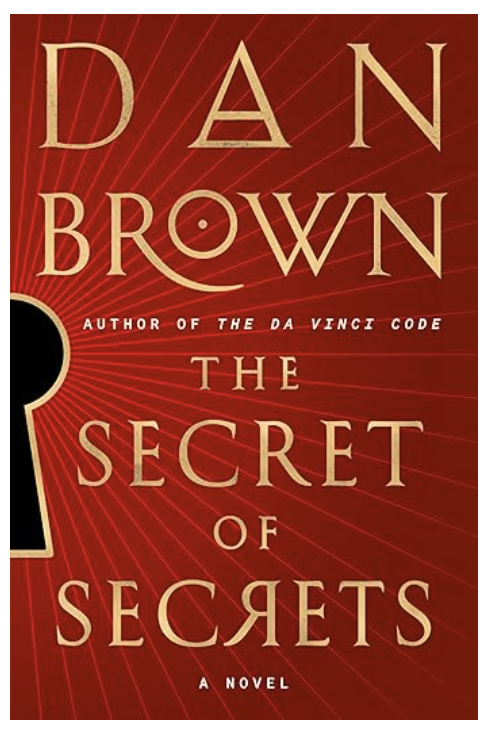
Reviews of Dan Brown’s book, The Secret of Secrets, have used the terms “entertaining,” “absorbing,” “encyclopedic lecturing,” “clear bias,” “unnecessary descriptions,” “tedious,” “predictable,” “silly”, “fast-paced,” “fun read.” And I guess I would agree with all of that. 🙂
I enjoyed The Secret of Secrets enough to finish all 671 pages of it – although I found myself frequently checking what page number I was on so I could calculate how much more time I still had to invest in this read.
One of the things that other readers criticized were the constant references to the tourist spots of Prague, but, personally, those references were some of my favorite parts. I love tourist books. Other readers complained about the continual diversions the author takes to roll out facts and details that have little or nothing to do with the plot. Here’s an example, I think, of what they meant: “The Temple of Athena, he mused, recalling how ancient Greeks had practiced catoptromancy by gazing into dark pools of water to glimpse their future.” But, again, being the nerd I am, I kind of liked those diversions. It was like watching an episode of Jeopardy.
But, as a madcap Christian Scientist, here’s what I found most disappointing: Brown’s references to metaphysics. Brown’s book was promising at the start. His character Katherine, a doctor of noetic science, says, “Your consciousness is not created by your brain. And, in fact, your consciousness is not even located inside your head.”
Okay. Cool. As a student of Christian Science I’ve come to feel that we live within the one Consciousness, our Father-Mother God, and are expressions, reflections, manifestations, ideas, children, images and likenesses of this one universal Consciousness. At this point in the book, I was excited about the possibility of Dan Brown exploring the idea of a non-material universal cosmic consciousness.
But as I read further into the book, I realized that Brown still couldn’t quite let go of the notion that consciousness is connected to the brain – with his character Katherine explaining that the brain acts as a transmitter for the “nonlocal consciousness”: “Your brain is just a receiver—an unimaginably complex, superbly advanced receiver—that chooses which specific signals it wants to receive from the existing cloud of global consciousness. Just like a Wi-Fi signal, global consciousness is always hovering there, fully intact, whether or not you access it.”
I felt that Brown was heading the right direction, but he couldn’t quite take that last step of letting go of a physical transmitter for a metaphysical presence.
Brown talks about the idea of a universal consciousness being a part of many religions and cultures. He writes: “The symbol of the halo was widely associated with Christianity, but Langdon knew there were many earlier versions—from Mithraism, Buddhism, and Zoroastrianism—that portrayed rays of energy around their subjects.” And “Like everyone around him, Langdon was stunned. He also knew that this very idea—the notion that human thoughts create reality—existed at the core of most major spiritual teachings. Buddha: With our thoughts, we create the world. Jesus: Whatever you ask for in prayer, it will be yours. Hinduism: You have the power of God.”
Dan Brown lives in Boston – home of The Mother Church for Christian Science. In the textbook for Christian Science, Science and Health with Key to the Scriptures by Mary Baker Eddy, the word “consciousness” is mentioned 80 times. And I guess I can’t help wondering – and speculating – why Brown didn’t mention Christian Science in The Secret of the Secrets. Sure, Christian Science isn’t considered one of the world’s major denominations – but, as a cultured, intelligent, well-educated man who lives in Boston and wrote a book about metaphysical universal consciousness, I’d expect that Christian Science would have shown up on his radar at SOME point, right?
And this got me to thinking about Dan Brown’s humanness and mine, too. We all have biases. All of us. And I’m thinking it’s human nature to want to be seen by others in our political tribe as not being one of “those guys” over there in the other tribe. As a self-identified “progressive Christian” I’m triggered by anyone trying to lump me in with those “other” Christians – the fundamentalist conservative ones. I make a point of letting everyone know that I am not THAT kind of Christian. And I can imagine that Dan Brown might have the same concerns. This is pure speculation on my part, of course – but it could be that he does NOT want in any way to be associated with those crazy Christian Scientists. And, as a human with my.own biases, I can not blame him. But I might have gained more respect for him if he’d been a little more fearless.
None of what Brown had to say about consciousness seemed “cutting edge” or mind-blowing to me. I’ve lived with these concepts my entire life.
I liked some of the other ideas Dan Brown shared in his book, though. I like the take on the “online world” that Dan Brown’s character, Katherine, offers: “I think you have to consider that the online world is a real world…when you see someone glued to a phone, you see a person ignoring this world – rather than a person engrossed in another world…a world that, like this one, is made up of communities, friends, beauty, horror, love, conflict, right and wrong. It’s all there. The online world is not so different from our world…except for one stark difference… It’s nonlocal.”
Brown writes: “…our current technological explosion is actually part of a spiritual evolution…a kind of training ground for the existence that, in the end, is our ultimate destiny…a consciousness, untethered from the physical world, and yet connected to all things.”
This reminds me very much of an interesting dialogue about science and technology between Mary Baker Eddy and an interviewer, as recounted In Prose Works (Miscellany, p. 345). The interviewer asks Eddy how she feels about the “pursuit of modern material inventions,” and Eddy replies: “Oh, we cannot oppose them. They all tend to newer, finer, more etherealized ways of living. They seek the finer essences. They light the way to the Church of Christ. We use them, we make them our figures of speech. They are preparing the way for us.”
And I like what Brown’s character, Katherine, says about fear and death: “Fear makes us selfish,” Katherine said. “The more we fear death, the more we cling to ourselves, our belongings, our safe spaces…to that which is familiar. We exhibit increased nationalism, racism, and religious intolerance. We flout authority, ignore social mores, steal from others to provide for ourselves, and become more materialistic. We even abandon our feelings of environmental responsibility because we sense the planet is a lost cause and we’re all doomed anyway.” Katherine says, “Death is not the end. There’s more work to do, but science continues to discover evidence that there is indeed something beyond all this. That message is one we should be shouting from the mountaintops, Robert! It’s the secret of all secrets. Just imagine the impact it will have on the future of the human race.” And “The elimination of the fear of death transforms the individual’s way of being in the world.’ Grof believes that a radical inner transformation of consciousness might be our only hope of surviving the global crisis brought on by the Western mechanistic paradigm.”
In Science and Health, Mary Baker Eddy writes: “The fact that the Christ, or Truth, overcame and still overcomes death proves the ‘king of terrors’ to be but a mortal belief, or error, which Truth destroys with the spiritual evidences of Life; and this shows that what appears to the senses to be death is but a mortal illusion, for to the real man and the real universe there is no death-process.” (p. 289) Later in Science and Health, Eddy writes: “Christian scientific practice begins with Christ’s keynote of harmony, ‘Be not afraid!'” (p. 410)
“Man is deathless, spiritual. He is above sin or frailty. He does not cross the barriers of time into the vast forever of Life, but he coexists with God and the universe.”
-Mary Baker Eddy
 Adventures of the Madcap Christian Scientist