Years ago I took part in a peace workshop being taught at our local community college by Leo Valk (I think that was his name?), from de Nederlands. Here’s what I remember about the peace workshop –
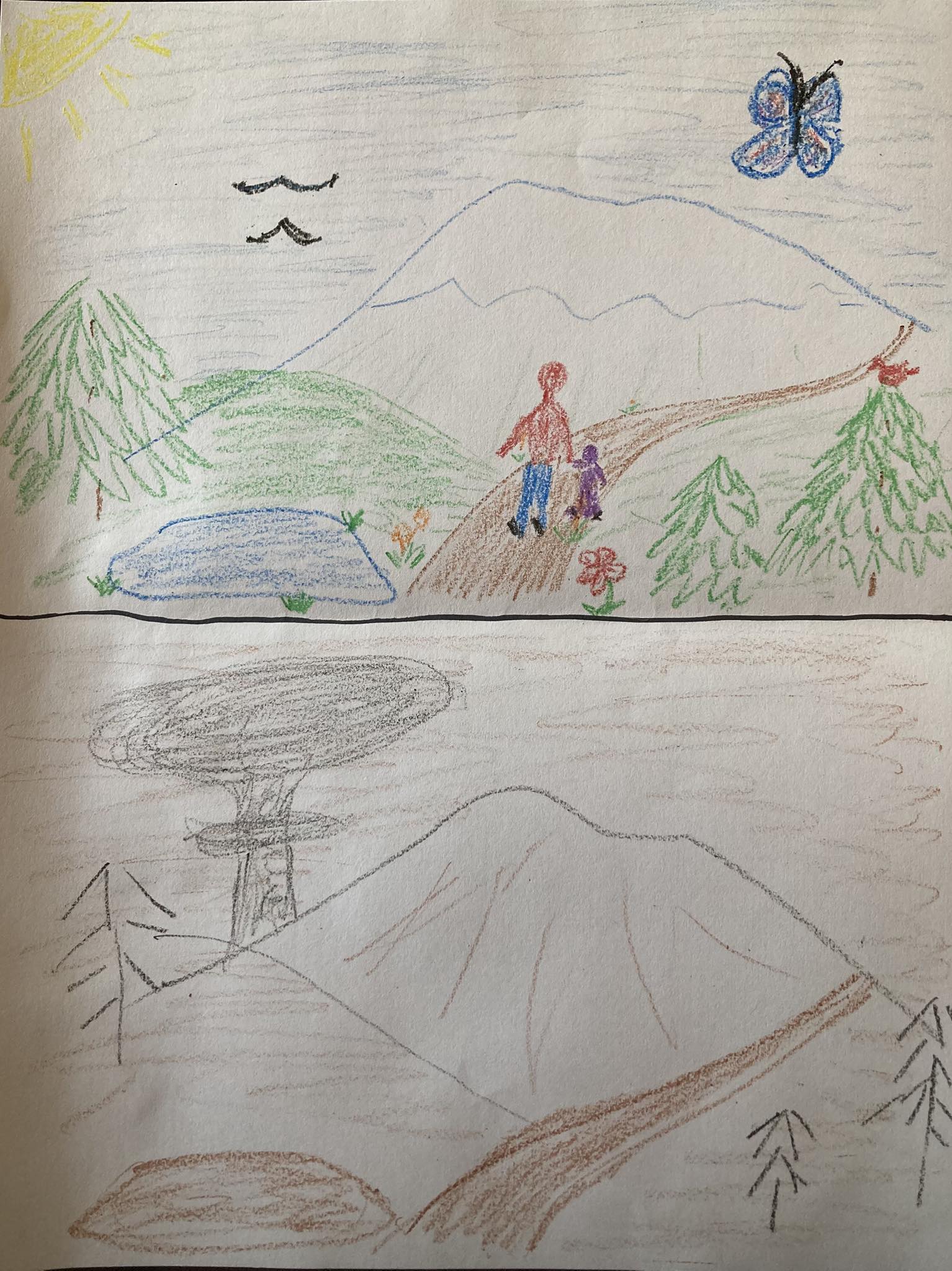
1) Leo asked us to draw a line down the middle of a paper. On one side of the line he asked us to draw war, and write our definition for war. On the other side he asked us to draw peace, and write our definition for peace. This got us all thinking about what war and peace actually ARE.
Then he told us that there are actually different kinds of war, and different kinds of peace. There is negative peace and positive peace: Negative peace is just the absence of war; Positive peace is built on the idea of social justice for all members of a society. Leo talked about Von Clausewitz and Tolstoy and Karl Deutsch and their differing views on war. Leo asked us if we thought, as Von Clausewitz did, that war can be justified as a way to solve problems when diplomacy doesn’t get us what we want? Is war, as Tolstoy believed, like a natural disaster that we can’t prevent, but shouldn’t participate in? Can just the threat of war be seen as war, as Karl Deutsch believed? Can we justify war if it’s used to stop evil? Or is war, as Gandhi believed, the worst evil of all?
Leo got us thinking.
2) Leo talked about nuclear weapons and explained the difference between missiles and warheads – just limiting the number of missiles, doesn’t limit nuclear power when each one of those missiles can have more than one warhead on it. He asked us if we thought a nuclear war was “winnable.” And if you “won” a nuclear war, what would that look like? What would be left of civilization to “win” when there’s already enough nuclear weapons to annihilate all life off the face of the planet?
3) He talked about strategies in a nuclear disarmament:
– Unilateralism – when a nation says, in essence, “We’re done playing this game,” and gives up all its nuclear weapons without waiting for other nations to give up their weapons.
– Reciprocity – when nations take turns giving up their weapons – “We’ll give up this, if you give up that.” This helps to build trust between nations.
4) He talked about ways to maintain peace:
– Stop changing boundaries – establish them and keep them.
– A nation’s security depends on the security of other nations. Maintaining peace is letting your neighbors know they’re safe, and not threatened by you. If countries are happy and prospering they’ll be less inclined to invade other countries.
– Do not intervene in other nations’ governments.
– Working with other nations to solve problems we all share – problems with the air we all breathe, and the oceans we share – builds alliances and trust.
– Trade with other countries is a way to maintain friendships and alliances.
I think so much of what Leo taught us all those years ago is timely now, too. I’ve been asking myself how our nation’s leadership is doing with the whole “maintaining peace” thing, and I’d have to give them all a failing grade right now. In fact, it seems like our leadership is doing the exact opposite of what brings peace.
 Adventures of the Madcap Christian Scientist