Just because someone calls you a rutabaga, doesn’t make you a rutabaga…

Photo of roses by Karen Molenaar Terrell.
Just because someone calls you a rutabaga, doesn’t make you a rutabaga…
Photo of roses by Karen Molenaar Terrell.
Any politician who plans to use marriage equality as her or his main focus will need to find another issue because – haleleujah, brothers and sisters! – marriage equality is now officially old news. I look forward to that happy day when bigotry of EVERY type is old news. We’re seeing the signs – the flags that symbolize racial bigotry are quietly being removed from their poles ( http://www.msnbc.com/rachel-maddow-show/surprise-move-alabama-confederate-battle-flag-comes-down ) – and people of every race, gender, sexual orientation, ethnicity, religion, and non-religion are coming together to speak out for equality and peace.
“What is going to happen, Dave?”
“Something wonderful.”
– 2001: A Space Odyssey
The weapons of bigotry, ignorance, envy, fall before an honest heart.
– Mary Baker Eddy

We Shall Overcome, performed by Joan Baez –
I had a visit with my optometrist today, and, as usual, I left feeling like I’d just participated in a stand-up comedy act. My optometrist and my dentist are two of the funniest folks I know. If I wasn’t paying for their health care services, I think I might pay them just to make me laugh.
Today’s fun started when the assistant asked me if I’d be willing to have my eyes dilated. I do not like having my eyes dilated, but if it’d help the doctor see in my eyes… “Okay,” I said. As she was putting the drops in I asked, “So why don’t they dilate the eyes of pregnant women?” The assistant said she wasn’t sure, but they didn’t put the eye drops in the eyes of pregnant women, nursing women, or people with one kidney.
That last bit sort of caught me up short. The assistant left to find out more, and came back a few moments later to say that apparently the chemicals in the eye drops could interact with the medicines that a person with kidney problems might be taking, and cause kidney failure. But otherwise the eye drops were alright.
This was reassuring.
Enter the doctor. He asks me how I’m doing, and I say something like, “Well, other than possible kidney failure, I’m doing alright, I guess.” He starts laughing and brings me back into his examination room. He puts on this helmet thing with weird tubes and gizmos sticking out of it. “You look very dapper in that,” I observe. He grins and wonders aloud if he should take it out of the clinic and strut down the street in it.
I tell him that I didn’t bring my sunglasses with me, and that – since my eyes have been dilated – I’m really looking forward to getting a pair of their special dorky sunglasses for my drive home – I always look so good in those things. He smiles and promises that a pair of dorky sunglasses will be mine.
He has grown a rather substantial beard since I last saw him – it’s about a foot long and nicely rounded at the bottom. I tell him he looks sort of like Santa Claus. He says being Santa Claus would be alright as long as random strangers didn’t try to sit on his lap or ask him for candy. I tell him about my friend who grew a beard down to his waist. “He said food would get stuck in there – he sometimes found whole sandwiches in that thing.” My optometrist notes you wouldn’t need a lunchbox with a beard like that.
All this time he’s examining my eyes, looking into them with his little flashlight dealie. He says they look pretty good in there. No signs of macular degeneration or anything. I mention that in a recent photo it looked like one of my eyes was sort of looking off to the side while my other eye was looking straight ahead, and he asks me to look at him while he shines his light on my eyes. “No,” he says, “everything looks good. Ah… yes, I see.” I ask him what he sees. He tells me that one of my eyelids is more saggy than the other, which makes it look like I have one eye that’s looking off to the side.
“Oh! Is that all?! Heck… I lost my vanity long ago. A saggy eyelid is no big deal.” He laughs and says that at our age we have more important things to worry about… like, say, breathing.
I remind him of the time when he saw a melanoma on my eyelid. I tell him that totally freaked me out. Of course, the more freaked out I get, the more I start cracking jokes. I reminded him that I went out to his receptionist and started making her laugh and then when they called the eye surgeon’s office for me, I started making THAT receptionist laugh – and then he had walked in, heard me joking about my impending death and had said, “Don’t start ordering caskets just yet” – and that had totally had me in stitches.
“That broke the fear for me, ” I tell him. “And then I went home and prayed and two weeks later when I went to the eye surgeon the melanoma was gone!” He checks his records and sees that my story rings true, and he likes that.
We talk about prayer then. I’ve been going to him for more than twenty years, but for the first time I confide to him that I am a Christian Scientist, and – to his credit – he doesn’t freak out or anything. He nods his head and waits to hear more. I tell him that when I pray I’m not, like, pleading with some guy who looks like him – with a long beard – sitting in the clouds. But that I’m just trying to bring myself close to the power of Love. And he nods and says he believes there’s a Higher Power, too, and he believes that there’s more beyond the life that we’re experiencing here.
We start talking about other religious beliefs then – and those who try to bring their religious beliefs into politics and government – not just in America, but elsewhere. The conversation about religious extremism ends with him saying, “I don’t want 70 virgins if I have to feed them and buy them bling and stuff. Can I pass on the virgins, and killing other people, and just be a kind and humane person instead?”
He walks me out to the receptionist’s desk, and tells her that I’ll need some of the special sunglasses they give out to patients. Then he turns to me, and tells me my eyes are looking really good – very nice and healthy. I tell him that’s probably the best compliment I’ll get all day. He smiles, and says, “Not with those sunglasses!”
He shakes my hand and tells me how much he always enjoys my visits. And I tell him how much I enjoy my visits with him.
And in another couple weeks I’ll be going to the dentist! I’m so looking forward to that… 🙂
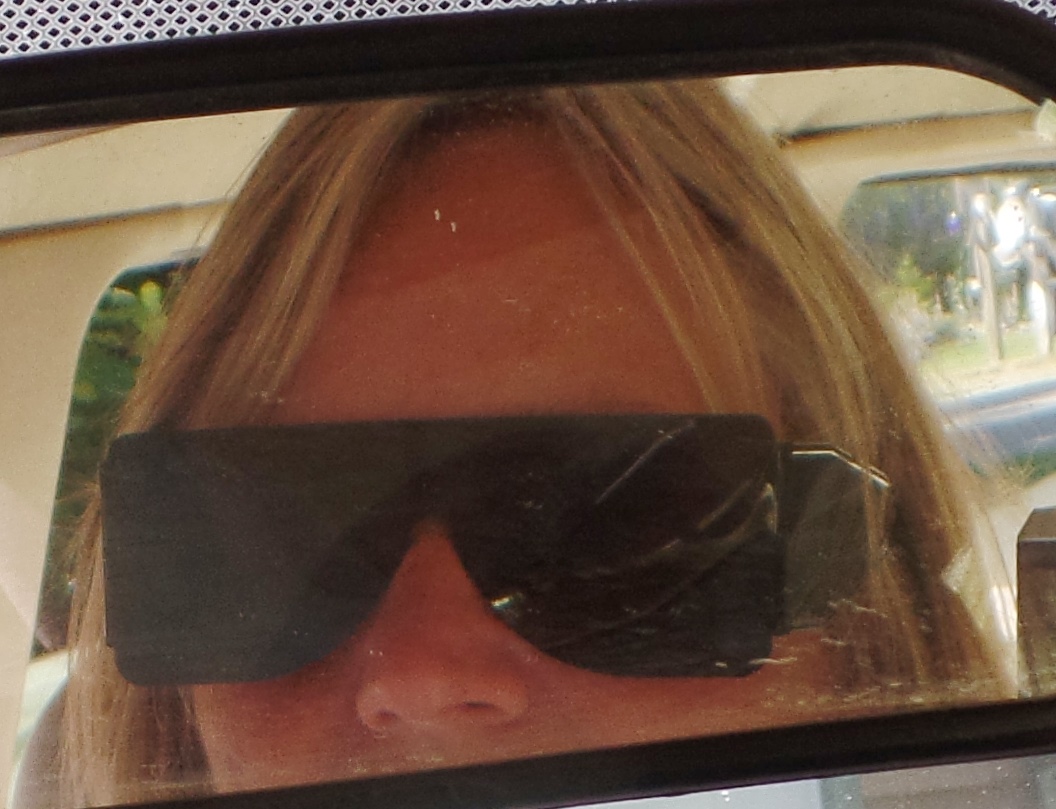
Karen in her special sunglasses.
“Might I,” quavered Mary, “might I have a bit of earth?”
However many years she lived, Mary always felt that she should never forget that first morning when her garden began to grow.
And the Secret Garden bloomed and bloomed and every morning revealed new miracles.
– from The Secret Garden by Frances Hodgson Burnett
Fourteen years ago, my Secret Garden started with a lilac bush, a couple knee-high azaleas, a stubby mock orange, some wild roses, and twin flowers. And look at it today – it is a haven for birds and bunnies, and me. I walk through a portal of climbing clematis, and sit underneath a canopy of Cecile Brunner climbing roses which have been in my family for more than 50 years, and watch the birds splash around in the birdbath I set out for them, and eat from the feeders I hung from the ash tree branches. There is something very satisfying about watching the garden evolve, and watching the wild creatures visit and enjoy its peace…


Eat well, sleep well, and do everything well.
– Bicknell Young (from The Collected Writings of Bicknell Young)
And I now bring you a moment from my perfect morning… 🙂
Crepes made with eggs from our little hens and raspberries from the garden…

Karen’s Crepes
Sitting with my crepes on the back deck, listening to the morning birdsong…
My friend, Kat, a thought-provoking ex-Christian Scientist of intelligence and interesting insight, posted a comment on my last blog post that I thought was worth responding to in a whole ‘nother post. Here’s Kat’s comment:
“Why would a Christian Scientist choose Christian Science over medical treatment for her children?”
Yeah, that’s the elephant in the room CS is going to have to address head-on over and over and over again. Some CS have made REALLY BAD CHOICES and people have died.
Caroline Fraser’s book God’s Perfect Child talks about this at length. Another excellent example is Rita Swan’s son Matthew,https://thedublinreview.com/‘matthew-you-cannot-be-sick’/ (you may have heard of her, she founded C.H.I.L.D. http://childrenshealthcare.org)
I agree A better question might be: “What is it about Christian Science that appeals to you?” it no longer appeals to me, but for a while it did, and on some level, I still understand the appeal.
Hi, Kat –
The producer at NPR wanted a Christian Scientist on her show who could respond to Dr. Paul Offit’s assertion that religion is killing children – an assertion presented in his book, Bad Faith: When Religious Belief Undermines Modern Medicine. I was not the right fit to respond to that assertion – seeing as how I did take my sons to doctors now and then when they were youngsters.
But if I were interviewing Offit, there are a couple questions I’d like to ask him, if I had the chance: We know that preventable errors in medical care are the third-leading cause of death in this country (according to the Journal of the American Medical Association, among other sources) and have been for several years now. Knowing that about 400,000 people a year die from preventable medical errors (http://www.healthcareitnews.com/news/deaths-by-medical-mistakes-hit-records ), I’d like to ask Dr. Offit –
I’ve lost friends who were under Christian Science treatment. I’ve also lost friends who died from the medical treatment they were under-going – not from the disease, but from the medical treatment itself. Neither type of death caused me less grief than the other. Humans die. I may even appear to die someday. (I know – it’s hard to believe, right? – but I think we need to consider the possibility that I may not ascend here.) And if I die while under Christian Science treatment, I really hope my loved ones don’t blame Christian Science for this. I hope they realize that Christian Science has helped make me the person they love – and that there was some part of me – maybe a part of me they love – that was drawn to this way of life.
Regarding Rita Swan: I’m not sure why Rita Swan made the choices she made when her baby became so ill. I’m not going to try to speak for someone else. But I imagine that if I’d been in her shoes I might have felt terrible guilt after my baby’s death and would have looked for someone else, or something else, to put the blame on for this tragedy – just to relieve the burden of self-condemnation a little. I wouldn’t judge anyone in Rita Swan’s position for taking the direction she took after Matthew’s death. I don’t blame her. But I’ve never been in the position she was in – as I wrote in my post, I took my sons to doctors now and then when I felt the need to do so. I’ve never felt any pressure from my church family to avoid medical treatment. And I’m pretty sure that if I ever did, it wouldn’t faze me at all. My responsibilities as a mother to keep my sons safe out-trumped any other considerations. (And sometimes that meant saying “no thank you” to drugs that doctors offered that had potentially adverse side effects and no guarantee of helping.)
Regarding Caroline Fraser: Years ago she wrote an article for Atlantic Monthly about Christian Science. Someone handed me the magazine, and I thought they were giving it to me because of the really well-written article on the environment that was in that issue. It wasn’t until a week later, when I was looking through the magazine again, that I saw Fraser’s article. What struck me about the article was the complete lack of objectivity, and the blatant bias. She wrote about Mary Baker Eddy with authority – as if she’d actually met the woman (which, of course, she had not – Eddy died long before either Fraser or I were born). Fraser acted as though she could get inside Eddy’s head and tell us all what was going on in there. I am always wary of people who set themselves up as experts on what’s going on inside someone else’s head – who presume to know what someone else is/was thinking, feeling, and believing – this is often a symptom of bigotry. Fraser’s article made me wary of Fraser.
There’s another book about Christian Science, though, written by Lucia Greenhouse, a woman who watched her Christian Science mother die of cancer – that I think is less sensationalistic than Fraser’s writings about Christian Science. One of my friends who was raised in Christian Science could relate to a lot of Greenhouse’s experiences with Christian Science in fathermothergod – and I think Greenhouse’s book was really helpful in validating my friend’s experience. I don’t discount Lucia Greenhouse’s experiences with Christian Science – I believe she’s telling the truth. But my experience being raised in Christian Science is very different from either my friend’s or Greenhouse’s. My brothers and I were brought to doctors, dentists, and optometrists – and this was no big deal. We also experienced some really beautiful healings in Christian Science. (Which you can read about in Blessings: Adventures of a Madcap Christian Scientist – http://www.amazon.com/dp/1419612298/ref=rdr_ext_tmb .)
As I wrote in my last post, what draws me to Christian Science is the transformation in my nature that I feel when I experience healing – and I HAVE experienced healing in Christian Science. Christian Science healing doesn’t just make me better physically – but it brings me closer to Love – it lifts my thoughts, inspires me, gives me courage – fills me with joy and gratitude and good will to my fellow man and woman. These are not things I’ve experienced in medical science treatment.
And now I give you a picture from my morning bike ride – just because I wanna… 🙂

Samish River (photo by Karen Molenaar Terrell)
A staffer at NPR recently asked me if I’d be interested in doing a segment on Christian Science for NPR’s Interfaith Voices. It sounded like a great opportunity and I agreed to do a pre-interview. I had a nice chat with the senior producer of Interfaith Voices. I talked about what prayer means for me as a Christian Scientist (not pleading to some anthropomorphic god to fix everything for me – but drawing my thoughts close to Love), and she shared what she’d heard about research that shows human thoughts and feelings play a huge part in healing. But then she asked me, “Why would a Christian Scientist choose Christian Science over medical treatment for her children?” and I realized that that’s what the whole segment was going to be about – Christian Science versus medical science. I told her that I’d sometimes taken my sons to doctors when I felt the need, and that maybe I wasn’t the right fit for this show. She graciously agreed that I probably wasn’t the right person for this segment, and let me off the hook.
I was hugely relieved to be let off the hook, but I guess I was also a little disappointed about the focus of the proposed segment. I wish that one day someone would ask me to talk about Christian Science just for itself – not as something in opposition to something else – but as a way of looking at life and a way of living. Sometimes it seems that the only thing people THINK they know about Christian Scientists is that they’re the ones “who don’t go to doctors.” As I’ve mentioned, there have been times when I felt the need to take my sons to doctors when they were youngsters. I was not conflicted about this or anything. I wasn’t worried about being ex-communicated or losing my Christian Science friends or making God angry – I don’t believe in a wrathful, vengeful god – in Christian Science “God” is another name for Principle, Mind, Soul, Spirit, Life, Truth, and Love – and Love doesn’t get angry at parents for doing what they feel they need to do, humanly, to keep their children safe and healthy. An angry god is not the kind of god I could ever worship.
Getting back to the producer’s question, here are some reasons why I might choose Christian Science treatment over medical treatment for myself –
But I think asking Christian Scientists why they would choose Christian Science over medical treatment is the wrong question to ask, really. It’s akin to asking people who go to doctors why they don’t choose Christian Science instead. It’s setting up Christian Scientists to be in a defensive position. A better question might be: “What is it about Christian Science that appeals to you?”
And here is my answer for THAT one: Christian Scientists believe that Jesus’ mission here was to teach us how to love and how to heal. I like the idea of that – that I can use my understanding of God as Love to help heal the world. It’s a way of life that I have found practical and useful. I have been able to prove the teachings of Christian Science in my own life and have experienced some wonderful healing through my understanding of it. I am a Christian Scientist because it has enriched my life and helped make me a better person.

photos by Karen Molenaar Terrell

Doodle by Karen Molenaar Terrell
Snippet of a dialogue from a discussion forum…
Robert says:
The requirements for an observation to be considered to be evidence are strict: the phenomenon must be repeatedly observable by anyone who is interested, and must be able to show, and actually show, that the thesis under discussion is true, if such is the case — AND must be able to show, and would actually show, that said thesis is false if such is the case. And this arises for good reason: it is extremely easy to fool oneself as to the nature and significance of a subjective phenomenon. Clearly, no subjective phenomena of any sort can qualify as evidence in a scientific sense.
None of this has anything whatever to do with anyone’s position on the rights of women and LGBT people — nor whether one is a theist, atheist, or whatever.
Karen writes:
Robert, you write: “None of this has anything whatever to do with anyone’s position on the rights of women and LGBT people — nor whether one is a theist, atheist, or whatever.”
Exactement!! Exactly! Which brings us back to my original question: Seeing as how my beliefs in God don’t cause me to do harm to others, why do you REALLY care about them? What impels you to want to refute them? Why does it matter to you what I believe? Why is it any of your business?
And if I were to tell you that my belief in God has made me a better person – has helped me become kinder, more compassionate, more tolerant – doesn’t that actually make my belief in God a positive thing? Something to be glad about?
I don’t think it’s our beliefs that are important. I think it’s what we do with them that matters. If your belief in Nogod has made you kinder, more compassionate, and more tolerant – then I celebrate your belief in Nogod with you.
Robert responds:
Good post. “…my beliefs in God don’t cause me to do harm to others…” Most of the time, they probably don’t. But if you ever do ANYTHING for religious reasons, there is a distinct possibility that there will be, somewhere, an adverse effect. But the more salient point is: do not these beliefs cause you to do harm to yourself? Do you spend time in a church, as opposed to doing something productive? Do you contribute time or money to religious things, instead of to things that actually improve peoples’ lives? Do you approve of what is demonstrably irrational thought?
“…my belief in God has made me a better person…” I would ask for your grounds for this. Such beliefs can impel people to do good things — or truly horrible things. And, since there does not (and, provably, cannot) exist any means for validating any such belief, whether you do well or ill in accordance with a religious belief is strictly a crapshoot. No doubt you temper your religion-impelled actions on the basis of your appraisal of their overall effect on the society in which you live, but not everybody does this. (Examples of such perfidy are rife in the news these days.)
“I think it’s what we do with them that matters.” Agreed. But the standards to be applied in determining this cannot be based solely on any religion.
Karen responds:
Robert, you ask: “…do not these beliefs cause you to do harm to yourself? Do you spend time in a church, as opposed to doing something productive? Do you contribute time or money to religious things, instead of to things that actually improve peoples’ lives? Do you approve of what is demonstrably irrational thought?”
I am a teacher in a non-profit alternative high school. Seventh-eighths of the population is composed of minority students. My students and their families are dealing with challenges that a lot of us can’t begin to imagine – and that I can’t really share here. I came to the alternative high school after a 20-year career in public education. I get paid peanuts, but I love my job and love working with these kids. I love helping them find academic success and helping them discover their gifts. There are days when I come home totally emotionally drained – not from my students, but from seeing the crap they have to deal with just to survive in our society. I feel useful there. I really like feeling useful. My work is not in any way connected with a religious institution.
I am involved in supporting political issues that matter to me – I served as a state delegate to the 2012 Democratic convention, and write letters to politicians and newspapers, and write posts on my blogs that take the time to address these issues. I have given money to the ACLU, Amnesty International, the Nature Conservancy, Sierra Club, Environmental Defense Fund, World Wildlife Fund, Habitat for Humanity, Humane Society, and Doctors Without Borders, among others. I have helped build a house for Habitat for Humanity.
I also like to keep moving – hiking, gardening – healthy activities that keep the blood pumping. And I’ve found it’s important to my well-being to set aside time for creative pursuits, too – I’m big into photography, singing, and writing.
I am not, actually, a very religious person. Not all theists are. There are periods in my life when I don’t attend church. And there are periods when I do. Right now I am the Reader at the mid-week testimony meetings, and my job is to pick the week’s topic, find readings on it, and conduct the service. I try to find readings that I think will be helpful and healing to the world. Last week’s readings were on “wrath/anger” and “love/forgiveness.” People seemed really grateful for the inspiration they felt from the readings, and I was glad I could provide that for them.
And now I give the question back to you: How do your beliefs in Nogod help mankind? How do they make the world a better place?
“We must think critically, and not just about the ideas of others. Be hard on your beliefs. Take them out on the verandah and beat them with a cricket bat… Be intellectually rigorous. Identify your biases, your prejudices, your privilege.” – Tim Minchin
I really like that quote. I especially like the thought that we need to start with our OWN biases when it comes to thinking critically. How much of your time do you spend on self-reflection? When was the last time you changed the way you thought about something? Or recognized a bias that wasn’t healthy for you to have?
How do we know when we need to change our beliefs about something? Well, for me it starts with looking at where my beliefs are taking me. If they’re leading me towards hate, fear, anger, bigotry, bullying, greed, and selfishness, then those beliefs have got to go. But if my beliefs are leading me towards love – guiding me to a place of courage and compassion, generosity and hope, joy and kindness and forgiveness and integrity – then those are the beliefs I’m going to nurture.
What about you? Where do your beliefs lead you?
Robert responds:
A most excellent post. It appears that you have your life well together — something that is rare in this day and age. I entirely approve of the Minchen quote. I am not young, and have spent much time and intellectual effort on identifying the source and nature of knowledge and what can be done with it.”it starts with looking at where my beliefs are taking me.” In other words, you are looking for evidence. Are your theses sound, or are they refuted by evidence of some sort? This is exactly what you should be doing — and are, with the notable exception of religious beliefs. You are doing appropriate things with respect to society, but your foundation is weak.”Where do your beliefs lead you?” Among other things, to participate in these forums. We have all seen the horrors that religious beliefs have brought to the world society; it is my purpose to show these to be the nonsense that they are. So, that instead of flying airplanes into tall buildings, we can indeed spend our efforts productively in things like teaching the next generation, discovering cures for loathsome diseases, and making it possible for people to live in comfort and peace.Carry on!
Seeker responds to Karen:
I read your post and then the reply from Robert, and I have to say that I don’t see your “foundation” as being weak. Even though I would probably side with Robert on the idea that there is no proof of God, I don’t see religious belief as automatically detrimental. In fact, in proper perspective and using definitions appropriately I have seen great value from those that profit by their faith. That said… it is sad that so many use religion to justify those reprehensible things you mention, “hate, fear, anger, bigotry, bullying, greed, and selfishness”, and do it in the name of religion. What is strange is that most of those failing in these areas ARE the religious. Very sad, and certainly detrimental to those that use faith as you apparently do.
I believe your last question, in context with your examples of guidance, is one that all people should be aware of. So I will ask it again…Where do your beliefs lead you?
Robert writes:
Re Karen T., above and elsewhere: You have well described your various activities, which I consider meritorious. Suppose, now, that you concluded that, since the existence of any god cannot be demonstrated by any means [1], you decide that it is pointless to believe in one. In what way (if at all), would your subsequent activities differ from what you are doing now?
1. Recall that this is provable.
Karen responds:
Thank you, Robert. You don’t know what a relief it is to learn that my life has met with your approval. 🙂
I guess I could lie and tell you that I no longer believe in God – and maybe win your complete approval of me and stuff… but… well, it wouldn’t be honest of me.
My belief in God is based on happenings I have witnessed or experienced first-hand – so, although these experiences are just nice anecdotes to people who didn’t live them or see them, to me they are more than that. For me, they are “proof.”
Remember that I don’t believe in an anthropomorphic god. I believe in a power and presence and Consciousness of Love and Truth. There’s nothing supernatural about this God.
Nando Perrado describes “God” this way (Miracle in the Andes: 72 Days on the Mountain and My Long Trek Home) and I have not found a better description for the God I believe in: “…I did not feel God as most people see Him. I did feel something larger than myself, something in the mountains and the glaciers and the glowing sky that, in rare moments, reassured me, and made me feel that the world was orderly and loving and good… It was simply a silence, a wholeness, an awe-inspiring simplicity. It seemed to reach me through my own feelings of love, and I have often thought that when we feel what we call love, we are really feeling our connection to this awesome presence.”
Seeker responds to Karen:
That’s nice, and I am awed by what can be experienced, too.
photo by Karen Molenaar Terrell
 Adventures of the Madcap Christian Scientist