Conversation About Christian Science on a Discussion Board (Repost)

(Originally published in 2015.)

Every now and then something really amazing happens – people with different perspectives on life will get beyond biases, prejudices, and stereotypes and have a real conversation with each other! I love when that happens…

Here are excerpts from a recent conversation about Christian Science on an Amazon Discussion Forum:

Mustaaaaard says:
Yeah. Christian Science. The people who let their children die because they don’t believe in Tylenol. Eff off.

Karen says:
I was raised by a CS mom (now 87) and a non-religious dad (will be 97 in a month), and I could not have asked for better parents. My parents maybe didn’t share the same religious beliefs, but they shared the same values and taught their children to take care of the environment, to appreciate the beauty of nature, to look for the good in people, to play fair, to not be quick to judge others, to not buy into every piece of hearsay, rumor, and gossip that comes our way, but to do our own research, and question our own beliefs and biases, and recognize the biases of others, too. I’m really grateful they are still in my life.


The Weasel asks:

Karen, can the core beliefs of CS be boiled down to a few bullet points? Can you try to list them as far as you understand them to be please?

Karen says:
Hi Weasel,
 It’s probably important to note that I am not an official spokesperson for the CS church or anything – and I do not speak for any other CSists – just for myself. CSists come in all shapes and sizes and colors and political parties and most professions (I even knew a CSist who was a dentist 🙂 ). There’s no one in our church leadership telling us how to vote or who to vote for or where to stand on social-political issues – that is left up to individual conscience. Some CSists are religious. Some are not. I am not. In my mind I make a distinction between the religion of Christian Science, and Christian Science as a way of living, and a way of looking at the world. 

It might actually be easier to start with what CSists don’t believe:
– CSists don’t believe in an anthropomorphic god
– CSists don’t believe the world was literally created in a week
– CSists don’t believe in literal places of hell and heaven
– CSists don’t believe in pleading, cajoling, and begging a capricious supernatural god who might choose to heal, or might choose to not heal his children
– CSists don’t believe in Original Sin, or that God’s children are sinners.

What CSists believe:
– Mary Baker Eddy, the discover of CS, offers these synonyms for God: Principle, Mind, Soul, Spirit, Life, Truth, and Love.
– CSists believe that Jesus’ mission here was to show us how to heal. In the CS textbook, Eddy writes: “Atonement is the exemplification of man’s unity with God, whereby man reflects divine Truth, Life, and Love. Jesus of Nazareth taught and demonstrated man’s oneness with the Father, and for this we owe him  endless homage. His mission was both individual and collective. He did life’s work aright not only in justice to himself, but in mercy to mortals,- to show them how to do theirs, but not to do it for them nor to relieve them of a single responsibility.”

What *I* have experienced: – I have found that when I’m able to draw my thoughts close to Love – to fill my thoughts up with joy, hope, and love (and eliminate fear, hate, and anger) – I experience healing in my life. I don’t have to plead with Love to heal me – it’s the nature of Love to heal. I don’t consider these healings “miracles” – I consider them natural. I apologize. I realize this was kind of long. I couldn’t figure out how to explain an entire way of life in a pithy post. Hope this helps you understand how at least ONE Christian Scientist looks at the world. And thanks for asking! 🙂
Karen  

Lifelong Atheist says:
There is no evidence whatsoever that prayer works at all (and no, “I prayed and God healed my little girl” is not evidence). There is plenty of evidence that medical care works, preventable errors notwithstanding. I can personally testify to that. Christian Science parents who deliberately withhold medical care from their children in favor of prayer are potential murderers. If their child then dies, they’re actual murderers. That’s the bottom line for me.

Karen says:
Lifelong,
 I suppose there may be CSists who view medical science as The Enemy. I am not one of them. My brother-in-law is an anesthesiologist, my sister-in-law is an emergency room nurse, a niece is a medical doctor, a nephew just graduated from med school – and these are all people I love and respect very much – they are not my enemies – they work very hard to do what they can to help their patients. But they are also all people of integrity and honesty – and I don’t doubt that they’d be the first to tell you that medical science is not perfect – theories about cause and cure are constantly in flux; medications that help one person might kill another; what seems like “good medical practice” today might prove to be the source of woe tomorrow. I’m sure we’ve all had friends and family members for whom the medical treatment that was supposed to cure them actually ended up killing them – I know I have. And I’m pretty sure we’ve all seen those commercials on television that tell us about the side effects of drugs that might include liver problems, depression, vulnerability to infections, diarrhea, nausea, death, etc. – I’m always wondering who is running out to get those medications, you know? I think a healthy skepticism in regards to medical science – as well as Christian Science, faith healing, religious beliefs, mass media, and political propoganda – is a good thing. Blind and unquestioning trust in any form of treatment does not seem very healthy to me.

Have you ever read Norman Cousins’s Anatomy of an Illness As Perceived by the Patient? I would highly recommend it.  Here’s my review for it:

In the beginning of the book, Cousins tells us about the illness from which he was told by medical specialists he wouldn’t be able to recover. He briefly describes how he declined to accept this medical verdict for himself, and with the support of his personal physician, set about putting into action a plan of treatment for himself which included plying himself with high doses of ascorbic acid (vitamin C) and humor (Candid Camera episodes, and Marx Brothers movies).Cousins was able to recover from his illness and later wrote a story about his treatment and recovery for the New England Journal of Medicine.

The remainder of the book shares communication from doctors and medical research that supports Cousins’s belief that medical care is both a science and an art – and that positive human emotions play a big part in recovery from an illness. Cousins talks about the importance of a healthy doctor-patient partnership when treating disease, the part creativity and a “robust will to live” plays in longevity, and the power found in placebos. Cousins writes: “It is doubtful whether the placebo – or any drug, for that matter – would get very far without a patient’s robust will to live… The placebo is only a tangible object made essential in an age that feels uncomfortable with intangibles… The placebo, then, is an emissary between the will to live and the body. But the emissary is expendable.”

Cousins talks about the need so many seem to have to see their doctor DOing something, and giving them something tangible to help them. But Cousins suggests there may come a time when these “tangibles” are no longer needed. 

Near the end of the book, Cousins asks the question: “Is there a conflict at times between the treatment of disease and the treatment of human beings?” What a great question! If a doctor treats his patient as just a lump of flesh to be prodded, injected, weighed, measured, and tested then, I think, a really important part of the healing process is missing. The best doctors, to my way of thinking, are the ones who are able to listen to their patients, reassure them, provide confidence in their healing, and value them as partners in the process. In my life I have encountered several practitioners with these fine qualities. After reading Cousins’s book, and the letters he included from doctors around the country, I am encouraged to believe that there is a growing number of medical physicians ready and willing to treat human beings, rather than just disease.  

Art asks:
“It might actually be easier to start with what CSists don’t believe: – CSists don’t believe in an anthropomorphic god – CSists don’t believe in pleading, cajoling, and begging a capricious supernatural god who might choose to heal, or might choose to not heal his children” OK, final question for now Karen: I always thought that Christian Scientists WERE praying and pleading with a capricious supernatural god to heal illnesses rather than take a family member to a doctor. If not, what is the exact nature of the prayer involved?

Karen replies:
Art, you ask: “I always thought that Christian Scientists WERE praying and pleading with a capricious supernatural god to heal illnesses rather than take a family member to a doctor. If not, what is the exact nature of the prayer involved?”

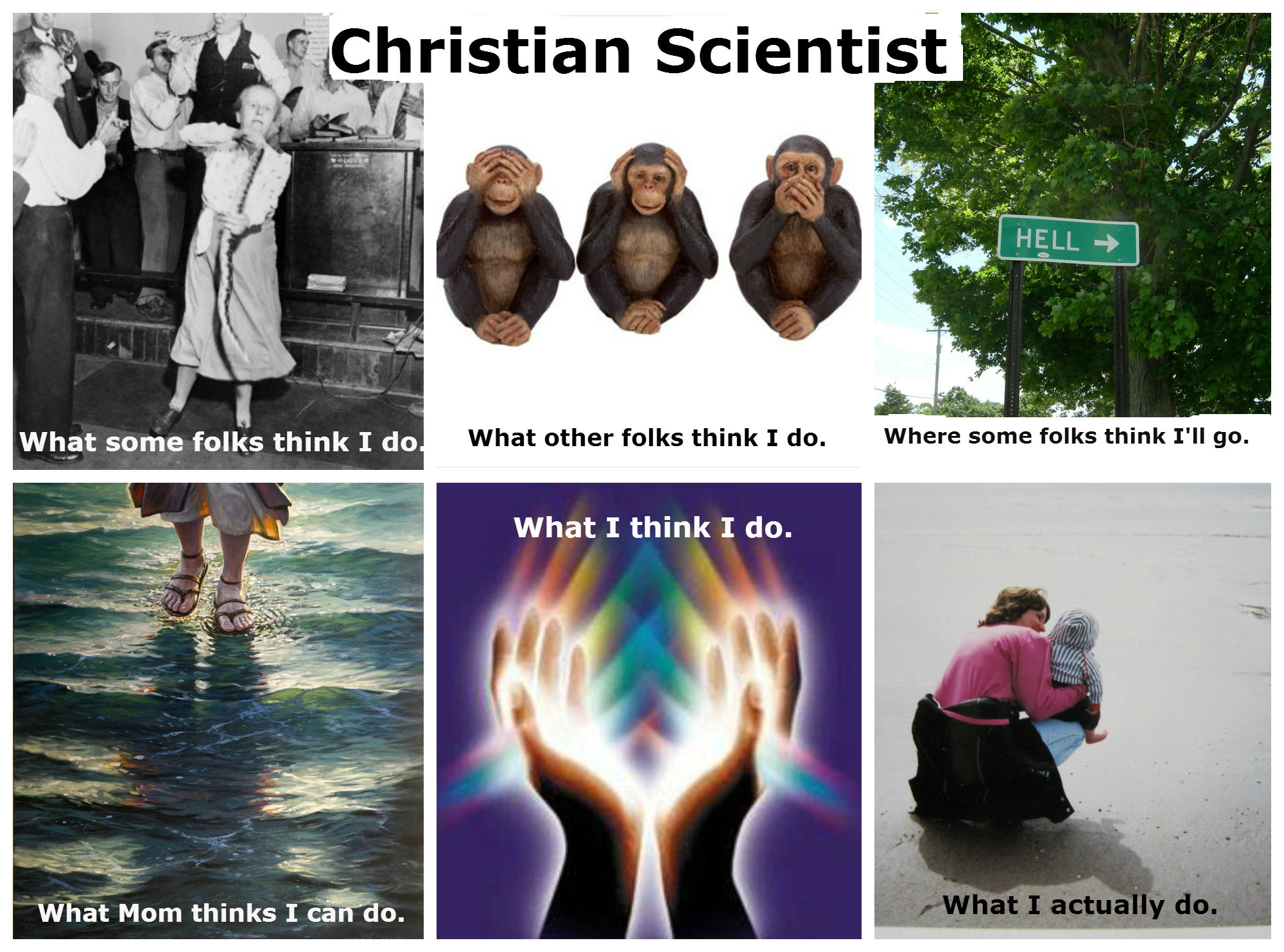
Thank you for asking this question. Christian Scientists have been lumped in with “faith healers” a couple times on this thread. Faith healers would not appreciate this – I’m pretty sure they consider CS a cult and its members “un-Christian” – and CSists don’t consider themselves faith healers. You wouldn’t hear a CSist ever saying “It’s God’s will” that someone died, or “God wanted that child with Him in heaven.” CSists don’t do the talking in tongues thing, or the laying on of hands thing, or the handling serpents thing. CSists may be crazy, but they are a totally different kind of crazy. 🙂

Mary Baker Eddy’s written a whole chapter on “Prayer” in the CS textbook, Science and Health with Key to the ScripturesHere are some thoughts about prayer from that chapter: 

“God is not moved by the breath of praise to do more than He has already done, nor can the infinite do less than bestow all good, since He is unchanging wisdom and Love… Prayer cannot change the Science of being, but it tends to bring us into harmony with it… The mere habit of pleading with the divine Mind, as one pleads with a human being, perpetuates the belief in God as humanly circumscribed,- an error which impedes spiritual growth. 

“God is Love. Can we ask Him to be more? God is intelligence. Can we inform the infinite Mind of anything He does not already comprehend? Do we expect to change perfection? Shall we plead for more at the open fount, which is pouring forth more than we accept?… Are we really grateful for the good already received? …The habitual struggle to be always good is unceasing prayer… 

“‘God is Love.’ More than this we cannot ask, higher we cannot look, farther we cannot go… In divine Science, where prayers are mental, all may avail themselves of God as ‘a very present help in trouble.’ Love is impartial and universal in its adaptation and bestowals.”

What prayer feels like, for me, is… it’s like waking up to a beautiful sunrise in the morning or listening to an inspiring piece of music, or looking at the stars on a clear night – it’s a feeling of uplift – of thoughts soaring, of fear dissipating, of a consciousness full of joy and good will. Often times my prayers come with humor – laughing always seems to help get rid of fear for me – and for me, fear is always a part of whatever problem I’m facing. And Love is always a part of the healing. I’ve sometimes known I was healed before I saw the healing manifested humanly – I could feel the change in my thoughts. 

Art asks:
Personal question Karen: you don’t believe as your parents do but you still self-identify as a Christian Scientist?

Karen responds:
My dad is non-religious. My mom is… she is simply wonderful. My mom wasn’t raised in CS – she found Christian Science not long before she married my dad – she was attracted to this way of life because she liked the idea of a God who is Love – a Love that heals. She never had any kind of official position in the church or anything – like me, she is not really a very religious person. She is an independent thinker and a free spirit – not into group-think. 

I identify as a Christian Scientist because I really like the ideas and thoughts found in the CS textbook – I believe in God as Love, and I’ve experienced healing through my understanding of Love.

Art responds:
“I identify as a Christian Scientist because I really like the ideas and thoughts found in the CS textbook – I believe in God as Love, and I’ve experienced healing through my understanding of Love.”
 Thanks for the insight Karen. Anyways, like many here I’ve always had a negative opinion of Christian Scientists so I appreciate an intelligent perspective from somebody like yourself.

Karen replies:
Art,
 You write: “Anyways, like many here I’ve always had a negative opinion of Christian Scientists so I appreciate an intelligent perspective from somebody like yourself.” Thank you.

And thank you for asking questions with a genuine interest in learning what I had to say. That felt really good. 🙂

Buck “Buck” Buckaw says:
Michael Nesmith is a devout CS (as I’ve mentioned to you on a previous occasion) but you wouldn’t know it by listening to his music. It didn’t come to my notice until I read a biography about him.

Karen responds:
Buck “Buck” Buckaw – 
 I do remember our talking about Michael Nesmith – and I remember enjoying that conversation very much. 🙂

Another one of my favorite people – an atheist, not a Christian Scientist – had this to say about Michael Nesmith: “So then, a few years ago, I was introduced to someone who became a great friend of mine, Michael Nesmith, who has done a number of different things in his career: In addition to being a film producer, he was originally one of the Monkees. Which is kind of odd when you get to know him, because he’s such a serious, thoughtful, quiet chap, but with quiet reserves of impish glee… I just hope that there will be other projects in the future that he and I will work on together, because I like him enormously and we got on very well together.” – Douglas Adams (Adams died not long after that and I don’t think he was able to work with Nesmith again – but it really meant something to me that Adams saw those qualities in Nesmith, a CSist.)

And no, you will not hear a CSist knocking at your door. 🙂 Frankly, it took me a long time before I felt comfortable “admitting” I was a CSist or talking about my way of life in an open and honest way. I know there is a lot of… not sure what the word is… misinformation? bias? prejudice?… about CS, and I’m not always eager to enter discussions about CS… sometimes – if I sense that nobody is really interested in having their minds relieved of their prejudices – I choose not to enter those discussions at all. But it felt to me like there were people on this thread who were genuine and sincere in their questions about CS. It is good to hear your voice again, my friend.  Karen

Buck “Buck” Buckaw says:
Thank you so much for your kind words, I always enjoy our exchanges immensely and recall them with fondness.
 Regardless of what belief system you might adhere to, you are a shining light. Keep on shining brightly.

Karen says:
Oh, Buck “Buck” Buckaw – thank you. You don’t know what your kind words mean to me tonight. Thank you. I am so glad to know you are in the world.

Buck “Buck” Buckaw says:
OK, that’s enough of the mutual admiration society.
 We risk turning the whole thing into some sort of giant hug fest and that just won’t do, particularly for the more jaundiced participants of this thrill ride. Now, what were we talking about? Oh yeah…..Christian Scientists hey? What a kooky bunch.

Karen says:
I know, right? Tell me about it. 🙂

Dear Amazon Forum Friends,

Long long ago and in a land far far away I stumbled into a rabbit hole full of delightful misfits and smartasses, wise folk and wits, and wacky and wonderful hooligans. My life would never be the same.

It was the summer of 2007. I was checking out my book on Amazon and saw that there were discussion forums listed at the bottom of the page. I clicked on one of the links and found a land full of rousing and intriguing conversations about Big Ideas – it was just like being back in university again. We talked about God and Nogod and The Bible and world leaders and policies and policy-makers and writers and books. As we bounced ideas off each other – shared and listened, debated and learned from each other – and laughed! – we built bonds of friendship and kinship that have lasted to this day.

As time goes on, I’ve come to realize just how valuable and important that time in the Amazon forums was for me. I learned so much from my Amazon friends!

A good chunk of my Facebook friends are friends from the Amazon forums. And a lot of them have become friends to my other friends, too! And I’ve become friends to THEIR friends and family. The ripples keep extending.

In the last few years we’ve begun to lose some of our Amazon classmates. Randy Kercher died unexpectedly in 2017. Dean Wrzeszcz died of COVID-19 in April. I feel like I’ve lost family.

And I guess Randy’s death and Dean’s death have given me a sense of urgency about letting my Amazon friends know how important they are to me. How much I love them. How grateful I am to have met them. We shared a unique and wonderful time together. My theistic heart believes we were meant to meet there and meant to be friends. Look at all we’ve come through together in the last 13 years! I’ve felt your support through the challenging times. I’ve been so grateful for your humor on those days when I really needed a good laugh. I’ve been so grateful for your wisdom on those days when I needed a new perspective. I can’t imagine my life now without you in it.

Thank you, dear friends.

(Through the years I’ve actually been able to meet some of my Amazon friends in the person: Kathi and Jamie in Nova Scotia; Marissa in Minnesota; Becky in Virginia; David in Michigan; and Allen, and Heather and her family, Craig and his wife, and Marissa and her husband, David and his family, and Sandy and her husband, have all taken the time to meet up with me in western Washington State. What a joy!)

Suggestions for talking with…

I wonder if I might make a few suggestions for conversing with others about religion on a discussion board? I have had some experience with this, and I’d like to share some of what I’ve observed and learned.

The most important thing to know, I think, is that if you ever encounter me on a discussion forum I am always, always right. And if you disagree with me about this you are wrong.

Once we have established that basic and most fundamental of all facts, we can move on to other stuff:

Might I suggest that we never, ever, ever presume to know what other people think, feel, and believe just because they identify themselves as atheist, theist, Christian, Muslim, Jew, Buddhist, pagan, Christian Scientist, or as a member of any other ideology.
Generalizations, stereotypes, and lumping whole groups of people together as one “type” are not helpful when trying to understand someone else’s perspective.
Don’t tell other people what they think. Let them tell you.
Although pomposity cracks me up, not everyone shares the same reaction as me to puffed-up know-it-allness. Humility is a beautiful thing. Let’s be willing to laugh at our own nonsense before we laugh at someone else’s.
Remember that we’re all human – we all have our own flaws and foibles – none of us is perfect here. Might I suggest that we correct our own flaws before we start trying to correct someone else’s?
Give each other grace.
Listen.
More specifically…

Karen Molenaar Terrell's avatarAdventures of the Madcap Christian Scientist

We should remember that the world is wide; that there are a thousand million different human wills, opinions, ambitions, tastes, and loves; that each person has a different history, constitution, culture, character, from all the rest; that human life is the work, the play, the ceaseless action and reaction upon each other of these different atoms. Then, we should go forth into life with the smallest expectations, but with the largest patience; with a keen relish for and appreciation of everything beautiful, great, and good, but with a temper so genial that the friction of the world shall not wear upon our sensibilities…
– Mary Baker Eddy (Miscellaneous Writings)

I wonder if I might make a few suggestions for conversing with others about religion on a discussion board?   I have had some experience with this, and I’d like to share some of what I’ve observed and learned.

The…

View original post 1,515 more words

An Incident in a Discussion Forum (okay, this is me being cranky)

Asking people about their opinions is a very good way of making friends. Telling them about your own opinions can also work, but not always quite as well. – Douglas Adams

 She arrived in the middle of a discussion upon international politics. “Look at India,” one of the ladies was saying. “Yes, but look at Japan,” urged the other with intense vehemence. Barbara was introduced to the ladies, of course, but she never heard their names. They were already labeled, much more legibly in her retentive memory, as Mrs. Japan and Mrs. India. She was rather crushed at the farsightedness of the two ladies— what did they see when they looked at Japan and India like that? Did their bird’s-eye view take in the whole of these Asiatic countries at a glance? Were India and Japan open before their eyes like a child’s picture book? – D.E. Stevenson

The following was originally a chapter in The Madcap Christian Scientist: All Things New, but I took it out because the voice in this chapter doesn’t fit in with the rest of the book. In this chapter you see me being cranky and a little ticked off. It ain’t pretty…

Have you ever looked back on a period in your life and smiled with amusement and a certain amount of affection for the person you were? That’s how I feel when I look back on the person I was five years ago – during the period when I was spending a lot of my free time on a religion discussion board. I was cute, wasn’t I? – idealistic, naïve, really believing that everyone was on the discussion board for the same reason I was – to learn about other people’s beliefs, share their own, and exchange ideas and thoughts about religion, science, metaphysics, philosophy, literature, music, art.

I learned an awful lot from that discussion board – some of it was awesome, and some of it not so much. I learned there were a lot of people in the world with kind hearts and open minds and good humor. I also learned that there are an awful lot of people who want everyone else to think and believe exactly what they think and believe – and I learned that I wasn’t one of them.

I saw bigotry.

If there’s one thing that toasts my cookies it is bigotry.

At first I found myself mostly coming to the defense of the atheists on the discussion board, who, initially, seemed to be the major target of bigotry. They were told they were going to hell. They were told they were all lacking any kind of moral compass. They were compared to Pol Pot and Stalin. It was all ridiculous and hateful, and I could not let the bigotry slide by without responding to it.

Then for a time the bigotry seemed to be mostly directed towards the “believers”. Those who believe in God were called ignorant, uneducated, unintelligent, superstitious scaredy cats, and blamed for the murders committed during The Crusades, the Spanish Inquisition, and the Salem witch trials. Which… yeah… I’m sitting here now, just shaking my head, as I remember the nonsense.

There were a lot of generalizations made – every atheist was lumped together into one group – as if they all believed, felt, and thought the same about everything; and every Christian was lumped together into another monolithic group. Finger-pointing and blame-laying was rampant. As a Christian Scientist, I was told by many of the Christians that I was going to hell because I didn’t believe in hell, or in a devil, or that Jesus was God. And as someone who identified as a Christian, a number of atheists seemed inclined to assume I held the same beliefs about God that they had learned when they were youngsters attending Christian Sunday Schools – and then judged me for the beliefs that they wrongly attributed to me.

It could all be a little exasperating.

For the first few years the humor, friendship, and intellectual stimulation I got from the discussion forum outweighed the exasperation. I met some really good friends there – people I still continue to call my friends – people who became familiar with my spiritual perspective about life in a way that many of my offline friends never did.

But after several years my interest in the discussion board began to wane. More and more I found myself in these weird dialogues with people who presumed to know what was in my head and heart without giving me the opportunity to tell them myself. More and more I found myself in the unsatisfying position of being treated like a student whose job it was to quietly sit and listen while others threw their great wisdom and knowledge at me. I found myself getting lectured to and preached at a lot, and I do not particularly enjoy being the target of lectures and preaching. Dialogues became one-sided monologues; the exchange of ideas turned into a one-way sermon – people telling me what I should believe, think, and feel, and then getting really agitated with me if I dared to question or voice a thought of my own.

The Grand Finale – the defining moment when I realized I no longer had any interest in serious participation on the discussion board – came for me on a thread titled “Repeal the child abuse for Christian Scientists in Washington State law”. For four pages (100 posts) I read comments, written by my friends (people whose atheism or Christianity I had defended time and again on the forum) about the lunatic Christian Scientists who are “neither Christian nor scientists” (pretty original, right?). For four pages I read comments from people attacking a “strawman” – indignantly pontificating on how wrong it is to legally allow Christian Scientists to abuse their children – when there never was a law or lobby that supported child abuse by Christian Scientists. And then I saw where one of my forum friends had written this: “I just took issue with the thought that the faith healers could be unaware that their ‘healings’ have zero positive effect… I think the fact that the alleged Christian Science lobby feels the need to protect themselves from prosecution tells me that they must know the reality of their faith… He seems to be saying that Christian Scientists aren’t True Christians. The Christian Science people seem to think they are Christians, based on my scanty reading of what they believe.”

SCANTY READING?!!! Oh, for Pete’s sake! I’d been sharing my experiences as a Christian Scientist on that forum for almost seven years – shared wonderful healings I’d had in Christian Science, shared my thoughts about “Christianity” – but my friend hadn’t, apparently, learned anything about my way of life or beliefs from what I’d written on there. It came to me, then, that the only reason some of these people had ever considered me their friend was because I had been a good audience – willing to listen to THEM – but that they hadn’t really been interested in anything I’d had to say.

I wrote a response:

Christian Scientist from Washington State here. I’m sure you are all completely right about me. I mean, you must be, right? I should be, like, locked-up for the good of society. Interned in a camp maybe. I should never have been allowed to marry – and certainly not to a nice, decent liberal man raised by his decent God-loving Methodist parents. I should never have been allowed to have children, and certainly never been allowed to raise them – it’s a miracle that they survived to adulthood and turned out to be such intelligent, healthy, whole, well-adjusted young men, considering their mom was a Christian Scientist. I should not be allowed to share in the rights of citizenship of this land – it’s far too good for the likes of me. I should certainly never have been allowed to vote – and never been allowed to participate in the democratic process. I should never have been allowed to be elected delegate to our state Democratic convention, and should never have been allowed to write letters and donate in support of environmental causes, the ACLU, gay rights, Habitat for Humanity, atheists, Amnesty International, and yes, universal health care (I don’t believe anyone should be denied the health care they feel they need just because they’re poor – health care should be considered a basic human right). I am, of course, just a cardboard cutout of a person – like every other Christian Scientist in the world.

As you know – seeing as how I’ve been on here for ALMOST SEVEN YEARS sharing my beliefs, thoughts, and feelings with you – I am a despicable, ignorant, uneducated, illiterate human being. I should probably be lined up with my fellow CSists against a wall and shot, as was once suggested on a local talk show.

Am I Christian? Nope, probably not (according to the current accepted definition of a “Christian”). Like my fellow CSists, I do not believe Jesus was god. Do not believe in a literal place of hell or heaven. Do not believe in Original Sin. Do not believe the story of Adam and Eve should be taken literally. Do not believe the world was, literally, created in seven days and seven nights. Do not believe in creationism. Do not believe dinosaurs and humans roamed the world at the same time. And, like those familiar with quantum physics, I DO believe matter is pretty much nothing . So shoot me.

My children , by the way, were vaccinated (edit: the topic of vaccinations is probably worth a whole ‘nother blog post), and were taken by me to doctors, when the need arose – which wasn’t often – they were mostly healthy. They also were raised by their parents – as I was raised by mine – to not be quick to make judgments on others, to try to approach the world without bigotry, and to question political and religious dogma, and those in authority (including the medical profession – you do all know that traditional medical practice is the third-leading cause of death in this country according to the JAMA, right? – it shouldn’t be surprising that thinking people might sometimes look for alternatives to it).

Okay. I’m pretty much done here. I’ve been yammering away on this forum for seven years. And apparently no one was listening.

Karen

Weirdly, I got nine out of ten “yes” votes for that post. 🙂 Most gratifying personally, though, was the response that came right after my post from my atheist friend, Conley. I think when I first came onto the forum Conley had had some pre-conceived notions about me as a Christian Scientist, but, like any true critical thinker, Conley had listened and observed and been willing to learn and shift his thinking. I liked and respected him. Following my post, Conley wrote: “Damned well said, Karen. And I was happy to note that you listed about half my favorite causes–which is what I’d have guessed of you. Best regards. -Conley”

I guess it’s because of people like Conley that I still sometimes pop in on the discussion forum. As for the “others” – the close-minded, arrogant, sermonizing, judgmental know-it-alls from the right and the left, the up and the down – both religious and non-religious –  who don’t really want to hear what other people have to say – I guess I just feel really bad for them. They are missing out, ain’t they?

what people think I do