Our How-We-Met Story

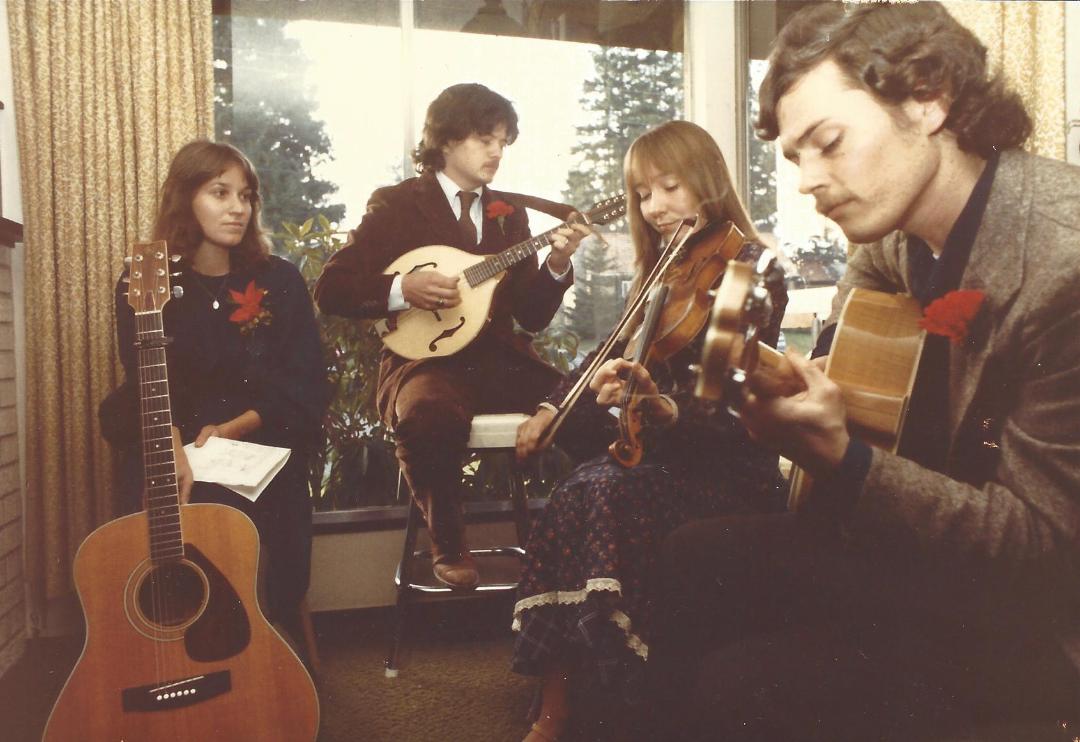
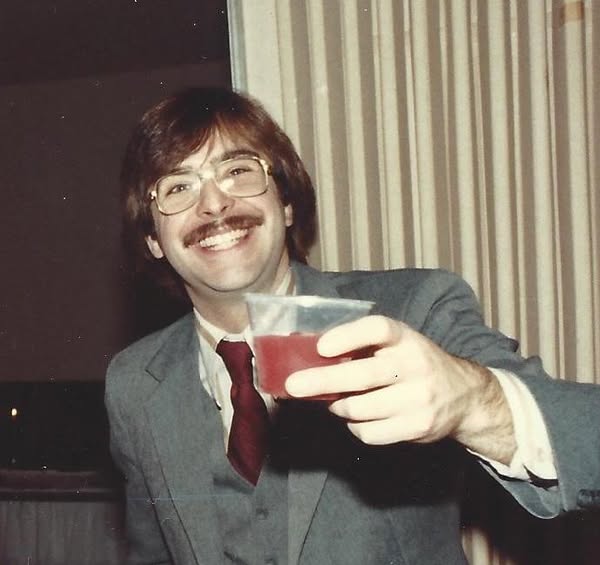
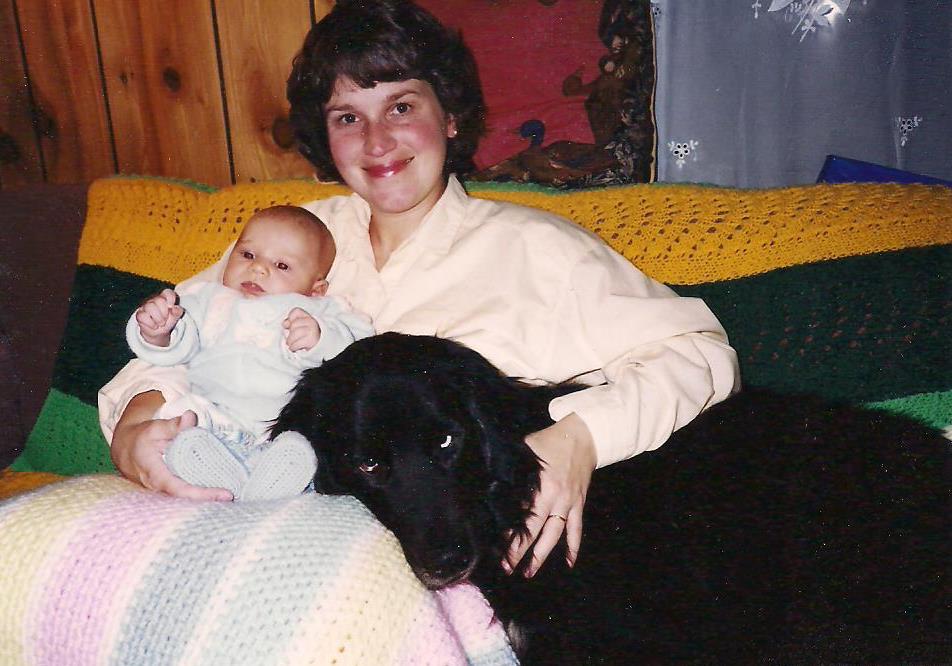
On December 11, 1982, I met Scotty for the first time. We were at a wedding – he was the photographer and I was the wedding singer. Here is our how-we-met story…

***

Okay, so there was this woman I knew. She was not a girly girl. She’d been raised with brothers, a mother who had no interest in accessories or luxury, and a mountain man for a father. Cosmetics and frou-frou clothes were not a part of her life as she grew up. Instead of a purse, she had her faithful hiking backpack. Instead of high heels, she had her tennis shoes and boots.

She was what you would call a late bloomer in the romance department. She was awkward around men and very self-conscious about any feminine wiles that might inadvertently peek out of her persona. Feminine wiles were not highly valued in her family and it was a little embarrassing to have any. There were young men who were attracted to her, but in her teens and early twenties she was mostly oblivious to their attraction or scared of it. There were young men to whom she was attracted, too, of course – but she mostly enjoyed fantasizing about them from afar, rather than having an actual relationship with any of them, and on those rare occasions when she took it in her head to try to flirt with one of them she had no idea how to go about it.

There came a day, though, when for the first time our heroine took interest in a male thigh. It was in the mountains of Colorado and the man who came with the thigh was young, confident, and easy to flirt with. Our heroine was twenty-two and for the first time realized that there might be more to find in the mountains than a good hike.

Not long after her epiphany about male thighs and other things male, a Dutch jazz musician entered her sphere. Now here was someone expert with the ways of romance. They spent almost a year together, culminating in a trip to The Netherlands to spend time with his family.

The Netherlands was the home of our heroine’s ancestors, and she felt a certain kinship with the people there. She loved the land – the tangy, saltwater smell of it, the wide open flatness and the canals, the black and white cows, the white lace curtains, the brick streets, the oldness and history. But, alas, there were no mountains to climb there. And, further alas, the Dutch jazz musician became someone she didn’t know when he stepped back onto his native soil.

In an autumnal Dutch wood on a sunny Dutch day, they both agreed that a certain kind of love and a certain kind of hate are very closely related and snipped the cords of their romance.

The relationship had to end. Our heroine knew that. But knowing it didn’t seem to make it any easier. It felt like someone she loved had died. She came home from Europe with her tail between her legs, dark circles under her eyes, and weighing about the same as Tinkerbell.

I think most people have experienced heartbreak at least once in their life. It’s a part of growing-up really. Makes us more empathetic to the pain of others, makes us more compassionate, and that’s a good thing – a blessing. And as Mary Baker Eddy writes in Science and Health with Key to the Scriptures, “Every trial of our faith in God makes us stronger.”

***

It took our heroine a few months to recover and then she earnestly entered what she has come to call her “dating phase.” She was meeting men everywhere – parking lots, the supermarket, the workplace, hiking, through friends. These men were talented, witty, and smart – a German physicist, a teacher-cum-comedy script writer, a sweetheart of a man who introduced her to cross-country skiing for the first time – and it was a heady thing for her to have them all show an interest in her.

At first the dating phase was great fun. Because her life wasn’t committed to one person she had the freedom to go and do what she wanted, meet and date all these interesting men, take road trips on impulse, head for the hills on a whim, with no one else’s schedule to have to negotiate.

But about the time she turned twenty-six something began to change in her thought. Singlehood began to lose its charm and these men she’d been meeting all started to seem the same to her. Dating became a little monotonous. She felt unsatisfied with the lack of direction in her life. She was beginning to feel it was time to get serious about this relationship thing and stop dinking around.

In a moment of self honesty, she admitted to herself she’d been going out with the wrong kind of men for what she now needed and wanted in her life. Mary Baker Eddy writes in the chapter entitled “Marriage” in Science and Health: “Kindred tastes, motives, and aspirations are necessary to the formation of a happy and permanent companionship.” And so our heroine made a list of qualities that she wanted to find in someone: She wanted to meet a man of compassion and integrity; If this man was going to be a part of her life he’d also need a sense of humor, believe me; And he’d have to love the mountains, of course; and she’d really like him to have some kind of a creative, stimulating occupation; And, as a last whimsical thing, she decided that he’d come from either California, Colorado, or Connecticut. She’d gone out with short men, tall men, blond, dark, wiry, and sturdy – and they’d all been attractive to her. But an image of The One came to mind: He’d be about six feet tall, lanky, have brown hair, and glasses.

***

In December of ‘82 a woman named Peggy, whom our heroine had met a couple of years before through the Dutch jazz musician, invited her to her wedding. To be honest, our heroine had no intention of going to this wedding, not wanting to mingle with all these people she’d met through the Dutchman. But on the eve of the wedding the woman who was scheduled to be the wedding singer got laryngitis and asked our heroine if she could take her place as the singer. She’d never sung at a wedding before, but asked herself, “How hard could it be?” and agreed to sing a song or two.

***

She spotted him as soon as she got there. The wedding was an informal affair held in a living room, and this man with a camera – the wedding photographer, she guessed – was weaving his way through the people who were seated and waiting for the wedding. Everywhere he stopped to chat, people would start chuckling. She surmised he must have a sense of humor. And he had a great smile – the full-faced, crinkly-eyed kind.

She found herself instantly attracted to him.

The wedding began, the ceremony proceeded, she sang her song (a little nervously), and kept her eyes on the man with the camera.

After the ceremony she, who had until now always been the pursued rather than the pursuer, walked up to him and introduced herself. He blinked behind his glasses, probably surprised at her directness, and grinned down at her. “Scott,” he said, shaking her hand.

At the reception, held in a local community hall, they talked and got to know each other better. She asked him if he liked the mountains. He said yes. She asked him if he’d ever climbed any. Yes, he said, Mt. Baker. She mentally put a check by the “loves mountains” on the list of qualities she was looking for in a man. Their conversation continued. She learned he was a newspaper photographer and checked off the requirement for “stimulating, creative job.” She saw how he opened the kitchen door to help an elderly woman with her hands full. “Compassionate” was checked off her list.

He asked her if he could fetch her something to drink. She told him she’d really just like some water. He nodded his head.

“Wadduh, it is,” he said.

“Wadduh?” she asked. “Are you from the east coast?”

“Connecticut,” he answered, grinning.

***

A year and a half later Scott got a call from Peggy. Our heroine answered the phone. She told Peggy that her husband wasn’t home right then, but could she take a message? When she heard the caller’s name she let her know her own. Peggy admitted she’d heard rumors that Scott and she had married. She was happy to have had a part in their meeting each other.

Scott and our heroine have been happily married for almost 42 years now.

And our heroine realizes that she wouldn’t have been blest with her love if she hadn’t first met the jazz musician. From cursing to blessing. It’s all connected.

– excerpt from Blessings: Adventures of a Madcap Christian Scientist

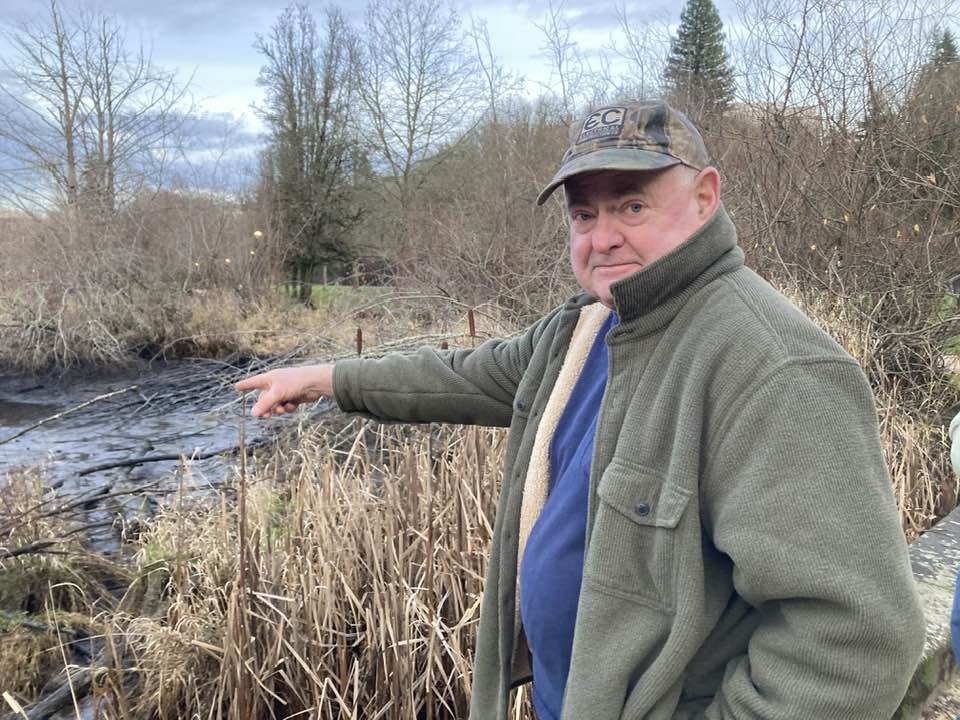
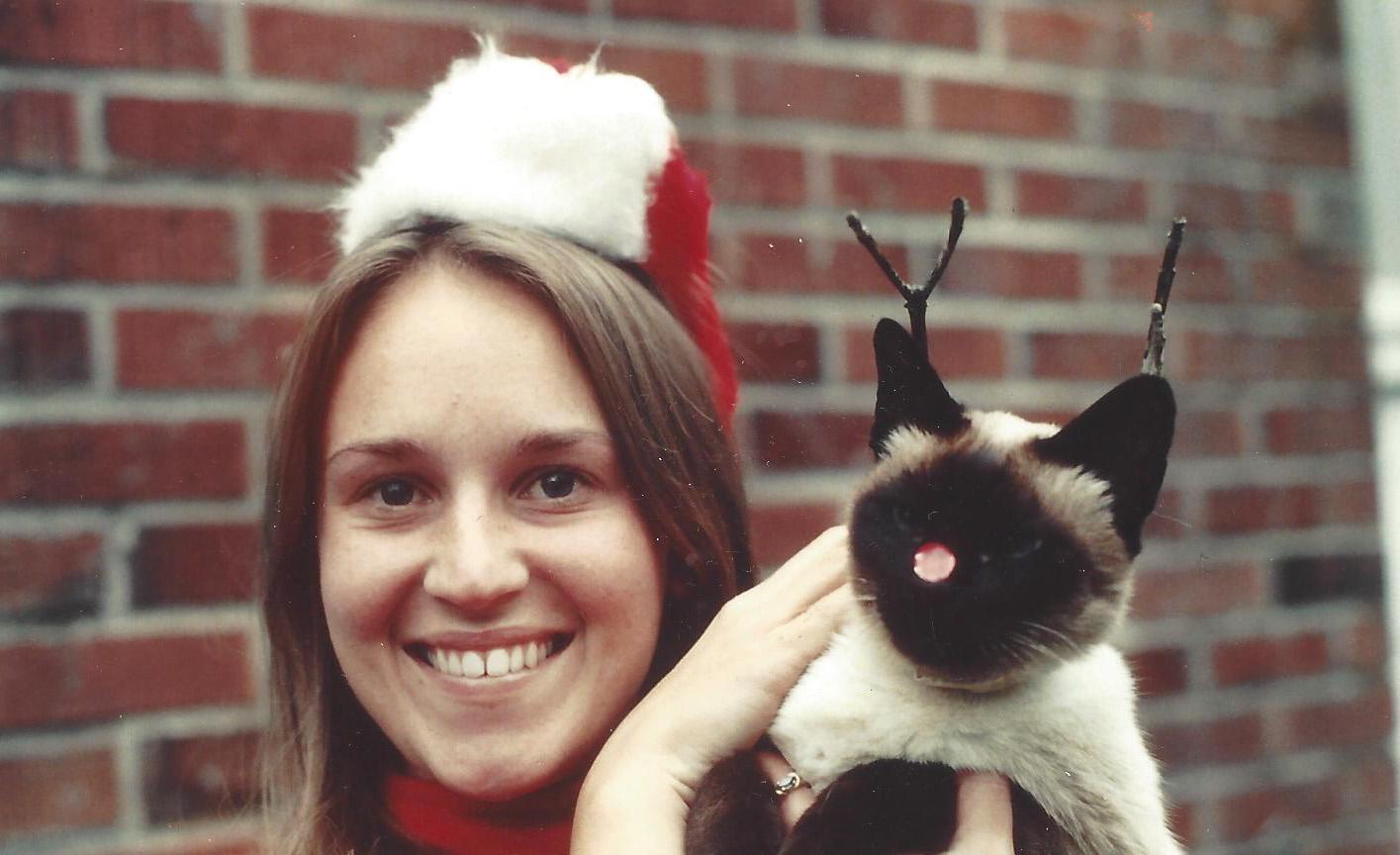
(Last year Peggy sent me pictures from that day! She sent me another one, too, of me with a Santa hat, probably taken around the same time.)
It Was Like She Was Right Here, Speaking to Me

Whoah.

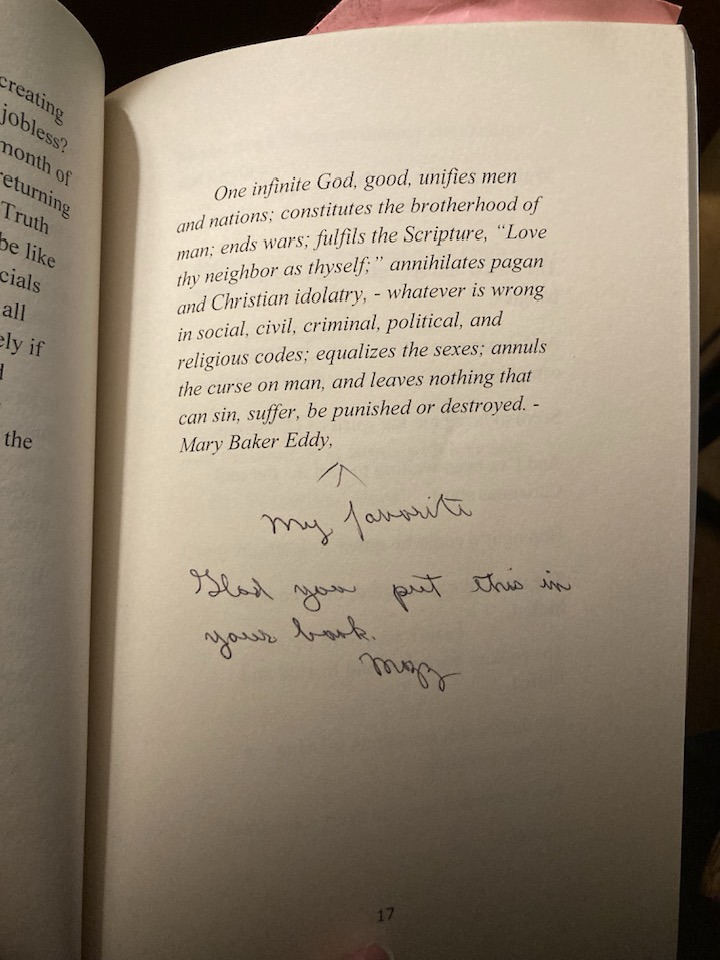
So I plucked up a copy of my Christmas book (literally called The Madcap Christian Scientists’s Christmas Book) sitting by my laptop so’s I could look for things to share. And the book flipped to this page and I realized this was the copy I’d given to Moz and Dad when I’d first published it – when they’d passed it had come back to me. And there was a note from Mom! It was like she was right here, speaking to me. I’d really been missing her lately, so to find this message from her felt cosmic to me. I don’t think I’d ever seen this note before – it was like finding a new treasure.

The Christmas Dog

Christmas Eve, 1988.  I was in a funk.  I couldn’t see that I was making much progress in my life.  My teaching career seemed to be frozen, and I was beginning to think my husband and I would never own our own home or have children. The world seemed a very bleak and unhappy place to me.  No matter how many batches of fudge I whipped up or how many times I heard Bing Crosby sing “White Christmas,” I couldn’t seem to find the Christmas spirit.

I was washing the breakfast dishes, thinking my unhappy thoughts, when I heard gunshots coming from the pasture behind our house.  I thought it was the neighbor boys shooting at the seagulls again and, all full of teacherly harrumph, decided to take it upon myself to go out and “have a word with them.”

But after I’d marched outside I realized that it wasn’t the neighbor boys at all.  John, the dairy farmer who lived on the adjoining property, was walking away with a rifle, and an animal (a calf, I thought) was struggling to get up in the field behind our house.  Every time it would push up on its legs it would immediately collapse back to the ground.

I wondered if maybe John had made a mistake and accidentally shot the animal, so I ran out to investigate and found that the animal was a dog.  It had foam and blood around its muzzle.  She was vulnerable and helpless – had just been shot, after all – but instead of lashing out at me or growling as I’d expect an injured animal to do, she was looking up at me with an expression of trust and seemed to be expecting me to take care of her.

“John!”  I yelled, running after the farmer.  He turned around, surprised to see me.  “John, what happened?” I asked, pointing back towards the dog.

A look of remorse came into his eyes.  “Oh, I’m sorry you saw that, Karen. The dog is a stray and it’s been chasing my cows.  I had to kill it.”

“But John, it’s not dead yet.”

John looked back at the dog and grimaced.  “Oh man,” he said.  “I’m really sorry. I’ll go finish the job.  Put it out of its misery.”

By this time another dog had joined the dog that had been shot.  It was running around its friend, barking encouragement, trying to get its buddy to rise up and escape.  The sight of the one dog trying to help his comrade broke my heart.  I made a quick decision. “Let me and my husband take care of it.”

“Are you sure?”

I nodded and he agreed to let me do what I could for the animal.

Unbeknownst to me, as soon as I ran out of the house my husband, knowing that something was wrong, had gotten out his binoculars and was watching my progress in the field.  He saw the look on my face as I ran back.  By the time I reached our house he was ready to do whatever he needed to do to help me.  I explained the situation to him, we put together a box full of towels, and he called the vet.

As we drove his truck around to where the dog lay in the field, I noticed that, while the dog’s canine companion had finally left the scene (never to be seen again), John had gone to the dog and was kneeling down next to her.  He was petting her, using soothing words to comfort her, and the dog was looking up at John with that look of trust she’d given me.  John helped my husband load her in the back of the truck and we began our drive to the vet’s.

I rode in the back of the truck with the dog as my husband drove, and sang hymns to her.  As I sang words from one of my favorite hymns from the Christian Science Hymnal– “Everlasting arms of Love are beneathe, around, above” – the dog leaned against my shoulder and looked up at me with an expression of pure love in her blue eyes.

Once we reached the animal clinic, the veterinarian came out to take a look at her.  After checking her over he told us that apparently a bullet had gone through her head, that he’d take care of her over the holiday weekend – keep her warm and hydrated – but that he wasn’t going to give her any medical treatment.  I got the distinct impression that he didn’t think the dog was going to make it.

My husband and I went to my parents’ home for the Christmas weekend, both of us praying that the dog would still be alive when we returned.  For me, praying for her really meant trying to see the dog as God sees her.  I tried to realize the wholeness and completeness of her as an expression of God, an idea of God.  I reasoned that all the dog could experience was the goodness of God – all she could feel is what Love feels, all she could know is what Truth knows, all she could be is the perfect reflection of God.  I tried to recognize the reality of these things for me, too, and for all of God’s creation.

She made it through the weekend, but when we went to pick her up the vet told us that she wasn’t “out of the woods, yet.”    He told us that if she couldn’t eat, drink, or walk on her own in the next few days, we’d need to bring her back and he’d need to put her to sleep.

We brought her home and put her in a big box in our living room, with a bowl of water and soft dog food by her side.  I continued to pray.  In the middle of the night I got up and went out to where she lay in her box.  Impulsively, I bent down and scooped some water from the dish into her mouth.  She swallowed it, and then leaned over and drank a little from the bowl.  I was elated!  Inspired by her reaction to the water, I bent over and grabbed a glob of dog food and threw a little onto her tongue.  She smacked her mouth together, swallowed the food, and leaned over to eat a bit more.  Now I was beyond elated!  She’d accomplished two of the three requirements the vet had made for her!

The next day I took her out for a walk.  She’d take a few steps and then lean against me.  Then she’d take a few more steps and lean.  But she was walking!  We would not be taking her back to the veterinarian.

In the next two weeks her progress was amazing.  By the end of that period she was not only walking, but running and jumping and chasing balls.  Her appetite was healthy.  She was having no problems drinking or eating.

But one of the most amazing parts of this whole Christmas blessing was the relationship that developed between this dog and the man who had shot her.  They became good friends.  The dog, in fact, became the neighborhood mascot.  (And she never again chased anyone’s cows.)

What the dog brought to me, who had, if you recall, been in a deep funk when she entered our lives, was a sense of the true spirit of Christmas – the Christly spirit of forgiveness, hope, faith, love.  She brought me the recognition that nothing, absolutely nothing, is impossible to God.

We named our new dog Christmas because that is what she brought us that year.

Within a few years all those things that I had wondered if I would ever have as part of my life came to me – a teaching job, children, and a home of our own.  It is my belief that our Christmas Dog prepared my heart to be ready for all of those things to enter my life.

(The story of our Christmas dog was first published in the Christian Science Sentinel [“Christmas Is Alive and Well“] in December 1999, and retold in Blessings: Adventures of a Madcap Christian Scientist in 2005. It was later included in The Madcap Christian Scientist’s Christmas Book in 2014. It was also included on the Christian Science Sentinel radio program in December 2000.)

A Friend Sent Me an Exchange We Shared Years Ago (and it made me teary)

Today a friend I met on the Amazon Discussion Forums years ago emailed me a copy of an exchange we’d had about Christian Science on the Religion Forum. What made this exchange so remarkable for me was that my friend – who went by the moniker “tokolosi” – wasn’t himself a Christian Scientist, but his questions were genuine and he actually listened to what I had to say. It meant a lot, to me, that he’d saved this exchange from long ago, and took the time to send it to me today. I hadn’t heard from my friend for maybe a year, so his email was unexpected. I needed hope for our world today, and “tokolosi” sent it to me.

(I love the summation our friend “Aardwizzz” gives to the whole exchange, too. It was fun to see his voice pop up there at the end.)

From an Amazon Religion Forum exchange:

Karen Wingoof (me) says:

There seems to be an assumption here that everyone who calls himself or herself a Christian is a creationist, in battle against logic, reason, education, and the science of evolution.

A few months ago—from sheer weariness at being constantly lumped in with the doings and beliefs of conservative Christians—and being expected to either defend them or change them—I decided I would no longer identify myself as a Christian, but as a “Karenian”—no longer responsible for anyone else’s foibles, flaws, beliefs, thoughts, and behaviors but my own. I’ve kind of enjoyed the freedom this has brought me. But, to be completely honest, although I’ve changed the label for myself, I still hold the same beliefs I held when I called myself a “Christian”—and I never held the belief that evolution and science were my enemies. In fact, most of my friends who still identify themselves as Christian believe in the workings of evolution—I can’t think of any friends who might believe humans and dinosaurs roamed the earth together like The Flintstones.

Regarding my thoughts on Christian Science: In my mind I’ve come to separate Christian Science into two separate parts—there’s CS the religion; and there’s CS as a way of perceiving the world and a way of living. The religion doesn’t really hold much interest for me these days. I’m just not a very religious person (Humoristianity excepted). I’m not into group-think, group-talk, or group-walk. I like having the freedom to follow my own path, and I will never be made to feel responsible for other people’s beliefs or actions—whether they call themselves Christian Scientists, Christians, theists, or Humoristians. I think any sane person recognizes that you’ll find crazies in pretty much every group—and I think any fair and just person would agree that whole groups of people shouldn’t be judged by the actions of the extremists within their membership.

CS as a way of life—as a way of perceiving life—has brought me a lot of good. The practice of CS has taught me how to bring my thoughts close to God—to Love and Truth—and how to experience healing by doing so. I’ve witnessed or experienced healings of (among other things) mastoiditis (the healing was instantaneous—one moment my little brother was screaming in pain, the next moment he was snoring and sleeping and completely healed), bronchitis; an inflamed hand (markers in a blood test indicated rheumatoid arthritis—but, after calling a CS practitioner for support the hand deflated within a couple days and I’ve never experienced a repeat of that condition in the three years since then); the natural delivery of my youngest son after I’d been wheeled down to the OR for a caesarean (one of the nurses was crying—she said she’d never been able to witness a natural delivery before and it was so beautiful); and what my eye doctor said was a melanoma on my eyelid. (I recently asked for a copy of my medical records from the family physician just to make sure I’d remembered all this stuff correctly and hadn’t inadvertently made any of it up—and the records substantiate my memory of events.) I’ve also experienced healings of clinical depression, and healings in relationships, supply, and employment. So. Yeah. I’ve been able to prove, for myself, the healing power found in Love and Truth.

Whew. That took some time and thought. How’d I do? 🙂

Shoot! My battery’s almost dead. I guess I better post this before my computer goes kapooey here.

tokolosi says:

Karen, I’m a bit confused. (OK, in addition to my normal state…) I don’t know much if anything about CS, but for instance, you said “after calling a CS practitioner for support” such and such occurred. What did calling this person accomplish (I mean besides the healing, or why did calling this person make it happen)? And, with the other miraculous healings, what was it that brought about the outcomes? I mean, did you or others “pray” or “lay on hands” or some such? Do you pray to “God” (or more specific, what you perceive is the Christian God)? No snark intended here. Genuinely curious. Thnx.

Karen Wingoof says:

No snark taken. 🙂

(Got my computer plugged-in now, so it should be good. I am starting to run out of energy, though, so… zzzzzzzzz)

For CSists prayer doesn’t mean pleading, cajoling, or begging some higher power to fix everything. What it really means—for me, anyway—is just filling my thoughts up with love, joy, forgiveness, hope, confidence, courage—and when I’m able to do this, I experience healing.

In the case of my puffed-up hand I’d gone to work and shown my hand to my colleagues who expressed a lot of concern for me and shared stories about allergic reactions and infections that had almost killed loved ones—they had me pretty scared—and so I went to the family physician to have it checked-out. He usually jokes around with me, but this time he did not joke. He said that it looked like I had either a serious infection or a serious reaction of some kind and wanted to take blood samples and put me on medications. I told him I didn’t want to take any drugs until I knew for sure what was going on, but I agreed to let them take blood samples. Then I went home and called a CS practitioner. What the practitioner did for me was—well, I remember just feeling this confidence coming from her. I remember laughing with her. The next morning my hand was even more puffed-up, but I wasn’t scared anymore. I knew I was healed even before my hand looked normal. And by the second morning after I’d called the practitioner it had deflated and I was fine.

I called the doctor’s office to get the results of the blood test, and the receptionist told me the blood test indicated markers for rheumatoid arthritis and they wanted me to get in touch with a rheumatoid specialist. I told her I was completely fine. She was shocked. She brought a nurse to the phone. I told the nurse I was fine, and she sort of paused—I could tell she was surprised—and told me that she guessed I didn’t have to do anything more right then, but to let them know if the condition returned—which it hasn’t.

When I was being wheeled to the OR for a C-section, I asked my mom to call a CS practitioner for support—my mom said the practitioner told her, with conviction, “God loves that baby!” The doctors hooked me up to a machine to monitor the baby. I could feel the love in the room—the love from the medical staff—and I had this sense that everything was moving in harmony with Love. Just before they were going to slice me open, the doctors got these surprised looks on their faces, and then they started yelling, “Push! Push!” And the baby was born naturally. Later, when I asked my midwife why I’d been able to have my son naturally, she said, “We don’t know.”

CSists don’t consider healings to be miracles, by the way. CSists see healings as natural and normal and to be expected—the natural outcome of a change of thought.

tokolosi says:

“CSists don’t consider healings to be miracles, by the way. CSists see healings as natural and normal and to be expected—the natural outcome of a change of thought.”

Excellent! (So is the rest.) Mirrors my own thoughts. (Though not associated with any formal/structured philosophy, i.e., “tokolosi 101.”)

Karen Wingoof says:

Ohmygosh, I’m so glad to hear that, tokolosi! I was really nervous about that post. To be honest, I was sorely tempted to just ignore your questions because I suspect that when I talk about this stuff I usually just end up looking like more of a nut than people already know I am. Thanks for asking, and thanks for being so gracious about the answer. 🙂

tokolosi says:

To me, the healings you describe are “miraculous” but not *miracles*. Way-cool s*** happens because we are human, and can happen for sometimes uncanny inexplicable reasons many times associated with focused intention. But nothing “supernatural” is necessary—it’s just part of the *Human* Experience. (Not-very-well articulated tokolosi 101.)

Aardwizzz says:

Well done, tokolosi, well done. Instead of trying to fit Karen’s experience into your worldview, you attempt to fit your experiences into her worldview. And she had done the same for you as she was relating her tale: telling it without expecting anyone to share the belief that goes behind it. I think that’s called “communication,” but I’m not sure, as I see so little of it these days.