Sharing a Child with the World…

 Sharing a child with the world is the absolute in love — he will be in contact with more love than he has ever had in his life. And will of course share it all with you. It’s time to sharpen your intuition and other heartfelt communications skills. If you stay in tune with him, you’ll see how easy it will be to have him experiencing the whole globe and still be connected to your heartstrings. Try to stop mourning something that you did not lose. This “graduation” into adulthood will pay back endless dividends to you and to him. So — I know that I am sounding like a big smartypants….but it is true, I AM a big smartypants! Congratulations on this essential step in parenting. Don’t worry, you have job security. Forever.                      – Linda Sola

***

My oldest son left home yesterday to return for his final year at the university. This time felt different, to me, than the three times he’s returned to school before. This time it felt so… well… final. At the end of this school year he graduates, launches off into his “own life”, and maybe returns to us once a year at Christmas.

As the son was getting himself packed up and ready to go, I was trying to figure out what I could give him to send him on his trip. If I had a daughter leaving to go back to university maybe I’d give her a card, or some little sentimental trinket, or flowers… but the son is a very male male… still… I had a sudden memory of the son at about the age of three, sweetly offering me a fistful of yellow dandelions… he’d always liked flowers when he was little.

Was it my turn to give him a flower? How would a manly man feel about his mother handing him a rose?

Oh bother. I still wasn’t sure how to proceed, but my rose bushes needed pruning, anyway, so I decided I might as well start clipping off some of the buds – and if, when the time came for the son to leave, it didn’t feel quite right to offer him roses, I’d just keep them and put them in a vase.

And then a cool thing happened: As I was bringing the rose buds inside, the son looked over and saw them. “Pretty flowers,” he observed.

And suddenly it was the most natural thing in the world to say,  “I’m going to give one to you to take on your trip,” He smiled and thanked me – kind and generous in the way of a man grown – accepting my little floral offering with the same look on his face that I’d probably had when he’d once offered me his little fistful of dandelions.

The husband and I smiled and waved as our son pulled out of the driveway and headed back to school. And then I made my way to the solace of my Secret Garden, and remembered…

Andrew and dandelion

Aspirin and the 91st Psalm and a Most Uncomfortable Read

We may or may not have an operation, we may or may not take a pill, we may or may not observe religious rituals, but whatever we do (or don’t do) does not affect us either for good or for ill. – from Christian Science Re-Explored by Margaret Laird

I asked a friend why she liked to repeat the Ninety-First Psalm when she was in trouble. She replied that it gave her comfort. She did not realize that the comfort it gave her was the same kind of comfort that an aspirin tablet gives. There is nothing wrong about this if transitory comfort is important to us, and there are times when it may be. But Enlightenment is the real Comfort that we feel in our belief of comfort. The comfort that comes from reading the Bible or from tranquilizers is an abstraction, or belief of comfort, which can easily turn into discomfort. The comfort we need when we are in trouble does not lie in words but in Science, the discernment of spiritual facts, since being is Spirit. Unfettered by nice-sounding, comforting words on which to lean, the Scientist moves to a new dimension of awareness, unfamiliar but exciting and self- fulfilling. – from Christian Science Re-Explored by Margaret Laird

***

I just finished reading Margaret Laird’s book, Christian Science Re-Explored, and found it wonderfully uncomfortable. I found myself questioning concepts I’d always just accepted as true. Margaret Laird’s book “stirred the waters” of my thought and helped me re-think my beliefs about Christian Science, and look at it in a new way. And that’s not a bad thing. I can’t say that I accept as “true” everything Laird writes – but I get the sense that Laird would have been really disappointed if I did. In fact, one of the big themes in her book was the idea that we should never just blindly accept what any “authority” tell us is the Truth – that individual freedom to explore new ideas, and question old and accepted ones, is something to be celebrated, not squelched. Laird writes: “…the man of imagination…does not regard another’s point of view as needing either rejection or acceptance. He recognizes that dissent is often more creative, more stimulating to original thinking, than consent. This does not mean dissent from the standpoint of right or wrong, but dissent from the standpoint of a view of Reality other than one’s own. Often a viewpoint that differs greatly from our own will do more to stoke the furnace of imagination than one with which we agree. The acceptance of another’s point of view as right, or the rejection of it as wrong, would interfere with our own individual creativity.”

I’m still processing the thoughts presented in Christian Science Re-Explored – the author’s thoughts regarding The Bible, organized and institutionalized religion, Ecclesiasticism, Christianity, and the “technique” of “affirmation and denial” were really interesting to me.

Laird believed that if Christian Scientists use Christian Science as just another health care system – a method for healing some ailment – it’s no  different than any other system for treating disease. She writes: “He who prays with a goal in mind is not being the prayer of understanding or unconditioned Love…” and “Christian Science is not a technique or an argument by which we try to remove that which is objectionable to become something man already is but sees as a goal… He who professes Science, ‘declares the Truth’ as if it were an intellectual tool, a means to an end, will find desires unfulfilled, hopes unrealized, goals unattained. If our goals are unattained, it is because goals are on our mind rather than Science or self-fulfillment.” Laird writes: “The Christian Scientist who is Science gives treatments entirely from the standpoint of no goal, no result, no consequence or effect.”

In Science and Health with Key to the Scriptures, the Christian Science textbook, Mary Baker Eddy assures us “Divine Love always has met and always will meet every human need.” In Christian Science Re-Explored, Margaret Laird refers to what she calls “compensations” as the forms, or mediums, that appear for meeting our human need: “Compensations on the human belief-level—food, air, exercise, sleep, and perhaps the ministrations of a physician— must be identified with and as Love. Their use must not be deplored or seen as obstacles in the path of demonstrating Health, Wealth, Happiness. The fact is that Love supplies the human need in the language of individual discernment. Compensations become obstacles only when the vision is too clouded to identify them with Love. The deplorable is never the use of the compensation, but the ignorance which would separate the compensatory image from Love. Love is the existence of everything contributive to well-being on the human belief-level.”

Laird asks, “Can you imagine Mind, Life, Principle, Truth needing to grow in grace or to sacrifice itself? Then why should man, whose existence is reflection, need to grow in grace or practice self- sacrifice?” I think she asks a really good question there. Starting from the standpoint of man and woman already perfect – reflections of Love, Mind, Life, Principle, Truth – how could we possibly improve or get better? In Science and Health, Mary Baker Eddy writes: “The great truth in the Science of being, that the real man was, is, and ever shall be perfect, is incontrovertible; for if man is the image, reflection, of God, he is neither inverted nor subverted, but upright and Godlike.” Eddy writes: “The Christlike understanding of scientific being and divine healing includes a perfect Principle and idea, – perfect God and perfect man, – as the basis of thought and demonstration.” Laird believed that to experience true healing one needed to start with the Absolute – perfect God and perfect man. She quoted her Christian Science teacher, Bicknell Young, as saying, “Let absolute Science be your one and only standpoint, for Christian Science is the only Science of Being and therefore the only standpoint from which to be. Give them (patients and seekers) the real, the absolute Science; then they will understand and not have to relearn—and not be confused. Explain from the standpoint of perfection; live from the standpoint of perfection . . . because ‘Perfection is gained only by perfection.’ Perfection is one and absolute. It is always its own protection, blessedness, bliss, and progressive unfoldment. . . .”

Well, dang. I already have 1154 words in this post – 1163 now – oops! 1166! It’s probably time to wrap this baby up: Margaret Laird’s book may or may not represent “Truth” – there were parts of it that were troublesome for me – but it was also wonderfully stimulating for me – got me thinking and questioning and looking at ideas anew. And I’m always glad for that opportunity.


***

Radical reliance on Truth has been interpreted inconsistently as the non-use of medicine. Scientific healing power has nothing to do with sickness but with ever- present self-fulfilling Health or Wholeness as one’s self. You may need a Christian Science treatment, a pill, a hospital or an institutional church for your personal identity. But, whatever the need, you have only to look out from your own Mind, God, to see that need supplied in discernible form. – from Christian Science Re-Explored by Margaret Laird

Christian Science is not practiced in words (incantations) or in deeds, but in understanding. – from Christian Science Re-Explored by Margaret Laird

Dry Bones or Lively Stones?

And when he was come nigh, even now at the descent of the mount of Olives, the whole multitude of the disciples began to rejoice and praise God with a loud voice for all the mighty works that they had seen; saying, Blessed be the King that cometh in the name of the Lord: peace in heaven, and glory in the highest.  And some of the Pharisees from among the multitude said unto him, Master, rebuke thy disciples.  And he answered and said unto them, I tell you that, if these should hold their peace, the stones would immediately cry out. – Luke 19

 Wherefore laying aside all malice, and all guile, and hypocrisies, and envies, and all evil speakings, as newborn babes, desire the sincere milk of the word, that ye may grow thereby:  if so be ye have tasted that the Lord is gracious.  To whom coming, as unto a living stone, disallowed indeed of men, but chosen of God, and precious,  ye also, as lively stones, are built up a spiritual house, an holy priesthood, to offer up spiritual sacrifices, acceptable to God by Jesus Christ. – I Peter 2

I just finished reading Stephen Gottschalk’s Rolling Away the Stone, which focuses on the last 20 years of Mary Baker Eddy’s life. It was not an easy read for me – it took several weeks to work my way through it – but I found it really thought-provoking. One of the themes that seemed to keep re-appearing was the idea of a “revival” – the idea of stirring up “the dry bones” and bringing new life to our Christian Science experience. Gottschalk quotes Mary Baker Eddy as instructing her student, Albert Farlow to, “…stir the dry bones all over the field, to more words, actions and demonstrations in Christian Science.”

Later Gottschalk writes: “As with other movements after the death of their founder, Christian Science became to a significant degree routinized, in the process losing much of the spiritual animus that accounted for its early growth. The pattern is observable, whether we are speaking of the early Christian church after Jesus, the Islamic movement in the decades after the death of Mohammad, or the Franciscan order after the death of St. Francis. Eddy appears to have anticipated with great apprehension that the Christian Science church, too, would settle down into a kind of bland predictability, when she was no longer on the scene. To her, being a Christian Scientist in any meaningful sense involved not only a strong commitment, but, in a sense, a spirit of adventure.”

Gottschalk writes: “What apparently concerned her the most was the prospect that the church would devolve into yet another ecclesiastic organization, ‘barren,’ to use her words in Science and Health, ‘of the vitality of spiritual power, by which material sense is made the servant of Science and religion becomes Christlike.’… This materialism could, she believed, take on ecclesiastical form. It did so when Christian Scientists, conditioned by their earlier adherence to orthodoxy, failed to break with outworn tradition, ritual, and other merely exterior forms of worship. ‘Long prayers, ecclesiasticism, and creeds,’ she stated, ‘have clipped the divine pinions of Love, and clad religion in human robes. They materialize worship, hinder the Spirit, and keep man from demonstrating his power over error.’”

Whoaaaah, right?

The Christ, Truth, is living, lively, dynamic –  it didn’t die with Jesus. And the Christian Science movement was not meant to stop and flash freeze at the moment of Mary Baker Eddy’s passing, either. I’m sure Eddy would not have wanted this for her movement. “I find the general atmosphere of my church as cold and still as the marble floors,” she wrote, after an appearance at The Mother Church,  “… I did feel a coldness a lack of inspiration all through the dear hearts… it was a stillness a lack of spiritual energy and zeal that I felt.” And, In Science and Health with Key to the Scriptures, the textbook for Christian Science, Eddy writes: “The letter of Science plentifully reaches humanity to-day, but its spirit comes only in small degrees. The vital part,  the heart and soul of Christian Science, is Love. Without this, the letter is but the dead body of Science, –  pulseless, cold, inanimate.”

Life! Joy! Love! Aren’t these the way-marks of the living Christ – the Truth that heals?

***

Jesus was alone

when he rolled away that stone

Pushing back matter –

throwing away the tatters

And we have our job, too

to see what is real

to do what we must do

to rise up and heal

to laugh, dance, and sing

praises to our King

to stir those dry bones

and be joyful, lively stones.

***

(I’m sure Seuss would have done better

at writing this poetry-letter

But he is not here

and you’re stuck with me, I fear.)

There ain’t no midi-chlorians here.

Do you remember the first time you heard the term “The Force”? If you’re of my generation, it was probably in the late 1970’s – when the first of the Star Wars movies came to theaters. “May The Force be with you,” we heard the characters tell each other as they headed off into battles and adventures and saved-by-the-skin-of-their-teeth escapades. And we probably all thought that WE knew what the characters meant when they used those words – and were no doubt impressed by the characters’ highly-evolved sense of The Force, which, weirdly, coincided so well with our own perceptions and beliefs.

As I was thinking about George Lucas’s use of the term The Force this morning it occurred to me that using those two words was a stroke of sheer brilliance on his part. No matter what background and beliefs the members of his audience had, The Force was vague enough that we could all relate to it, and claim it for our own. For some audience members The Force probably represented nothing more than luck, and when the characters said “may The Force be with you” to each other, they were really saying, “Good luck!” For other audience members, The Force no doubt represented God – whatever they perceived God to be.

In the movies that first came out in the late 1970’s and the early 1980’s, The Force seemed to me to represent a power that was equally available to everyone. But in the Star Wars movies that came out in the late 1990’s and early otts,, The Force seemed to become less universal, and more selective. Now the characters talked about these microscopic life forms called midi-chlorians ( http://starwars.wikia.com/wiki/Midi-chlorian ) that connected humans to The Force – and we learned that there was a genetic or hereditary factor involved in the whole shebang – some people were born with more of these midi-chlorians than others, and had an easier time of tapping into The Force’s power.

And I found myself feeling really disappointed in the direction the movies had taken when it came to defining The Force for us.

“Heredity is not a law,” Mary Baker Eddy writes in the Christian Science textbook, Science and Health with Key to the Scriptures. “In divine Science, where prayers are mental, all may avail themselves of God as ‘a very present help in trouble.’ Love is impartial and universal in its adaptation and bestowals. It is the open fount which cries, ‘Ho, every one that thirsteth, come ye to the waters.'”

No individual, no family, no dynasty, no nation, and no religion owns the power of Love and Truth. Having the ability to heal – to use the power of Good, God –  is not something we inherit from our parents or grand-parents. The power found in the Science of the Christ, Truth, is not genetic – it’s not like the midi-chlorians that “run strong” in the family of Luke and Leia of the Star Wars movies. Christian Science is available equally to all of God’s children – no one has more access to the power of Love than anyone else, and no one has less.

There ain’t no midi-chlorians here.

Lesson from a Sunflower

Unobserved until today – never watered, never fed Miracle-Gro, never fussed over or tended – never nurtured by human hands at all – a sunflower has been growing under one of our cedar trees. How it got there I have no idea – probably sprouted up from a seed a bird dropped or something – but look how perfect it is! It just grew where it landed, and nothing could stop it from being what it was meant to be… 

There is a lesson there.


Our Memory

If delusion says, “I have lost my memory,” contradict it. No faculty of Mind is lost. – Mary Baker Eddy

Bless the Lord, O my soul, and forget not all his benefits… Psalm 103: 2

He hath made his wonderful works to be remembered:
the Lord is gracious and full of compassion. – Psalms 111: 4

Get wisdom, get understanding: forget it not… Proverbs 4: 5

***

Through the years there’ve been several fictional films that have tackled the subject of false memory – The Manchurian Candidate, Total Recall, and The Bourne Ultimatum come to mind.  But this week I freaked out a little when a friend posted an article on Facebook that reported researchers had, in fact, discovered a way to implant false memories in mice: “Memory researchers from U.S. and Japan have, for the first time, implanted false memories into a lab animal… It’s already clear that people are able to form false memories. Think about that family tale about your getting sick at Disneyland—the one that’s been told so often, you’ve felt yourself ‘remember’ the event more and more over the years, even though you were way too young to truly recall it. Or, more seriously, think about how often eyewitness testimony fails, convicting people who are later exonerated through DNA testing… The team also performed further experiments that showed that the formation of true and false memories both set off a series of molecular changes in the brain that are very similar. So false memories may feel indistinguishable from real ones.” – http://www.popsci.com/science/article/2013-07/researchers-successfully-implant-mice-false-memories?src=SOC&dom=fb

The story gave a link to another story – this one titled Why Science Tells Us Not to Trust Eyewitness Accounts:”Many people believe that human memory works like a video recorder: the mind records events and then, on cue, plays back an exact replica of them. On the contrary, psychologists have found that memories are reconstructed rather than played back each time we recall them. The act of remembering, says eminent memory researcher and psychologist Elizabeth F. Loftus of the University of California, Irvine, is ‘more akin to putting puzzle pieces together than retrieving a video recording.” Even questioning by a lawyer can alter the witness’s testimony because fragments of the memory may unknowingly be combined with information provided by the questioner, leading to inaccurate recall.'”  http://www.scientificamerican.com/article.cfm?id=do-the-eyes-have-it

Yeah. Soooo….

How can we trust that what we think we remember actually happened? How can we protect ourselves from false memories? Contrariwise, how can we make our true memories – the memories that we cherish, or that have helped us learn important lessons – safe from tampering or disease? And how do we distinguish the false memories from the true ones?

Were you expecting answers here? 🙂

Nah. I’m just trying to figure it all out, too. But I guess I could share some thoughts I’ve had about it all…

As a history major, it’s always struck me as interesting how people can look at the exact same events and see them in such completely different ways. If you read a school textbook about American history written in, say, 1955, for instance, it seems to tell a completely different story than a textbook written about American history in 1985. And I find it interesting – and personally disturbing – that some events – The Holocaust, for example – are discounted, by some individuals, as never having happened at all. It seems important to me that we remember The Holocaust – the lessons learned from it, and the heroism of those who experienced it, and those who helped others survive it.

One of my favorite books is a book called The Giver, written by Lois Lowery. In the book one boy, Jonas, is chosen to hold the collective memories of his community so that the other members of his community don’t need to be burdened by them. This really stinks for Jonas, and for his community, too. To have shared memories – of both painful times and good times – is comforting, I think. It helps us know we’re not alone and isolated from one another, but connected in our common humanity.

We build our communities, and our own lives, on our memories – learning from our mistakes, remembering and celebrating all the good, keeping loved ones who’ve left us alive in our thoughts.

But what if a memory is holding us back – keeping us from loving, from forgiving, and from moving forward in our lives? That can’t be a good thing, right? Maybe there are times when forgetting is actually a part of the healing? Mary Baker Eddy, the discoverer of Christian Science, tells us several times in her writings to “forgive and forget”  and Paul writes in Philippians 3: “Brethren, I count not myself to have apprehended: but this one thing I do, forgetting those things which are behind, and reaching forth unto those things which are before, I press toward the mark for the prize of the high calling of God in Christ Jesus.” Paul’s words make sense to me. There have been times in my life when a painful experience was so completely healed in my thought it was as if it never happened, and I’ve so completely forgotten it that I was surprised, later, to be reminded of it. One example of this is when my mom called to tell me that the mother of a third grade classmate had called to apologize for blaming me for things I’d never done. She was weepy as she told Mom, “Karen never did anything wrong. She always treated my daughter with kindness. I’m sorry that I was so mean to her.” What this woman was referring to was something that had happened 30 years before! I had completely forgotten about it. I was glad to hear that she and her daughter were doing well. Whatever lessons they’d needed to learn from that experience, they apparently had learned. Now they could forget all about it, too, and move on.

But to get back to the article on mice at the top of the page: What if the painful memory we have is a false memory to begin with – a memory implanted by scientific researchers or a hypnotist or that we’ve unknowingly created ourselves –  how do we discern that it’s false and jettison it? Speaking from personal experience, I’ve sometimes only discovered I was carrying around a false memory after a professor’s given a test and I gave the wrong answer, or after others showed me evidence – notes, letters, videoclips – that proved to me my memories were wrong. It’s always kind of an interesting moment when I realize I was carrying around a false memory. “Whoah! Look at that! I had no idea!”  And it’s always a relief. I can correct my thought then and move on.

Maybe, in the end, the only memories that are important to us are the ones that lead us to self-correction and reformation – and the memories that bring us closer to Love.

God is the only Mind. Our Mind is God. And we’re never for a moment, separated from Mind. That’s kind of reassuring, isn’t it? I mean… we can’t lose our Mind because where would it go? Mind is everywhere, fills all space, and we dwell in the consciousness of Mind. All we can know is what God, Truth, knows. All we can feel is what God, Love, feels. All we can be is God’s expression, manifestation, and reflection. There’s no part of us that can hold false memories, for all we can know is the perfect truth of perfect Mind.

“…you consult your brain in order to remember what has hurt you, when your remedy lies in forgetting the whole thing; for matter has no sensation of its own, and the human mind is all that can produce pain. As a man thinketh, so is he. Mind is all that feels, acts, or impedes action.” – Mary Baker Eddy

“…you will discover the material origin, growth, maturity, and death of sinners, as the history of man, disappears, and the everlasting facts of being appear, wherein man is the reflection of immutable good.” – Mary Baker Eddy

“When we learn that error is not real, we shall be ready for progress, ‘forgetting those things which are behind.'” – Mary Baker Eddy

“Fear not; for thou shalt not be ashamed: neither be thou confounded; for thou shalt not be put to shame: for thou shalt forget the shame of thy youth, and shalt not remember the reproach of thy widowhood any more”. – Isaiah 54: 4
We Shall Overcome

The good you do today will be forgotten tomorrow. Do good anyway. –                                                                                        from the Paradoxical Commandments by Dr. Kent M. Keith http://www.paradoxicalcommandments.com/

Consciousness of right-doing brings its own reward; but not amid the smoke of battle is merit seen and appreciated by lookers-on… If your endeavors are beset by fearful odds, and you receive no present reward, go not back to error, nor become a sluggard in the race. When the smoke of battle clears away, you will discern the good you have done, and receive according to your deserving. – Mary Baker Eddy

***

It sure appears sometimes that injustice, bigotry, hatred, and inequality are winning the battle, doesn’t it? We crave justice. We yearn for equity and fair play. But we don’t always seem to find those things in the here and now. We might be tempted to feel discouraged and frustrated about the state of our world. We might be tempted to lose hope. We might even be tempted to just give up. But… well, if we just give up – what’s the alternative? To STOP trying to do good? To choose to be  unkind? To choose to be dishonest? To deliberately and consciously choose to feel no joy? Those do not feel like healthy options to me.

The other day I decided to conduct a little experiment: I decided to make a bad day for myself.  I had no idea how to go about this, really. I figured that making a bad day for myself would probably start with a bad attitude, though, right? About half an hour into my experiment I made the mistake of calling my mom. Within a minute she had me cracking up.  So. Yeah.  So much for my little experiment.  After my inauspicious beginning, it didn’t get much worse, either. My experiment was a spectacular failure. I learned something from it, though. I learned that I’d have to work really hard to make a bad day for myself.  And I faced the fact that I’m simply too lazy to have much success with that kind of thing.

Call me a naïve idealist, but I believe that good overcomes evil. I believe Love overcomes hate. I believe that wisdom overcomes ignorance. I believe Truth overcomes dishonesty. Always.  I believe what Mary Baker Eddy writes in Science and Health with Key to the Scriptures: “Though error hides behind a lie and excuses guilt, error cannot forever be concealed. Truth, through her eternal laws, unveils error.”

I believe that we SHALL overcome someday.

We shall overcome,

 We shall overcome,

We shall overcome, someday.

 Oh, deep in my heart,

 I do believe.

 we shall overcome,  someday.

We’ll walk hand in hand,

We’ll walk hand in hand,

We’ll walk hand-in-hand, someday. – Zilphia Hart, Frank Hamilton, Guy Carawan, and Pete Seeger

http://www.youtube.com/watch?v=yId_ABmtw-w

We won’t forget Trayvon. He is important to us – the verdict this week doesn’t change the truth of  that. God bless his family.

  … Want of uniform justice is a crying evil caused by the selfishness and inhumanity of man. Our forefathers exercised their faith in the direction taught by the Apostle James, when he said: “Pure religion and undefiled before God and the Father, is this, To visit the fatherless and widows in their affliction, and to keep himself unspotted  from the world.”The wicked man is not the ruler of his upright neighbor. Let it be understood that success in error is defeat in Truth… – Mary Baker Eddy

Humoristianity

In the summer of 2007, as a response to what I saw as an over-abundance of people who took themselves WAAAY too seriously,  I started a new “religion” on a discussion board about religion…

* I’ve decided to create a new religion. People belonging to this religion will call themselves “Humoristians.” Here are the 5 tenets: 
1) You must be able to laugh at yourself. 
2) You must be able to recognize how ludicrous your beliefs might appear to others. 
3) You must want nothing but good for everyone, everywhere in the universe. 
4) You must have a natural aversion to meetings, committees, and scheduled events (as we will be having none of those). 
5) You must enjoy the humor of Jon Stewart, Steven Colbert, Tom Lehrer, and Jerry Seinfeld (if you’re a Jerry Lewis kind of guy, you might want to think about starting your own religion – although we wish you nothing but good).

The “one true fallacious faith” (as our “Grand Inquisitor”  the Right Ribald Reverend JL soon dubbed it) immediately took off and had an almost instant following.  Our ragtag little congregation of hooligans covered the globe – including people as far away as Australia and Europe and an army base in Afghanistan – and was comprised of atheists, a couple Mormons, an hilarious evangelical preacher’s wife, a Methodist , a Buddhist, a Catholic-Methodist-Celtic language aficionado, a nuclear physicist Trinitarian, a couple of agnostics, a pagan, an atheist Jew, and at least one Christian Scientist (moi).  We seemed a kind of unlikely little fellowship, I guess.  But we all had one really important thing in common – we  knew how to laugh at ourselves.

And soon we came to identify our church’s purpose on the discussion board: We made it our mission to battle busybody bullying bigotry wherever we found it, to bring laughter to those athirst in a dry desert of stodginess and pomposity,  and to transform the humoristically-challenged with our good-natured joie de vivre.

It was fun. 🙂

I made some wonderful new friends on that discussion thread – people who entered my life at a time when I was dealing with some major challenges and changes in my life,  and showed genuine care and friendship towards me.   We talked about stuff with each other that you don’t usually talk about in off-line life – shared our beliefs about God, Nogod, heaven, hell, nature, dogma, karma, the after life, politics – stuff you don’t often talk about even with your closest friends – and, in some ways, came to know each other better than friends and family who had been in our lives for decades.  Maybe BECAUSE we were all new to each other – we actually saw each other, and listened to each other, and didn’t take each other for granted. We didn’t assume we knew what our fellow Humoristians thought, felt, and believed, or who they were. There’s a line in Waitress that sort of sums up what I was feeling about my new friends: “I was addicted to saying things and having them matter to someone.”

On the discussion board where we established our Humoristian temple, when a discussion thread reaches 10,000 posts it’s “locked” and no more posts can be added to it. Knowing this, we only posted on our thread sporadically – it held a lot of special memories for all of us and we wanted to stretch it out for as long as we could.  But last week we finally reached our 10,000th post and closed and locked the doors of the temple. On the one hand I felt a kind of relief, I guess – that thread had been going along  for six years, and I knew it was time to graduate now – but there was a kind of sadness about it, too – it marked the end of a really happy era for me.

The good news, though, is that my Humoristian friends are STILL my friends.  I’ve actually been able to meet, in the person, several of these hooligans in recent years.  My husband and sons traveled with me to Nova Scotia to meet  the Humoristian  “Grand Inquisitor” JL and his lovely wife, Kathi (who has become one of my bestest friends ever) back in 2009;  Sandy and her husband, Danny, from New York, met up with me at Seattle’s Pike Place Market in 2011; David”Runny Babbit”  and his wife, Sue, and their two daughters, traveling from their home in Michigan, spent a couple days with our family hiking and laughing, and listening to David play the Native American flute he’d made for me out of sassafras wood from his home state; and just this week Heather “DS Wallingsford” brought her lovely South Carolinian accent and met me for lunch in Olympia.  The really amazing and wonderful thing about meeting all these people is that there was no awkwardness. At all! It was like meeting up with old, dear friends. Hugs. Laughter. Conversation that just seemed to pick up where we’d left off on the Humoristian discussion thread. It was all kind of surreal. And very cool.

I do not know what I’d do without humor in my life. I do not know what I’d do if I was surrounded by people who couldn’t laugh at themselves.  I think I might go just a little insane.

I’m so grateful for my Humoristian friends, and I’m so grateful to God – the power of Love and Life – for never failing to bring me what I need to prosper and grow. “Divine Love always has met and always will meet every human need,” writes Mary Baker Eddy in Science and Health with Key to the Scriptures.  And, for me, that human need includes laughter.

*(the tenets for Humoristianity can be found in  http://www.amazon.com/Humoristian-Chronicles-James-Longmire/dp/1105093441/ref=sr_1_1?ie=UTF8&qid=1373805117&sr=8-1&keywords=humoristian+chronicles)


A Healthy Environment and a Most Hospitable Tree

Bless the Lord, O my soul. O Lord my God, thou art very great… He sendeth the springs into the valleys, which run among the hills. They give drink to every beast of the field: the wild asses quench their thirst. By them shall the fowls of the heaven have their habitation, which sing among the branches… He causeth the grass to grow for the cattle, and herb for the service of man: that he may bring forth food out of the earth…  The trees of the Lord are full of sap; the cedars of Lebanon, which he hath planted; Where the birds make their nests: as for the stork, the fir trees are her house. The high hills are a refuge for the wild goats; and the rocks for the conies…  O Lord, how manifold are thy works! in wisdom hast thou made them all: the earth is full of thy riches…. thou openest thine hand, they are filled with good…  Thou sendest forth thy spirit, they are created: and thou renewest the face of the earth. – Psalms 104

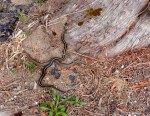
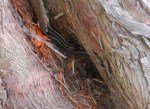
 Down the road about a quarter of a mile  there is rooted a most hospitable cedar tree.  A pair of garter snakes have made their home at its base, a happily buzzing community of busy honeybees have created a hive in its middle, and in a hole further up the tree’s trunk there is a bird’s nest.  The cedar tree has its own little ecosystem dwelling in it…

There are lessons to be learned from this tree. Note that it’s embracing the life living within it. The snakes, bees, and birds, and the tree are all living in harmony with one another. There’s no battle going on there – the bees aren’t taking up more space than they need for their hive, the snakes and bird aren’t fighting over trunk rights. There’s no evidence of greed here. Nothing trying to get more than its share of what it needs to survive.  It is A Peaceable Kingdom of a Tree.

And isn’t a peaceable kingdom what we want for our whole world? Don’t we want to see all of creation living in healthy harmony?

Our environment seems to be in real trouble right now. The Earth’s water, land, and air are polluted; our food has been genetically-altered from its natural state; we have rising seas and rising temperatures.  We appear to have gotten ourselves in a real mess.

How can we, as expressions of Life and Love, help heal our environment?

Working to help heal our environment has been an on-going demonstration for me. I’ve been involved in environmental causes since I was a youngster. I’ve written letters, signed petitions, marched with signs, boycotted corporations that seem to be working against a clean environment, written blog posts, taken photos, recycled, had No Car days, picked up trash, and tried to become conscious of the affect I have on the world around me.  These actions have all been the human footsteps I’ve felt led to take to help heal our environment.

But I’ve found the best place for me to START when I’m looking for healing is in my own thoughts – my internal environment.  As Jesus said  (Luke  17), “…the kingdom of God is within you.” I believe we carry around our own heaven, and our own hell in our thoughts. And to help heal myself and the world, I believe I need to be diligent about casting out the hell-thoughts of greed, selfishness, fear, ego, pride, cruelty, hopelessness, and guilt in my own consciousness – because those suckers are, for sure, not going to help me or anything around me.  And while I’m emptying my human consciousness of the hell-stuff, I’m filling my consciousness  with the heaven-thoughts of love, joy, kindness, generosity, hope, wisdom – these are the thoughts that bring me near to God, Love, and bring healing.

I’m not going to ignore the erroneous actions that come from greed and cruelty, or try to appease the greedy and corrupt in any way.  Mohatma Gandhi said, “A ‘No’ uttered from the deepest conviction is better than a ‘Yes’ merely uttered to please, or worse, to avoid trouble.” And  I refuse to let the greed and selfishness that seem to be in the world have any power over me – I’m not going to let someone else’s greed make me afraid, or take away my hope, or have any control over me whatsoever.  I’m not going to allow some corporation’s dishonest engineering or thoughtless polluting have any effect on my health or well-being. I refuse to let the corruption in politics stop me from doing my job of expressing God – of being kind, wise, and loving.  I refuse to be led astray from my job of working out my “own salvation.”

Are we without hope? Is it too late to heal our environment? Are we already experiencing “the end of the world”?

Nope. I believe that “nothing is impossible to God” – that it’s never too late for a victory over evil. Mary Baker Eddy writes: “Human hate has no legitimate mandate and no kingdom. Love is enthroned. That evil or matter has neither intelligence nor power, is the doctrine of absolute Christian Science, and this is the great truth which strips all disguise from error.”

I believe that as we transform and purify our thoughts – our outward environment will be transformed and purified, too.

And God said, Let the waters bring forth abundantly the moving creature that hath life, and fowl that may fly above the earth in the open firmament of heaven. And God created great whales, and every living creature that moveth, which the waters brought forth abundantly, after their kind, and every winged fowl after his kind: and God saw that it was good. And God blessed them, saying, Be fruitful, and multiply, and fill the waters in the seas, and let fowl multiply in the earth…And God said, Let the earth bring forth the living creature after his kind, cattle, and creeping thing, and beast of the earth after his kind: and it was so. And God made the beast of the earth after his kind, and cattle after their kind, and every thing that creepeth upon the earth after his kind: and God saw that it was good. – Genesis 1

Waiting for Approval


I’m on the patch right now. Where it releases small dosages of approval until I no longer need it, and then I’m gonna rip it off
. – Ellen DeGeneres

Study to shew thyself approved unto God, a workman that needeth not to be ashamed, rightly dividing the word of truth. – II Timothy 2: 15

In the textbook for Christian Science, Science and Health with Key to the Scriptures, Mary Baker Eddy points out that “Jesus’  system of healing received no aid nor approval from other sanitary or religious systems, from doctrines  of physics or of divinity…”  Did this lack of approval stop Jesus from fulfilling his mission, from healing, and accomplishing what he was sent here to accomplish? Did he wait around for permission to heal and do his life’s work? Nope.  He had the approval of God, Love, and that’s the only approval that concerned him.

Okay, listen, if you want to paint your neighbor’s house or rearrange his furniture or drive his car to work – it might be a good thing to wait for his approval before doing these things.  His house, furniture, and car do not belong to you, and it is not your business to take it upon yourself to paint, rearrange, or drive what doesn’t belong to you, without permission.

However, if you are waiting for someone else’s approval to be who YOU are and to live YOUR life – well, that’s just silly. We who live in the U.S. of A. live in a time of wonderful freedom and incredible invention, and it behooves us to take advantage of this. If you want to move or travel – you don’t need to wait for the government’s approval. Just do it. If you want to leave your job, or switch schools , or switch majors – that is your choice, not anyone else’s.  You need no one else’s approval to attend the church of your choice, or to choose not to attend a church at all.  If consenting adults of whatever gender, sexual orientation, race, or religion choose to build a life together – they don’t need anyone else’s permission or approval. And we live at a time when we no longer have to wait for someone else to decide if our writing is book-worthy or our voice is worth recording – the technology to put our words and voices out there is available to anyone with access to a computer – and no one else’s approval is necessary.

You need not wait for approval, my friend

You need not wait to practice zen

You need not wait to sing and soar

You need not wait –  not one second more!

You need no one’s permission to be who you are,

to express and reflect and travel far.

If you want to write and publish a book

or cook up the recipes of a cordon bleu cook

If you want to dance or hop or run

don’t wait for permission – just get ‘er done.

You don’t need permission to love one another –

to be a partner, or friend, or sister or brother.

No, you need no approval to your life live.

You were MADE to express your you-ness,

and your talents to give.

(All photos by Karen Molenaar Terrell.)