
Doodle by Karen Molenaar Terrell
Doodle by Karen Molenaar Terrell
Snippet of a dialogue from a discussion forum…
Robert says:
The requirements for an observation to be considered to be evidence are strict: the phenomenon must be repeatedly observable by anyone who is interested, and must be able to show, and actually show, that the thesis under discussion is true, if such is the case — AND must be able to show, and would actually show, that said thesis is false if such is the case. And this arises for good reason: it is extremely easy to fool oneself as to the nature and significance of a subjective phenomenon. Clearly, no subjective phenomena of any sort can qualify as evidence in a scientific sense.
None of this has anything whatever to do with anyone’s position on the rights of women and LGBT people — nor whether one is a theist, atheist, or whatever.
Karen writes:
Robert, you write: “None of this has anything whatever to do with anyone’s position on the rights of women and LGBT people — nor whether one is a theist, atheist, or whatever.”
Exactement!! Exactly! Which brings us back to my original question: Seeing as how my beliefs in God don’t cause me to do harm to others, why do you REALLY care about them? What impels you to want to refute them? Why does it matter to you what I believe? Why is it any of your business?
And if I were to tell you that my belief in God has made me a better person – has helped me become kinder, more compassionate, more tolerant – doesn’t that actually make my belief in God a positive thing? Something to be glad about?
I don’t think it’s our beliefs that are important. I think it’s what we do with them that matters. If your belief in Nogod has made you kinder, more compassionate, and more tolerant – then I celebrate your belief in Nogod with you.
Robert responds:
Good post. “…my beliefs in God don’t cause me to do harm to others…” Most of the time, they probably don’t. But if you ever do ANYTHING for religious reasons, there is a distinct possibility that there will be, somewhere, an adverse effect. But the more salient point is: do not these beliefs cause you to do harm to yourself? Do you spend time in a church, as opposed to doing something productive? Do you contribute time or money to religious things, instead of to things that actually improve peoples’ lives? Do you approve of what is demonstrably irrational thought?
“…my belief in God has made me a better person…” I would ask for your grounds for this. Such beliefs can impel people to do good things — or truly horrible things. And, since there does not (and, provably, cannot) exist any means for validating any such belief, whether you do well or ill in accordance with a religious belief is strictly a crapshoot. No doubt you temper your religion-impelled actions on the basis of your appraisal of their overall effect on the society in which you live, but not everybody does this. (Examples of such perfidy are rife in the news these days.)
“I think it’s what we do with them that matters.” Agreed. But the standards to be applied in determining this cannot be based solely on any religion.
Karen responds:
Robert, you ask: “…do not these beliefs cause you to do harm to yourself? Do you spend time in a church, as opposed to doing something productive? Do you contribute time or money to religious things, instead of to things that actually improve peoples’ lives? Do you approve of what is demonstrably irrational thought?”
I am a teacher in a non-profit alternative high school. Seventh-eighths of the population is composed of minority students. My students and their families are dealing with challenges that a lot of us can’t begin to imagine – and that I can’t really share here. I came to the alternative high school after a 20-year career in public education. I get paid peanuts, but I love my job and love working with these kids. I love helping them find academic success and helping them discover their gifts. There are days when I come home totally emotionally drained – not from my students, but from seeing the crap they have to deal with just to survive in our society. I feel useful there. I really like feeling useful. My work is not in any way connected with a religious institution.
I am involved in supporting political issues that matter to me – I served as a state delegate to the 2012 Democratic convention, and write letters to politicians and newspapers, and write posts on my blogs that take the time to address these issues. I have given money to the ACLU, Amnesty International, the Nature Conservancy, Sierra Club, Environmental Defense Fund, World Wildlife Fund, Habitat for Humanity, Humane Society, and Doctors Without Borders, among others. I have helped build a house for Habitat for Humanity.
I also like to keep moving – hiking, gardening – healthy activities that keep the blood pumping. And I’ve found it’s important to my well-being to set aside time for creative pursuits, too – I’m big into photography, singing, and writing.
I am not, actually, a very religious person. Not all theists are. There are periods in my life when I don’t attend church. And there are periods when I do. Right now I am the Reader at the mid-week testimony meetings, and my job is to pick the week’s topic, find readings on it, and conduct the service. I try to find readings that I think will be helpful and healing to the world. Last week’s readings were on “wrath/anger” and “love/forgiveness.” People seemed really grateful for the inspiration they felt from the readings, and I was glad I could provide that for them.
And now I give the question back to you: How do your beliefs in Nogod help mankind? How do they make the world a better place?
“We must think critically, and not just about the ideas of others. Be hard on your beliefs. Take them out on the verandah and beat them with a cricket bat… Be intellectually rigorous. Identify your biases, your prejudices, your privilege.” – Tim Minchin
I really like that quote. I especially like the thought that we need to start with our OWN biases when it comes to thinking critically. How much of your time do you spend on self-reflection? When was the last time you changed the way you thought about something? Or recognized a bias that wasn’t healthy for you to have?
How do we know when we need to change our beliefs about something? Well, for me it starts with looking at where my beliefs are taking me. If they’re leading me towards hate, fear, anger, bigotry, bullying, greed, and selfishness, then those beliefs have got to go. But if my beliefs are leading me towards love – guiding me to a place of courage and compassion, generosity and hope, joy and kindness and forgiveness and integrity – then those are the beliefs I’m going to nurture.
What about you? Where do your beliefs lead you?
Robert responds:
A most excellent post. It appears that you have your life well together — something that is rare in this day and age. I entirely approve of the Minchen quote. I am not young, and have spent much time and intellectual effort on identifying the source and nature of knowledge and what can be done with it.”it starts with looking at where my beliefs are taking me.” In other words, you are looking for evidence. Are your theses sound, or are they refuted by evidence of some sort? This is exactly what you should be doing — and are, with the notable exception of religious beliefs. You are doing appropriate things with respect to society, but your foundation is weak.”Where do your beliefs lead you?” Among other things, to participate in these forums. We have all seen the horrors that religious beliefs have brought to the world society; it is my purpose to show these to be the nonsense that they are. So, that instead of flying airplanes into tall buildings, we can indeed spend our efforts productively in things like teaching the next generation, discovering cures for loathsome diseases, and making it possible for people to live in comfort and peace.Carry on!
Seeker responds to Karen:
I read your post and then the reply from Robert, and I have to say that I don’t see your “foundation” as being weak. Even though I would probably side with Robert on the idea that there is no proof of God, I don’t see religious belief as automatically detrimental. In fact, in proper perspective and using definitions appropriately I have seen great value from those that profit by their faith. That said… it is sad that so many use religion to justify those reprehensible things you mention, “hate, fear, anger, bigotry, bullying, greed, and selfishness”, and do it in the name of religion. What is strange is that most of those failing in these areas ARE the religious. Very sad, and certainly detrimental to those that use faith as you apparently do.
I believe your last question, in context with your examples of guidance, is one that all people should be aware of. So I will ask it again…Where do your beliefs lead you?
Robert writes:
Re Karen T., above and elsewhere: You have well described your various activities, which I consider meritorious. Suppose, now, that you concluded that, since the existence of any god cannot be demonstrated by any means [1], you decide that it is pointless to believe in one. In what way (if at all), would your subsequent activities differ from what you are doing now?
1. Recall that this is provable.
Karen responds:
Thank you, Robert. You don’t know what a relief it is to learn that my life has met with your approval. 🙂
I guess I could lie and tell you that I no longer believe in God – and maybe win your complete approval of me and stuff… but… well, it wouldn’t be honest of me.
My belief in God is based on happenings I have witnessed or experienced first-hand – so, although these experiences are just nice anecdotes to people who didn’t live them or see them, to me they are more than that. For me, they are “proof.”
Remember that I don’t believe in an anthropomorphic god. I believe in a power and presence and Consciousness of Love and Truth. There’s nothing supernatural about this God.
Nando Perrado describes “God” this way (Miracle in the Andes: 72 Days on the Mountain and My Long Trek Home) and I have not found a better description for the God I believe in: “…I did not feel God as most people see Him. I did feel something larger than myself, something in the mountains and the glaciers and the glowing sky that, in rare moments, reassured me, and made me feel that the world was orderly and loving and good… It was simply a silence, a wholeness, an awe-inspiring simplicity. It seemed to reach me through my own feelings of love, and I have often thought that when we feel what we call love, we are really feeling our connection to this awesome presence.”
Seeker responds to Karen:
That’s nice, and I am awed by what can be experienced, too.
photo by Karen Molenaar Terrell
At this time ten years ago I was busy putting together my first book, Blessings: Adventures of a Madcap Christian Scientist. That little book has brought a whole lot of good into my life in the last decade. Because of Blessings I’ve been able to connect with new friends all over the world – with Chip and his partner, Eric, in Florida; with readers in a book club in Chicago; with members of the local Unitarian Universalist church; with Norman in Africa and Tui in Australia; and with a whole host of wonderful hooligans on an Amazon discussion forum. Blessings has led me into cool new communities and opened new doors for me, and the encouraging response I’ve gotten for Blessings over the years has touched my heart and inspired me to keep writing..
I re-read my three Madcap Christian Scientist books again this week – Blessings: Adventures of a Madcap Christian Scientist, The Madcap Christian Scientist’s Middle Book, and All Things New: Further Adventures of a Madcap Christian Scientist – and… is it alright for me to say that I really liked them? 🙂
As I read them, it was fun seeing my own development and progress over the last ten years. I wrote Blessings: Adventures of a Madcap Christian Scientist in 2005, when I was in my forties. My sons were 13 and 10 when I published it. I hadn’t yet experienced the crises with depression or my career – I was chatty and friendly and “mostly harmless” (as Douglas Adams would say). I published The Madcap Christian Scientist’s Middle Book seven years later, in 2012. When I wrote the Middle Book I’d just come through a life-changing depression, and wanted to share my healing – hoping it might give hope to others dealing with the same challenge. The Madcap Christian Scientist: All Things New was published two years after The Middle Book. When I published All things New my sons were no longer youngsters, but grown men, the depression was behind me, I’d entered a new career, and I’d just discovered the writings of Douglas Adams, Kurt Vonnegut, and D.E. Stevenson, and wanted to share them with my readers.
It’s interesting to contemplate what new adventures and friends, authors and healing, I’ll be able to write about in another ten years. I know there will be new adventures and friends. I know I will discover new authors that will open up, for me, new ways of looking at the world. And I know there will be healing, too.
To mark the tenth anniversary of the publication of Blessings: Adventures of a Madcap Christian Scientist I’ve reduced the price of the e-book version (found on both Kindle and Nook) to $2.99. Note that $2.99 is only $2.99 away from nothing – and that’s not bad, right? 🙂 (And if you’ve already purchased the print version, you can get the Kindle version for FREEEE!) (Twenty-nine reviews and 4.8 stars now!)
This link will take you there:

“God is not moved by the breath of praise to do more than He has already done, nor can the infinite do less than bestow all good, since He is unchanging wisdom and Love… Prayer cannot change the Science of being, but it tends to bring us into harmony with it… The mere habit of pleading with the divine Mind, as one pleads with a human being, perpetuates the belief in God as humanly circumscribed,- an error which impedes spiritual growth.”
–Mary Baker Eddy

“My life flows on in endless song;
Above earth’s lamentation
I hear the sweet though far off hymn
That hails a new creation:
Through all the tumult and the strife
I hear the music ringing;
It finds an echo in my soul—
How can I keep from singing?”
– Robert Lowry
photo by Karen Molenaar Terrell
It has been a challenging month. There has been death, a need to help loved ones make a major transition in their lives, the end of a school year (my fellow teachers will understand what that means), and car troubles. And there have been times when I wondered how in the heck I was going to get from here to there – both figuratively and literally.
But every challenge has come with a blessing:


– You may remember that several weeks ago I wrote about an adventure I had with my car – the alternator gave out on me in downtown Bellingham – and that adventure led me to meeting some really nice people and finding a paper clip at the end, too. But after the alternator adventure my car continued to make squeeks and squawks and screeches, and so last Monday I took it in to have it checked. I do not have the mechanical language to tell you exactly what they diagnosed, but it involved a ball bearing in the clutch, some leaking fluid, and something to do with the thing that’s attached to the muffler. Yup. My car has been in the car hospital all week.

car repair
My husband has been shuttling me into work in the mornings, and my sons have been shuttling me back home again in the afternoons. These daily commutes have brought unforeseen blessings to me. I’ve been used to sitting in my own thoughts to and from work – and I’ve always kind of enjoyed that quiet alone time – but I’ve found a lot of joy in being able to hold conversations with my husband and sons while they are trapped… I mean… sitting… in their cars with me. I’ve had twenty minutes with my husband that I don’t usually have during the day – we’ve gotten caught up on what’s going on with family, friends, his work and mine. We’ve talked about politics, world news, and community happenings. We’ve laughed, and we’ve been serious, and we’ve ended every commute with a kiss. My sons and I have had the opportunity to talk about past, present, and future. They’ve shared their wisdom with me, and their insights on life, and they’ve shared their humor. I’ve learned a lot from them this week.
– One afternoon I found myself stalled-out on an Algebra problem I was working on with one of my students. It was actually a pretty simple problem – using long division to solve a quadratic equation – but the math compartment in my brain just seemed to shut down all of a sudden. And then I remembered that my eldest son – the mechanical engineer – was going to be picking me up at the end of the day, so I gave him a call and asked him if he could come in a little early and help Carlos and I work through this algebra problem. The son agreed to come in and help us, and he was wonderful! He was calm, he was patient – he knew exactly what to do to get through the problem, and he knew exactly what to say to help Carlos understand how to get through the problem. A blessing.
– At the end of February my beloved calico cat, Freckle Rose, died. I have felt the loss of Freckle Rose terribly. But out of this loss has come another blessing. My parents are in the process of moving out of their home of 48 years into a home more suitable to their current needs. My parents have five cats, and knew they were going to need to find homes for at least a couple of them. Mom asked me if I’d take their cat, Gabby. So I brought the cat carrier down to my folks to pick up Gabby-cat. But as soon as Gabby saw the carrier she headed for the farthest corners of the house – she wanted nothing to do with that thing. Enter Princess. Princess is a fluffy little ball of ebony fur who adopted my parents about four years ago. Princess looked at the carrier, looked up at me, looked back at the carrier, and calmly and deliberately walked right into it! She was meant to be with us. When we brought her back to our house she was a little shy – but as soon as I sat down on the sofa and opened up my laptop – BOOM! – Princess was there – walking over the keys, rubbing up against my arms – what is it with cats and laptops? 🙂 Princess has brought feline ambiance back into our home. Our home really needed some feline ambiance.

Princess
– Our neighbor and dear friend, Mike, passed away this week. Mike and his family are some of the most wonderful people you’ll ever meet – kind, funny, quirky, genuinely caring people – all of them were a huge support when I went through a personal crisis a few years ago. Before Mike passed on, his family and friends organized a sky lantern extravaganza in celebration of Mike’s amazing life. Apparently Mike had bought, like, a gazillion sky lanterns some time ago – never realizing, his wife said, that they’d be used to celebrate HIS life. And so we all met – friends, family, neighbors – in a green field in Bow to send our lanterns of love into the sky for Mike. Mike arrived just before the lanterns alighted and was able to watch the magic from the comfort of a car. It was good to see him there. Being able to celebrate Mike WITH Mike – instead of after him – was a huge blessing – a magical, teary, amazing time. I’m so glad I could be part of that.

celebrating Mike
– The end of a school year can be a really stressful time for teachers and students as they try to wrap up the year. Sometimes it can be a little overwhelming – there are state assessments for students to pass, courses for them to complete, and graduation busy-ness. But there have also been a lot of blessings this year. This week one of my seniors presented her Culminating Project PowerPoint to the staff – and she did a most excellent job of it, too. At the end of it, the director of our school asked my student what the best part of her time at our alternative school has been for her. My student answered, “My teacher. Karen believed in me when I didn’t believe in myself.” Oh gosh. I started tearing up. That – right there – that is why I teach. Blessings.
– One of my sons let me use his car to get to the testimony meeting that I needed to conduct on Wednesday. As soon as I started the car I realized I was going to need to get some gas for my son – the tank was almost empty. Normally the getting-of-gas would not be a big deal to me. But by Wednesday I was feeling totally over-the-top mentally and emotionally stretched – I felt like those street performers who spin plates on their noses and toes whilst juggling fiery torches – adding even one more teensy thing to my juggling torches and twirling plates made me wonder if I had the mental wherewithal to keep it all from crashing around me. But I took a deep breath – asked myself how hard it could be – and decided it would be best if I stopped on the way to the meeting to get gas, rather than afterwards.
I tried to remember which side of the car the gas tank was on – and I guessed my side – and I remembered that you couldn’t just open the flap to the gas tank – there was some super-secret something I had to do – I figured when the time came I would figure it all out. My son drives an automatic and I am used to driving a stickshift – so there was that – my left foot kept searching for the clutch. It was raining – where were the windshield wipers? And whoah! How did you slow them down?! And it was getting dark – where were the lights? I got all that sorted out before I reached the gas station – I started to pull into a gas lane just as the attendant put a cone down to block it off – I tried to pull around and ended up in reverse somehow – but there was no one behind me – blessings. I finally got myself pulled next to a gas pump – and found I’d been right about which side of the car it was on. And when I opened the door to get out of the car I looked down and discovered a little lever that would open the car’s gas tank – blessings. I know this all seems like simple stuff – but it’s amazing how each little thing can seem like an almost-insurmountable mountain at times – and it’s amazing how grateful a person can be when it all works out.
– Yesterday I came home from school to find a bouquet of yellow lilies and little pink roses waiting for me on the counter. There was a card attached. I had no idea who could have sent me this beautiful bouquet – Mother’s Day was LAST weekend, right? I opened the card. These words greeted me: “From your wily Amazonian Humoristian hooligans. We love you.”

flowers from the Humoristian hooligans
You’ll need a little background to understand what that bouquet meant to me: Eight years ago, on an Amazon religion discussion forum, I started a new religion – Humoristianity. The people who were attracted to the Humoristian “temple” represented a wide range of religious and non-religious backgrounds – there were atheists, Methodists, Jews, Catholics, a couple Mormons, and at least one Christian Scientist (moi). But what they all had in common was the ability to laugh at themselves, and to laugh with me at the nonsense of life. This little community of friends has been with me through the good times and the challenging times. I’ve been blest to meet half a dozen of them in the person – and continue to be friends with many of them on Facebook. They are like a second family to me. And apparently one of them had discerned that I needed flowers. It was totally unexpected – a complete surprise – I never could have seen it coming – but I am so grateful for the love these dear people showed to me with that lovely bouquet.
I am blest – I really am. I’m blest with the physical stuff – the roof over my head, the food on the table, the water coming out of our pipes. But more – so much more than that – I am blest with love – the love of a new cat in our lives, the love of my family, the love expressed in my community for a dear neighbor, the love from my students, and the love from my Humoristian fellowship. There is power in Love – the power to lift up a burdened heart, and to help our fellow humans see that they matter.
Dear reader, may your moments and days and years be filled to over-flowing with Love.
Video of the celebration of Mike’s life:
What prayer feels like, for me, is… it’s like waking up to a beautiful sunrise in the morning or listening to an inspiring piece of music, or looking at the stars on a clear night – it’s a feeling of uplift – of thoughts soaring, of fear dissipating, of a consciousness full of joy and good will. Often times my prayers come with humor – laughing always seems to help get rid of fear for me – and for me, fear is always a part of whatever problem I’m facing. And Love is always a part of the healing. I’ve sometimes known I was healed before I saw the healing manifested humanly – I could feel the change in my thoughts.
– Karen Molenaar Terrell
Every now and then something really amazing happens – people with different perspectives on life will get beyond biases, prejudices, and stereotypes and have a real conversation with each other! I love when that happens…
Here are excerpts from a recent conversation about Christian Science on an Amazon Discussion Forum:
Mustaaaaard says:
Yeah. Christian Science. The people who let their children die because they don’t believe in Tylenol. Eff off.
Karen, can the core beliefs of CS be boiled down to a few bullet points? Can you try to list them as far as you understand them to be please?
Karen says:
Hi Weasel, It’s probably important to note that I am not an official spokesperson for the CS church or anything – and I do not speak for any other CSists – just for myself. CSists come in all shapes and sizes and colors and political parties and most professions (I even knew a CSist who was a dentist 🙂 ). There’s no one in our church leadership telling us how to vote or who to vote for or where to stand on social-political issues – that is left up to individual conscience. Some CSists are religious. Some are not. I am not. In my mind I make a distinction between the religion of Christian Science, and Christian Science as a way of living, and a way of looking at the world.
It might actually be easier to start with what CSists don’t believe:
– CSists don’t believe in an anthropomorphic god
– CSists don’t believe the world was literally created in a week
– CSists don’t believe in literal places of hell and heaven
– CSists don’t believe in pleading, cajoling, and begging a capricious supernatural god who might choose to heal, or might choose to not heal his children
– CSists don’t believe in Original Sin, or that God’s children are sinners.
What CSists believe:
– Mary Baker Eddy, the discover of CS, offers these synonyms for God: Principle, Mind, Soul, Spirit, Life, Truth, and Love.
– CSists believe that Jesus’ mission here was to show us how to heal. In the CS textbook, Eddy writes: “Atonement is the exemplification of man’s unity with God, whereby man reflects divine Truth, Life, and Love. Jesus of Nazareth taught and demonstrated man’s oneness with the Father, and for this we owe him endless homage. His mission was both individual and collective. He did life’s work aright not only in justice to himself, but in mercy to mortals,- to show them how to do theirs, but not to do it for them nor to relieve them of a single responsibility.”
What *I* have experienced: – I have found that when I’m able to draw my thoughts close to Love – to fill my thoughts up with joy, hope, and love (and eliminate fear, hate, and anger) – I experience healing in my life. I don’t have to plead with Love to heal me – it’s the nature of Love to heal. I don’t consider these healings “miracles” – I consider them natural. I apologize. I realize this was kind of long. I couldn’t figure out how to explain an entire way of life in a pithy post. Hope this helps you understand how at least ONE Christian Scientist looks at the world. And thanks for asking! 🙂
Karen
Lifelong Atheist says:
There is no evidence whatsoever that prayer works at all (and no, “I prayed and God healed my little girl” is not evidence). There is plenty of evidence that medical care works, preventable errors notwithstanding. I can personally testify to that. Christian Science parents who deliberately withhold medical care from their children in favor of prayer are potential murderers. If their child then dies, they’re actual murderers. That’s the bottom line for me.
Karen says:
Lifelong, I suppose there may be CSists who view medical science as The Enemy. I am not one of them. My brother-in-law is an anesthesiologist, my sister-in-law is an emergency room nurse, a niece is a medical doctor, a nephew just graduated from med school – and these are all people I love and respect very much – they are not my enemies – they work very hard to do what they can to help their patients. But they are also all people of integrity and honesty – and I don’t doubt that they’d be the first to tell you that medical science is not perfect – theories about cause and cure are constantly in flux; medications that help one person might kill another; what seems like “good medical practice” today might prove to be the source of woe tomorrow. I’m sure we’ve all had friends and family members for whom the medical treatment that was supposed to cure them actually ended up killing them – I know I have. And I’m pretty sure we’ve all seen those commercials on television that tell us about the side effects of drugs that might include liver problems, depression, vulnerability to infections, diarrhea, nausea, death, etc. – I’m always wondering who is running out to get those medications, you know? I think a healthy skepticism in regards to medical science – as well as Christian Science, faith healing, religious beliefs, mass media, and political propoganda – is a good thing. Blind and unquestioning trust in any form of treatment does not seem very healthy to me.
Have you ever read Norman Cousins’s Anatomy of an Illness As Perceived by the Patient? I would highly recommend it. Here’s my review for it:
In the beginning of the book, Cousins tells us about the illness from which he was told by medical specialists he wouldn’t be able to recover. He briefly describes how he declined to accept this medical verdict for himself, and with the support of his personal physician, set about putting into action a plan of treatment for himself which included plying himself with high doses of ascorbic acid (vitamin C) and humor (Candid Camera episodes, and Marx Brothers movies).Cousins was able to recover from his illness and later wrote a story about his treatment and recovery for the New England Journal of Medicine.
The remainder of the book shares communication from doctors and medical research that supports Cousins’s belief that medical care is both a science and an art – and that positive human emotions play a big part in recovery from an illness. Cousins talks about the importance of a healthy doctor-patient partnership when treating disease, the part creativity and a “robust will to live” plays in longevity, and the power found in placebos. Cousins writes: “It is doubtful whether the placebo – or any drug, for that matter – would get very far without a patient’s robust will to live… The placebo is only a tangible object made essential in an age that feels uncomfortable with intangibles… The placebo, then, is an emissary between the will to live and the body. But the emissary is expendable.”
Cousins talks about the need so many seem to have to see their doctor DOing something, and giving them something tangible to help them. But Cousins suggests there may come a time when these “tangibles” are no longer needed.
Near the end of the book, Cousins asks the question: “Is there a conflict at times between the treatment of disease and the treatment of human beings?” What a great question! If a doctor treats his patient as just a lump of flesh to be prodded, injected, weighed, measured, and tested then, I think, a really important part of the healing process is missing. The best doctors, to my way of thinking, are the ones who are able to listen to their patients, reassure them, provide confidence in their healing, and value them as partners in the process. In my life I have encountered several practitioners with these fine qualities. After reading Cousins’s book, and the letters he included from doctors around the country, I am encouraged to believe that there is a growing number of medical physicians ready and willing to treat human beings, rather than just disease.
Art asks:
“It might actually be easier to start with what CSists don’t believe: – CSists don’t believe in an anthropomorphic god – CSists don’t believe in pleading, cajoling, and begging a capricious supernatural god who might choose to heal, or might choose to not heal his children” OK, final question for now Karen: I always thought that Christian Scientists WERE praying and pleading with a capricious supernatural god to heal illnesses rather than take a family member to a doctor. If not, what is the exact nature of the prayer involved?
Karen replies:
Art, you ask: “I always thought that Christian Scientists WERE praying and pleading with a capricious supernatural god to heal illnesses rather than take a family member to a doctor. If not, what is the exact nature of the prayer involved?”
Thank you for asking this question. Christian Scientists have been lumped in with “faith healers” a couple times on this thread. Faith healers would not appreciate this – I’m pretty sure they consider CS a cult and its members “un-Christian” – and CSists don’t consider themselves faith healers. You wouldn’t hear a CSist ever saying “It’s God’s will” that someone died, or “God wanted that child with Him in heaven.” CSists don’t do the talking in tongues thing, or the laying on of hands thing, or the handling serpents thing. CSists may be crazy, but they are a totally different kind of crazy. 🙂
Mary Baker Eddy’s written a whole chapter on “Prayer” in the CS textbook, Science and Health with Key to the Scriptures. Here are some thoughts about prayer from that chapter:
“God is not moved by the breath of praise to do more than He has already done, nor can the infinite do less than bestow all good, since He is unchanging wisdom and Love… Prayer cannot change the Science of being, but it tends to bring us into harmony with it… The mere habit of pleading with the divine Mind, as one pleads with a human being, perpetuates the belief in God as humanly circumscribed,- an error which impedes spiritual growth.
“God is Love. Can we ask Him to be more? God is intelligence. Can we inform the infinite Mind of anything He does not already comprehend? Do we expect to change perfection? Shall we plead for more at the open fount, which is pouring forth more than we accept?… Are we really grateful for the good already received? …The habitual struggle to be always good is unceasing prayer…
“‘God is Love.’ More than this we cannot ask, higher we cannot look, farther we cannot go… In divine Science, where prayers are mental, all may avail themselves of God as ‘a very present help in trouble.’ Love is impartial and universal in its adaptation and bestowals.”
What prayer feels like, for me, is… it’s like waking up to a beautiful sunrise in the morning or listening to an inspiring piece of music, or looking at the stars on a clear night – it’s a feeling of uplift – of thoughts soaring, of fear dissipating, of a consciousness full of joy and good will. Often times my prayers come with humor – laughing always seems to help get rid of fear for me – and for me, fear is always a part of whatever problem I’m facing. And Love is always a part of the healing. I’ve sometimes known I was healed before I saw the healing manifested humanly – I could feel the change in my thoughts.
Art asks:
Personal question Karen: you don’t believe as your parents do but you still self-identify as a Christian Scientist?
Karen responds:
My dad is non-religious. My mom is… she is simply wonderful. My mom wasn’t raised in CS – she found Christian Science not long before she married my dad – she was attracted to this way of life because she liked the idea of a God who is Love – a Love that heals. She never had any kind of official position in the church or anything – like me, she is not really a very religious person. She is an independent thinker and a free spirit – not into group-think.
I identify as a Christian Scientist because I really like the ideas and thoughts found in the CS textbook – I believe in God as Love, and I’ve experienced healing through my understanding of Love.
Art responds:
“I identify as a Christian Scientist because I really like the ideas and thoughts found in the CS textbook – I believe in God as Love, and I’ve experienced healing through my understanding of Love.” Thanks for the insight Karen. Anyways, like many here I’ve always had a negative opinion of Christian Scientists so I appreciate an intelligent perspective from somebody like yourself.
Karen replies:
Art, You write: “Anyways, like many here I’ve always had a negative opinion of Christian Scientists so I appreciate an intelligent perspective from somebody like yourself.” Thank you.
And thank you for asking questions with a genuine interest in learning what I had to say. That felt really good. 🙂
Buck “Buck” Buckaw says:
Michael Nesmith is a devout CS (as I’ve mentioned to you on a previous occasion) but you wouldn’t know it by listening to his music. It didn’t come to my notice until I read a biography about him.
Karen responds:
Buck “Buck” Buckaw – I do remember our talking about Michael Nesmith – and I remember enjoying that conversation very much. 🙂
Another one of my favorite people – an atheist, not a Christian Scientist – had this to say about Michael Nesmith: “So then, a few years ago, I was introduced to someone who became a great friend of mine, Michael Nesmith, who has done a number of different things in his career: In addition to being a film producer, he was originally one of the Monkees. Which is kind of odd when you get to know him, because he’s such a serious, thoughtful, quiet chap, but with quiet reserves of impish glee… I just hope that there will be other projects in the future that he and I will work on together, because I like him enormously and we got on very well together.” – Douglas Adams (Adams died not long after that and I don’t think he was able to work with Nesmith again – but it really meant something to me that Adams saw those qualities in Nesmith, a CSist.)
And no, you will not hear a CSist knocking at your door. 🙂 Frankly, it took me a long time before I felt comfortable “admitting” I was a CSist or talking about my way of life in an open and honest way. I know there is a lot of… not sure what the word is… misinformation? bias? prejudice?… about CS, and I’m not always eager to enter discussions about CS… sometimes – if I sense that nobody is really interested in having their minds relieved of their prejudices – I choose not to enter those discussions at all. But it felt to me like there were people on this thread who were genuine and sincere in their questions about CS. It is good to hear your voice again, my friend. Karen
Buck “Buck” Buckaw says:
Thank you so much for your kind words, I always enjoy our exchanges immensely and recall them with fondness. Regardless of what belief system you might adhere to, you are a shining light. Keep on shining brightly.
Karen says:
Oh, Buck “Buck” Buckaw – thank you. You don’t know what your kind words mean to me tonight. Thank you. I am so glad to know you are in the world.
Buck “Buck” Buckaw says:
OK, that’s enough of the mutual admiration society. We risk turning the whole thing into some sort of giant hug fest and that just won’t do, particularly for the more jaundiced participants of this thrill ride. Now, what were we talking about? Oh yeah…..Christian Scientists hey? What a kooky bunch.
Karen says:
I know, right? Tell me about it. 🙂
Posts taken from this thread: http://www.amazon.com/forum/religion/ref=cm_cd_pg_pg8?_encoding=UTF8&cdForum=Fx1M9TK6UGAX6EO&cdPage=8&cdThread=Tx3ND88NVC53B3
My mother tells me that when I was born and she held me in her arms for the first time, the weight of the responsibility of raising and caring for me suddenly filled her with great fear. She was so afraid she’d mess it all up somehow.
She looked up at the doctor and shared her fears with him. The doctor smiled at her sweet face and said, “Love her. Just love her.”
This was something my mom knew how to do – and do really well.
My brothers and I may not have had the most conventional up-bringing – but none of us could have asked for a mother with more love in her heart. We grew up witnesses to how she expressed love to others – seeing her voice her protest for those who were being treated unfairly, watching her take in stray animals and make them part of the family, seeing how a room would light up as soon as she entered it and smiled her love on everyone. And the love she expressed wasn’t some feigned thing, either. It came from deep inside her – true and pure. She truly loved mankind and all God’s creatures – and we saw this, and incorporated her example into our own sense of how to live a decent and moral life.
As I think back on my younger years, there’s one moment that stands out for me. I think I must have been in my early twenties, and there was some sadness about a break-up with a boyfriend or something – dashed hopes of some kind – I can’t remember the specifics now – but I was feeling lost and alone – not sure what direction I was supposed to take in my life. I was home visiting Mom and Dad, and had gone out into the backyard to look up at the stars and pray. Mom must have known I was out there, and came and stood beside me. I shared my sadness with her then – I think I shared how I was feeling like a “surplus” person – like there seemed to be no place for me. My mom reached over to one of her rose bushes and gently plucked a rose from it and handed it to me. She looked into my eyes and said, “This is you. I see you unfolding into a most beautiful rose.” And then she went back into the house.
Wow. Those simple words, spoken with perfect love, totally reversed my thoughts about myself and my circumstances. Mom loved me. Mom thought I was unfolding like a beautiful rose. How cool is that?!
I’m grateful to say that Mom is still with us here, still loving her fellow creatures, and still an example to us all of how to live a “good” life, and how to be the best kind of mother.
“As an eagle stirreth up her nest, fluttereth over her young, spreadeth abroad her wings, taketh them, beareth them on her wings…” – Deuteronomy 32: 11
“A mother’s affection cannot be weaned from her child, because the mother-love includes purity and constancy, both of which are immortal. Therefore maternal affection lives on under whatever difficulties.” – from Science and Health with Key to the Scriptures by Mary Baker Eddy
(Originally posted in November, 2012)
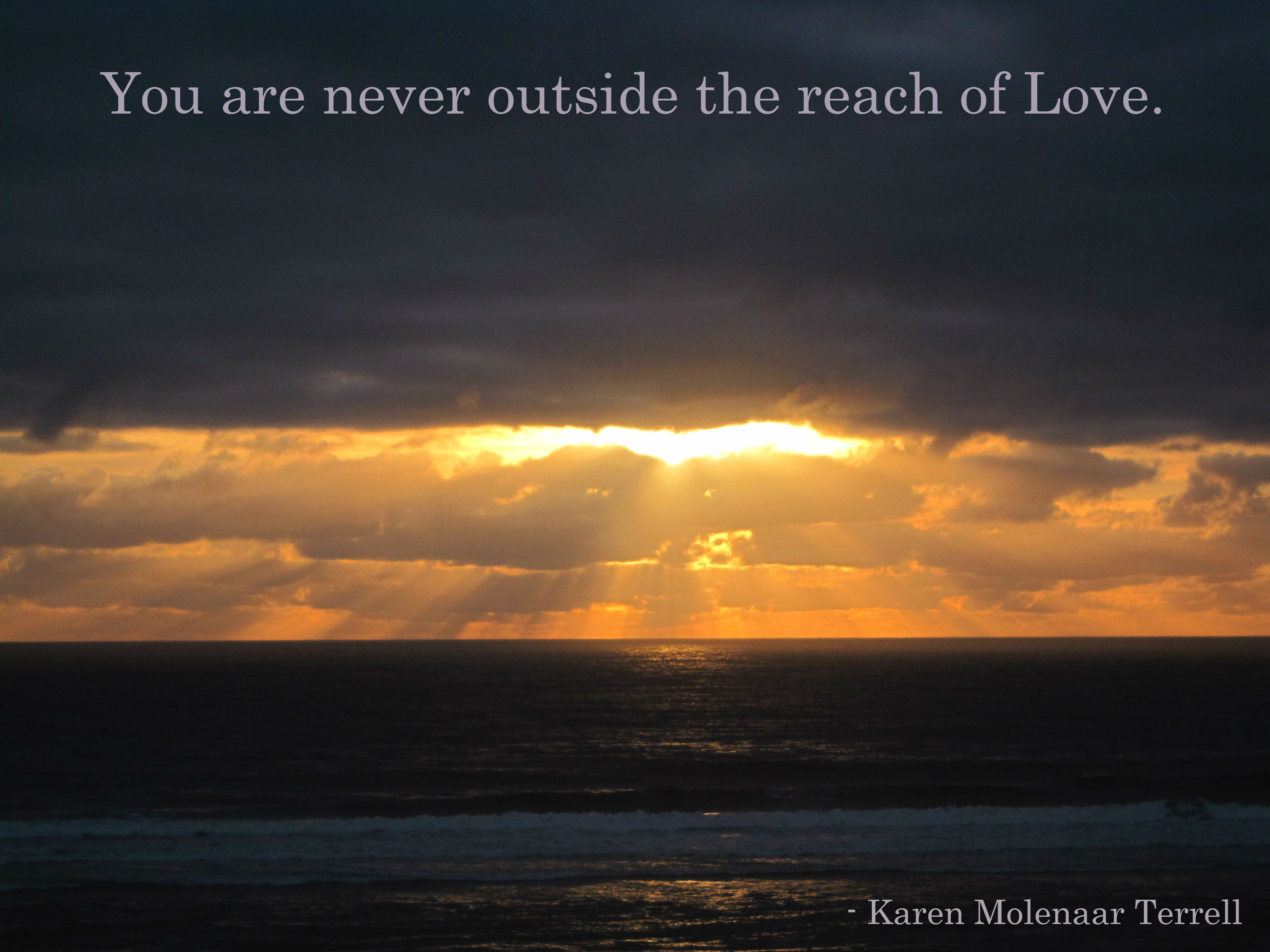
Photo of sunset in Lincoln City, Oregon, by Karen Molenaar Terrell.
 Adventures of the Madcap Christian Scientist