Thoughts on Love from Noemi Ban, a Holocaust Survivor

I had the great privilege of knowing Holocaust survivor Noemi Ban. I invited Noemi to come to my class and speak to my eighth graders about her experiences as a survivor of the Auschwitz-Birkenau death camp. Her sharing was powerful and inspiring. Afterwards, Noemi asked me if I could drive her home, and she invited me into her house. The first thing I saw when I stepped into her home was a photo of her family – her parents and siblings – taken before the Holocaust. Noemi told me it was the only picture she had of her family. Her father had found it in the rubble of their home after the war. The photo was precious to her. She’d lost her mother and siblings in the death camp’s gas chambers almost as soon as they’d arrived at Auschwitz.

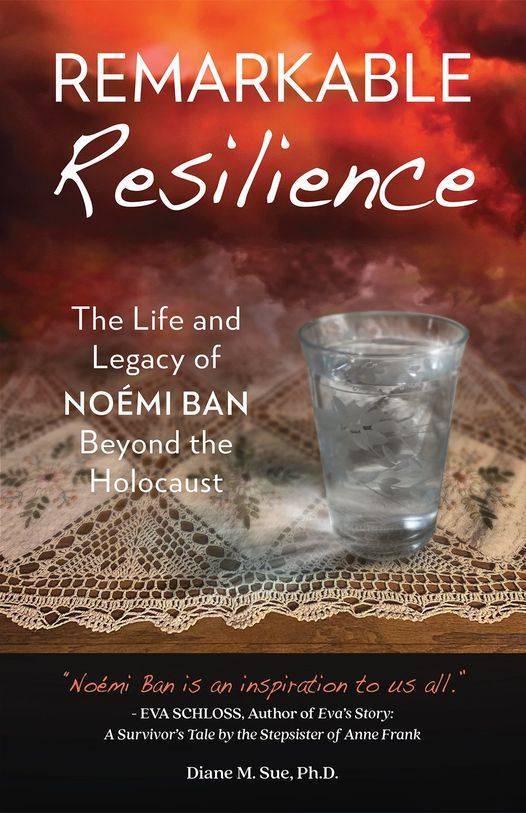
My friend, Diane Sue, who was a close friend of Noemi’s, told Noemi’s story in the book, Remarkable Resilience. I am feeling a sense of urgency right now to share this excerpt from Remarkable Resilience: The Life and Legacy of Noemi Ban:

“I imagine that my story has opened your eyes to the ease with which hatred can grow and destroy. Hate can be perilously insidious, beginning as a seedling that grows into a powerful tree, and, before we know it, we are surrounded by a dark and dangerous forest. Hate can destroy a person, or can destroy a civilization. Why is it so easy for some people to hate their fellow human beings? We asked that question when imprisoned in Auschwitz, trying to understand why the Nazis hated us when they didn’t even know us. Similarly, we may ask why some people hold so much animosity toward certain groups even in today’s world…

“I realize my reaction to what happened during the Holocaust could easily have been hatred. Many trauma survivors find it difficult to let go of their anger or resentment. I feel fortunate that I not only survived, but that I also avoided having my heart poisoned by hate. Those who hate can become bitter and lose their perspective on the beauty of life. I learned in Auschwitz what hate can do and I refused to do to myself what the Nazis did to me. If I focused on hating the Nazis, then I would still be their prisoner. And how can you live a peaceful life with hate in your heart? Some people wonder if I have forgiven the Nazis. Although I am working on it, I doubt I will ever be able to say that I have completely forgiven them. Nevertheless, when someone asks if I hate the Nazis for what they did to my family, I can honestly say I don’t hate anyone. I feel sadness, anger, and hurt, but not hate. There is another way to live life, and that was my choice—to live with love. “

Thoughts on This Memorial Day

Thoughts on this Memorial Day:

In 1961 – when I was just four – our country went through the tensions of the “Bay of Pigs.” I don’t remember anybody explaining to me what was going on, but I remember my mom and dad exchanging secret looks. I remember knowing the grown-ups were afraid.

Two and a half years later, our president was assassinated. I was in second grade. An announcement came over the school’s loud speakers that all students should return to their rooms. I was alone, walking in the hall – I think I’d just delivered a message to the office or something. I could feel the urgency in the voice over the intercom. We all were sent home from school. The next week was Thanksgiving, and I remember my dad and my Uncle Emery (retired Army officer) weeping. I didn’t often see my dad or my Uncle Emery weeping. It was a dark time.

Five years later, Civil Rights leader, Rev. Martin Luther King, Jr., was assassinated and, a few months after that, JFK’s younger brother was assassinated. By that time, my dad had climbed Mount Kennedy with Bobby Kennedy and considered him a friend. The assassinations of MLK and Bobby Kennedy brought more darkness to our country.

In 1969, our country began drafting young men – most of them still teenagers – to fight in a war on the other side of the world. The draft ended in June 1973 – a year before I graduated from high school. I wonder how many of the young men I passed in the halls of my high school were ordered to Vietnam?

Conflict and war didn’t end with the Vietnam War. I don’t need to go through the list – you all know.

But when I was asking myself this morning to try to identify that time in my life that might be called “the good old days” – I realized that I’ve always lived in a world with tension and conflict, hate and killing. I was blessed to have a happy childhood with loving parents, inspiring teachers, and healthy adventures in the outdoors – but beyond my own personal circle, there was darkness.

My teaching major was history. As I studied world history, I remember having an epiphany that all the wars fought in the world have been connected – that we’re really still fighting the First Peloponnesian War. Greed for land, greed for spices, greed for oil, greed for money and power – all the wars are related – leaders sending young people off to kill and be killed so their leaders can get more of whatever it is they want.

The world has always had its heroes, too – the humble unknown people who go about quietly doing the right thing, sharing the good they have, creating beauty, treating others with kindness and compassion. I meet these people every day on my walks and trips to the store – heroic people who don’t even know they’re heroic – people who do the right thing because they can’t NOT do the right thing.

And I see the progress towards liberty and love that humanity continues to make. Nothing can stop the progress. Once we’ve moved forward, it’s impossible to go back.

We live in challenging times – some might say “unprecedented” – but that in itself gives me hope. The more blatant and brazen evil becomes – the more it exposes itself for what it is – the easier it will be to see it and overcome it. With love. With the courage of progress. With the quiet heroism of kindness. Nothing can stop progress. Nothing can stop the power of Love.

Don’t Tell Me You Don’t Like Him, But You “Like His Policies”

The despicable, hateful, fear-inducing, violence-inciting things he says that target my friends in the LGBTQ community and the Haitian and Puerto Rican immigrant communities, and those who’ve served and died in the military, tell me everything I need to know about his “policies”

No, I was not better off under his presidency. And the economy is only going to get worse if he’s elected and his plans for the economy are implemented – his tariffs would bring up the cost of groceries and deporting millions of farm workers would, too.

I don’t want to hear even one more person say they don’t like him, but they like his policies. His policies are all based on hate and greed.

Insurrection Should Have Been a Deal-Breaker for Every Patriotic American

No, I’m not voting for Harris because she’s a woman. If Trump was a woman, and Harris was a man, I’d still be voting for Harris.

No, I’m not freaked out by the flags that proclaim “WITCHES FOR KAMALA.” I am freaked out, though, by the Confederate and NAZI flags I’ve seen at Trump’s rallies.

And you can tap dance around it all you want, but the Trump-led insurrection of January 6th should have been a deal-breaker for every patriotic, stars-and-stripes-flying, law-abiding, Constitution-loving American.

Here’s what I witnessed live in front of my television on January 6: I witnessed Trump urging his followers to march on the capitol and “fight like hell” – I watched his followers climb over barricades, clash with capitol police, stab the police with flagpoles, crash through windows, and enter the capitol building with Confederate battle flags. I watched legislators being rushed out of the building by security because their lives were in danger. I saw a gallows for Pence set up. And we were wondering where the National Guard was – why hadn’t they been called in? Surely Trump could have called them directly – he was the commander-in-chief, he didn’t need to go through official channels.

I had a friend who actually went to the rally – she was a Trump supporter and still is, I think – but she left after Trump spoke and got on a bus and went home and I don’t think – even though she was there for the speech – she’s ever actually realized what happened after the speech. I feel like I had a better view than she did at that point. What my friend did was practice her First Amendment rights – she came to peacefully protest the lie she’d been led to believe – that this was a “stolen election.”

What happened after my friend left, though, was criminal. Our Constitution guarantees that “Congress shall make no law respecting an establishment of religion, or prohibiting the free exercise thereof; or abridging the freedom of speech, or of the press; or the right of the people peaceably to assemble, and to petition the Government for a redress of grievances.” For me, the key qualifier there in regards to January 6th is “peaceably.”

I was, frankly, traumatized by what I saw that day. How could this happen in the USA?!
-Karen Molenaar Terrell
Link to footage from January 6th.

FEMA Memes

So there’s this meme popping up on some of my friends’ FB walls like those little animals in a Whac-a-Mole game. The meme goes something like this: “Why is our government spending all this money on illegal immigrants when it’s not doing anything for the hurricane victims?”

Which. What?!

If you do a little research, you’ll find that “As of Sunday, FEMA says it has provided more than $137 million in assistance to six states in the southeast, including 7,000 federal personnel, nearly 15 million meals, 14 million liters of water, 157 generators and more than half a million tarps. The agency also says more than 3,000 North Carolina residents have been rescued or supported by more than 1,200 urban search and rescue personnel, with recovery efforts aided by National Guard and active duty troops. North Carolina has also received $100 million in federal transportation funds to rebuild roads and bridges washed out by the storm.” (NPR)

In addressing Trump’s claim that the federal government is only offering $750 to “people whose homes have been washed away.” NPR explains: “The $750 Trump refers to is what’s called Serious Needs Assistance, an initial direct relief payment intended to help cover emergency supplies like food, water, baby formula and other basics. The serious needs assistance is one of many changes to FEMA’s individual assistance programs that took effect earlier this year, along with displacement assistance to cover immediate housing needs while residents sort out long-term options. FEMA assistance also covers storm-related damage to homes and personal property.” In other words, the $750 is simply the first immediate initial payment given to people to get the things they need right now to stay alive. It’s not the ONLY payment they’re going to get.

Here’s the link to the source for that information: https://www.npr.org/…/fema-funding-migrants-disaster…

Regarding illegal immigrants costing the United States a lot of money: Just what kind of money are we spending on illegal immigrants? I mean. I don’t see undocumented immigrants living lazy lives of luxury, you know? So I wondered just how illegal immigrants affected our economy and googled that. Here’s the AI answer that popped up:

“The economic impact of illegal immigration on the United States is complex and controversial, but economists generally agree that the effects are positive:
Economic growth
Illegal immigrants contribute to economic growth and increase the size of the U.S. economy.
Tax revenue
Illegal immigrants pay more in taxes than they collect. In 2022, undocumented immigrants paid $25.7 billion in Social Security taxes, $6.4 billion in Medicare taxes, and $1.8 billion in unemployment insurance
Consumer benefits
Illegal immigrants benefit consumers by reducing the prices of goods and services.
Employer benefits
Illegal immigration provides clear benefits for employers.
Labor market dislocationsIllegal immigration may cause some short-term dislocations in labor markets.
Low-skilled native workers
Illegal immigration may slightly depress wages for low-skilled native workers.
Economists estimate that legalizing the illegal immigrant population would increase U.S. gross domestic product. The New American Economy estimates that legalization would result in $68 billion in additional state and local tax revenue, $116 billion in additional federal tax revenues, and $1.4 trillion in estimated GDP growth.”

AI-generated

A bunch of links were provided:

https://www.newamericaneconomy.org/…/undocumented…/#

https://en.wikipedia.org/…/Economic_impact_of_illegal…#:

https://www.migrationpolicy.org/…/illegal-immigrations…#:

https://www.congress.gov/…/HHRG-118-JU01-20240111-SD013…#:

-Karen Molenaar Terrell

Reason to Impeach

No, no, no, no, no. An American president does not ask a foreign president to investigate a fellow American. American investigations of Americans stay in America. And to offer weapons to a foreign president in exchange for investigating an American citizen is also a no-no. I feel weird having to say this. I mean. Duh, right?

puzzle-flag

“We should remember…”

“We should remember that the world is wide; that there are a thousand million different human wills, opinions, ambitions, tastes, and loves; that each person has a different history, constitution, culture, character, from all the rest; that human life is the work, the play, the ceaseless action and reaction upon each other of these different atoms. Then, we should go forth into life with the smallest expectations, but with the largest patience; with a keen relish for and appreciation of everything beautiful, great, and good, but with a temper so genial that the friction of the world shall not wear upon our sensibilities; with an equanimity so settled that no passing breath nor accidental disturbance shall agitate or ruffle it; with a charity broad enough to cover the whole world’s evil, and sweet enough to neutralize what is bitter in it, – determined not to be offended when no wrong is meant, nor even when it is…” – Mary Baker Eddy

earth NASA

Earth (NASA)

Neither Snow, Nor Rain, Nor Heat, Nor Gloom…

Neither snow, nor rain, nor heat, nor gloom of night stays these couriers from the swift completion of their appointed rounds.
– Herodotus

My dear Humoristian hooligans,

Today, as you do battle against the forces of gloom and stodge, may you know that you are making a difference in the world. May your commitment to good will and humor lighten the loads of those burdened with fear and hate. May you bring laughter to the cranky, kindness to the bullied, and cheerful enlightenment to the ignorant. Let neither snow, nor rain, nor bigotry, nor FOX, deter you from your mission of irrepressible, unrelenting joyfulness. Go out there and make some laughter!

– Karen

Where do your beliefs lead you?

Snippet of a dialogue from a discussion forum…

Robert says:
The requirements for an observation to be considered to be evidence are strict: the phenomenon must be repeatedly observable by anyone who is interested, and must be able to show, and actually show, that the thesis under discussion is true, if such is the case — AND must be able to show, and would actually show, that said thesis is false if such is the case. And this arises for good reason: it is extremely easy to fool oneself as to the nature and significance of a subjective phenomenon. Clearly, no subjective phenomena of any sort can qualify as evidence in a scientific sense.

None of this has anything whatever to do with anyone’s position on the rights of women and LGBT people — nor whether one is a theist, atheist, or whatever.

Karen writes:
Robert, you write: “None of this has anything whatever to do with anyone’s position on the rights of women and LGBT people — nor whether one is a theist, atheist, or whatever.”

Exactement!! Exactly! Which brings us back to my original question: Seeing as how my beliefs in God don’t cause me to do harm to others, why do you REALLY care about them? What impels you to want to refute them? Why does it matter to you what I believe? Why is it any of your business?

And if I were to tell you that my belief in God has made me a better person – has helped me become kinder, more compassionate, more tolerant – doesn’t that actually make my belief in God a positive thing? Something to be glad about?

I don’t think it’s our beliefs that are important. I think it’s what we do with them that matters. If your belief in Nogod has made you kinder, more compassionate, and more tolerant – then I celebrate your belief in Nogod with you.

Robert responds:
Good post. “…my beliefs in God don’t cause me to do harm to others…” Most of the time, they probably don’t. But if you ever do ANYTHING for religious reasons, there is a distinct possibility that there will be, somewhere, an adverse effect. But the more salient point is: do not these beliefs cause you to do harm to yourself? Do you spend time in a church, as opposed to doing something productive? Do you contribute time or money to religious things, instead of to things that actually improve peoples’ lives? Do you approve of what is demonstrably irrational thought?

“…my belief in God has made me a better person…” I would ask for your grounds for this. Such beliefs can impel people to do good things — or truly horrible things. And, since there does not (and, provably, cannot) exist any means for validating any such belief, whether you do well or ill in accordance with a religious belief is strictly a crapshoot. No doubt you temper your religion-impelled actions on the basis of your appraisal of their overall effect on the society in which you live, but not everybody does this. (Examples of such perfidy are rife in the news these days.)

“I think it’s what we do with them that matters.” Agreed. But the standards to be applied in determining this cannot be based solely on any religion.

Karen responds:
Robert, you ask: “…do not these beliefs cause you to do harm to yourself? Do you spend time in a church, as opposed to doing something productive? Do you contribute time or money to religious things, instead of to things that actually improve peoples’ lives? Do you approve of what is demonstrably irrational thought?”

I am a teacher in a non-profit alternative high school. Seventh-eighths of the population is composed of minority students. My students and their families are dealing with challenges that a lot of us can’t begin to imagine – and that I can’t really share here. I came to the alternative high school after a 20-year career in public education. I get paid peanuts, but I love my job and love working with these kids. I love helping them find academic success and helping them discover their gifts. There are days when I come home totally emotionally drained – not from my students, but from seeing the crap they have to deal with just to survive in our society. I feel useful there. I really like feeling useful. My work is not in any way connected with a religious institution.

I am involved in supporting political issues that matter to me – I served as a state delegate to the 2012 Democratic convention, and write letters to politicians and newspapers, and write posts on my blogs that take the time to address these issues. I have given money to the ACLU, Amnesty International, the Nature Conservancy, Sierra Club, Environmental Defense Fund, World Wildlife Fund, Habitat for Humanity, Humane Society, and Doctors Without Borders, among others. I have helped build a house for Habitat for Humanity.

I also like to keep moving – hiking, gardening – healthy activities that keep the blood pumping. And I’ve found it’s important to my well-being to set aside time for creative pursuits, too – I’m big into photography, singing, and writing.

I am not, actually, a very religious person. Not all theists are. There are periods in my life when I don’t attend church. And there are periods when I do. Right now I am the Reader at the mid-week testimony meetings, and my job is to pick the week’s topic, find readings on it, and conduct the service. I try to find readings that I think will be helpful and healing to the world. Last week’s readings were on “wrath/anger” and “love/forgiveness.” People seemed really grateful for the inspiration they felt from the readings, and I was glad I could provide that for them.

And now I give the question back to you: How do your beliefs in Nogod help mankind? How do they make the world a better place?

“We must think critically, and not just about the ideas of others. Be hard on your beliefs. Take them out on the verandah and beat them with a cricket bat… Be intellectually rigorous. Identify your biases, your prejudices, your privilege.” – Tim Minchin

I really like that quote. I especially like the thought that we need to start with our OWN biases when it comes to thinking critically. How much of your time do you spend on self-reflection? When was the last time you changed the way you thought about something? Or recognized a bias that wasn’t healthy for you to have?

How do we know when we need to change our beliefs about something? Well, for me it starts with looking at where my beliefs are taking me. If they’re leading me towards hate, fear, anger, bigotry, bullying, greed, and selfishness, then those beliefs have got to go. But if my beliefs are leading me towards love – guiding me to a place of courage and compassion, generosity and hope, joy and kindness and forgiveness and integrity – then those are the beliefs I’m going to nurture.

What about you? Where do your beliefs lead you?

Robert responds:

A most excellent post. It appears that you have your life well together — something that is rare in this day and age. I entirely approve of the Minchen quote. I am not young, and have spent much time and intellectual effort on identifying the source and nature of knowledge and what can be done with it.”it starts with looking at where my beliefs are taking me.” In other words, you are looking for evidence. Are your theses sound, or are they refuted by evidence of some sort? This is exactly what you should be doing — and are, with the notable exception of religious beliefs. You are doing appropriate things with respect to society, but your foundation is weak.”Where do your beliefs lead you?” Among other things, to participate in these forums. We have all seen the horrors that religious beliefs have brought to the world society; it is my purpose to show these to be the nonsense that they are. So, that instead of flying airplanes into tall buildings, we can indeed spend our efforts productively in things like teaching the next generation, discovering cures for loathsome diseases, and making it possible for people to live in comfort and peace.Carry on!

Seeker responds to Karen:
I read your post and then the reply from Robert, and I have to say that I don’t see your “foundation” as being weak. Even though I would probably side with Robert on the idea that there is no proof of God, I don’t see religious belief as automatically detrimental. In fact, in proper perspective and using definitions appropriately I have seen great value from those that profit by their faith. That said… it is sad that so many use religion to justify those reprehensible things you mention, “hate, fear, anger, bigotry, bullying, greed, and selfishness”, and do it in the name of religion. What is strange is that most of those failing in these areas ARE the religious. Very sad, and certainly detrimental to those that use faith as you apparently do.

I believe your last question, in context with your examples of guidance, is one that all people should be aware of. So I will ask it again…Where do your beliefs lead you?

Robert writes:
Re Karen T., above and elsewhere: You have well described your various activities, which I consider meritorious. Suppose, now, that you concluded that, since the existence of any god cannot be demonstrated by any means [1], you decide that it is pointless to believe in one. In what way (if at all), would your subsequent activities differ from what you are doing now?

1. Recall that this is provable.

Karen responds:
Thank you, Robert. You don’t know what a relief it is to learn that my life has met with your approval. 🙂

I guess I could lie and tell you that I no longer believe in God – and maybe win your complete approval of me and stuff… but… well, it wouldn’t be honest of me.

My belief in God is based on happenings I have witnessed or experienced first-hand – so, although these experiences are just nice anecdotes to people who didn’t live them or see them, to me they are more than that. For me, they are “proof.”

Remember that I don’t believe in an anthropomorphic god. I believe in a power and presence and Consciousness of Love and Truth. There’s nothing supernatural about this God.

Nando Perrado describes “God” this way (Miracle in the Andes: 72 Days on the Mountain and My Long Trek Home) and I have not found a better description for the God I believe in: “…I did not feel God as most people see Him. I did feel something larger than myself, something in the mountains and the glaciers and the glowing sky that, in rare moments, reassured me, and made me feel that the world was orderly and loving and good… It was simply a silence, a wholeness, an awe-inspiring simplicity. It seemed to reach me through my own feelings of love, and I have often thought that when we feel what we call love, we are really feeling our connection to this awesome presence.”

Seeker responds to Karen:
That’s nice, and I am awed by what can be experienced, too.

Lesson from a Seagull and a Cormorant

Image

seagull and cormorant

photo by Karen Molenaar Terrell