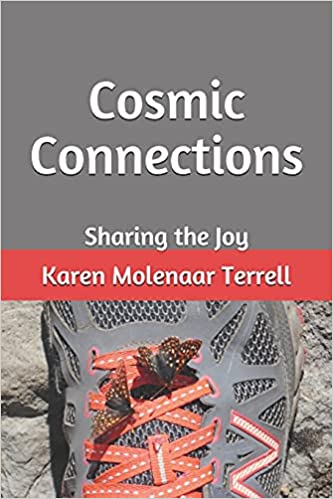
There’s a new review on Amazon for my book Cosmic Connections: Sharing the Joy! SB writes: “I often feel like I’m right there with the author in her small town travels and happenings. The writing is fluid, poignant, and personal, yet universal – easy to translate to any place. It got me thinking about life, love, and the smallness of this big world.”
I so appreciate when someone takes the time to write a review for one of my books. It means so much to me when I read a review like this because it helps me feel I’ve connected to someone else in a positive way.
This morning I finished reading Joanna Nell’s new book, Mrs. Winterbottom Takes a Gap Year. I love Joanna Nell’s books. Here’s the review I wrote for the one I finished this morning:
I so enjoy Joanna Nell’s stories. Joanna Nell gives dignity and respect to her aging characters. Her characters are full of life and humor, wanting to make use of every moment left to them. Her books inspire me. She makes growing old fun.
My father lived to be 101 and, even as he was losing his memory, he wanted to get out and go on drives and have adventures with me. As I read Joanna Nell’s books, I can see him as the hero in one of her stories. That makes me smile.
I can’t know exactly what went through your mind that day – you’ve been reluctant to step into the limelight and say – you’ve been humble, wanting to fade quietly into the background. But the impulse that led you to step to the front on January sixth – the impulse that made you run towards hell – when our government was on the verge of being felled by its own people – continues to give me hope for our nation. Maybe for you the choice was no choice – you could no more have run away from the terror of that day than the sun can stop shining. You simply did what heroes do without question or thought. You are a miracle. You represent the best in us. -Karen Molenaar Terrell
“Rise in the strength of Spirit to resist all that is unlike good. God has made man capable of this, and nothing can vitiate the ability and power divinely bestowed on man.” -Mary Baker Eddy, Science and Health with Key to the Scriptures (p. 393)
I finally gathered my courage and watched Leave the World Behind on Netflix. I’d been reluctant to watch this movie because I’ve been feeling fragile lately – bombarded on the internet and television with images of disease and death, destruction and war and inhumanity – and I didn’t feel like I was ready for any more emotional breakage right now. But as I’ve been processing the movie in the last couple days, I’ve felt myself gathering courage, building a sort of steely resolve. If the people with financial and political power want us to isolate ourselves from each other, want us to be fearful and distrustful of each other, want us to cower in paranoia so that they can control and manipulate us – then, hell no! I am not going to isolate myself, or be scared or cowering.
I am going to be part of the resistance movement.
Wikipedia says this about “resistance movements“: “Resistance movements can include any irregular armed force that rises up against an enforced or established authority, government, or administration. This frequently includes groups that consider themselves to be resisting tyranny or dictatorship.”
In the textbook for Christian Science, Science and Health with Key to the Scriptures, Mary Baker Eddy writes (on p. 29): “Christians must take up arms against error at home and abroad.They must grapple with sin in themselves and in others, and continue this warfare until they have finished their course.”
Note that Mrs. Eddy isn’t saying we should arm ourselves with assault weapons or bazookas. She’s talking about another kind of warfare all together. She writes in Science and Health (p. 225): “A few immortal sentences, breathing the omnipotence of divine justice, have been potent to break despotic fetters and abolish the whipping post and slave market; but oppression neither went down in blood, nor did the breath of freedom come from the cannon’s mouth. Love is the liberator.”
I’m going to take up arms of love and joy and hope against the would-be tyranny of hate and fear and despair. I’m going to consciously reach out with joy and kindness and patience to my fellow earthlings. I’m not going to let the images of war and hate we’re constantly bombarded with on television and in social medial deter me from my mission of kindness. I’m not going to let the advertisements and commercials filled with images of disease keep me shackled in fear and isolated from others. “Hell no! We won’t go!” there. -Karen Molenaar Terrell
***
P.S. As I was pondering “resistance” the climactic scene from A Wrinkle in Time by Madeleine L’Engle came into my thoughts. In this scene the protagonist, Meg, is resisting the hate and tyranny of IT. She’s been told she can fight IT with something she has that IT doesn’t have – and she’s trying to figure out what that is. IT is trying to get control of her thoughts, and she’s starting to lose the battle:
“…as she became lost in hatred she also began to be lost in IT…
“With the last vestige of consciousness she jerked her mind and body. Hate was nothing that IT didn’t have. IT knew all about hate…
“‘Mrs. Whatsit hates you,’ Charles Wallace said.
“And that was where IT made ITs fatal mistake, for as Meg said, automatically, ‘Mrs. Whatsit loves me; that’s what she told me, that she loves me,’ suddenly she knew.
“She knew!
“Love.
“That was what she had that IT did not have.
“She had Mrs. Whatsit’s love, and her father’s, and her mother’s, and the real Charles Wallace’s love, and the twins’, and Aunt Beast’s.
“And she had her love for them…”
“She could love Charles Wallace. Charles. Charles, I love you. My baby brother who always takes care of me. Come back to me, Charles Wallace, come away from IT, come back, come home. I love you, Charles. Oh, Charles Wallace, I love you. Tears were streaming down her cheeks, but she was unaware of them…
“I love you. Charles Wallace, you are my darling and my dear and the light of my life and the treasure of my heart. I love you. I love you. I love you.
“Slowly his mouth closed. Slowly his eyes stopped their twirling. The tic in the forehead ceased its revolting twitch. Slowly he advanced toward her.
“‘I love you!’ she cried. “I love you, Charles! I love you!’ Then suddenly he was running, pelting, he was in her arms, he was shrieking with sobs. ‘Meg! Meg! Meg!’
“‘I love you, Charles!’ she cried again, her sobs almost as loud as his, her tears mingling with his. ‘I love you! I love you! I love you!’”
T’was the day after Christmas and all o’er the earth people were waking to find there still seemed a dearth of peace on our earth and to all good will – we wondered if the promises would ever be fulfilled.
And then a someone shouted, “Hey! I have a thought! Let’s celebrate Christmas every day – let’s celebrate a lot! Let’s keep kindness and sharing alive in our hearts – not just at Christmas, but in all the year’s parts!”
And we thought this was wise, and we thought this was good, so we celebrated kindness all over our earth’s ‘hood. -Karen Molenaar Terrell
I’m deep in sleep and suddenly there’s a voice right outside my window, insistent. “Hello? Hellooo?!”
And I wake. But I’m on the second floor and, unless someone’s on a ladder, no one is right outside my window. Someone was calling for help in my dreams.
I’m groggy, but waking now. The world is calling for help. “Hello? Hellooo?!”
It’s a humble holiday, tucked in between Christmas and New Year’s, but it’s really keen. Things look a little bedraggled, it’s true The tree’s a little droopy and no longer new
The movies and music of the Christmas season Are getting on our nerves now, and we’re seeing no reason To eat even one more sugary oversweet sweet It’s time for broccoli and carrots (maybe hold on the beets)
The pressure for perfection comes off on this day, the toys have been opened, and it’s come time to play. And if before we were wearing faux holiday cheer to blend in with the others and not Scroogey appear
It’s time now to be genuine, and honest and real. The food banks are empty, people still need a warm meal. The homeless and hungry and jobless and alone still need love and care, still need a home.
So maybe we can celebrate the day after Christmas by keeping the spirit of hope alive, we might make that our business. – Karen Molenaar Terrell, from *A Poem Lives on My Windowsill*
I look around the table and see bountiful blessings there is a vegan feast here and family and love and I have a flashback to forty years ago before marriage before the sons before the daughters-in-law before Clara Cat and Sparky and for a moment I am in awe of the bounty of today
Christmas isn’t hiding in the tree. Christmas isn’t hiding in the lights. Christmas isn’t hiding in what we see. We don’t see Christmas through our eyesight.
And it’s not hidden in rhyme – which rhymes with time, dime, climb, clime, lime, thyme, mime…
Is Christmas hidden in the past when Mom and Dad were still here and the sons were little and scampering around in their footy pajamas and waiting for Santa?
Is it hidden in the office Christmas parties? The community caroling, the tree-lighting, the Christmas sales? The Christmas cookies, gift-wrapping, Hallmark movies?
Breaking News: I just found it! And you know where it was? It was inside ME all along! And I just needed to be still and listen to hear its song.
Forty-one years ago today, my husband and I met each other at a wedding.
Here’s our “meeting” story: Okay, so there was this woman I knew. She was not a girly girl. She’d been raised with brothers, a mother who had no interest in accessories or luxury, and a mountain man for a father. Cosmetics and frou-frou clothes were not a part of her life as she grew up. Instead of a purse, she had her faithful hiking backpack. Instead of high heels, she had her tennis shoes and boots.
She was what you would call a late bloomer in the romance department. She was awkward around men and very self-conscious about any feminine wiles that might inadvertently peek out of her persona. Feminine wiles were not highly valued in her family and it was a little embarrassing to have any. There were young men who were attracted to her, but in her teens and early twenties she was mostly oblivious to their attraction or scared of it. There were young men to whom she was attracted, too, of course – but she mostly enjoyed fantasizing about them from afar, rather than having an actual relationship with any of them, and on those rare occasions when she took it in her head to try to flirt with one of them she had no idea how to go about it.
There came a day, though, when for the first time our heroine took interest in a male thigh. It was in the mountains of Colorado and the man who came with the thigh was young, confident, and easy to flirt with. Our heroine was twenty-two and for the first time realized that there might be more to find in the mountains than a good hike.
Not long after her epiphany about male thighs and other things male, a Dutch jazz musician entered her sphere. Now here was someone expert with the ways of romance. They spent almost a year together, culminating in a trip to The Netherlands to spend time with his family.
The Netherlands was the home of our heroine’s ancestors, and she felt a certain kinship with the people there. She loved the land – the tangy, saltwater smell of it, the wide open flatness and the canals, the black and white cows, the white lace curtains, the brick streets, the oldness and history. But, alas, there were no mountains to climb there. And, further alas, the Dutch jazz musician became someone she didn’t know when he stepped back onto his native soil.
In an autumnal Dutch wood on a sunny Dutch day, they both agreed that a certain kind of love and a certain kind of hate are very closely related and snipped the cords of their romance.
The relationship had to end. Our heroine knew that. But knowing it didn’t seem to make it any easier. It felt like someone she loved had died. She came home from Europe with her tail between her legs, dark circles under her eyes, and weighing about the same as Tinkerbell.
I think most people have experienced heartbreak at least once in their life. It’s a part of growing-up really. Makes us more empathetic to the pain of others, makes us more compassionate, and that’s a good thing – a blessing. And as Mary Baker Eddy writes in Science and Health with Key to the Scriptures, “Every trial of our faith in God makes us stronger.” *** It took our heroine a few months to recover and then she earnestly entered what she has come to call her “dating phase.” She was meeting men everywhere – parking lots, the supermarket, the workplace, hiking, through friends. These men were talented, witty, and smart – a German physicist, a teacher-cum-comedy script writer, a sweetheart of a man who introduced her to cross-country skiing for the first time – and it was a heady thing for her to have them all show an interest in her.
At first the dating phase was great fun. Because her life wasn’t committed to one person she had the freedom to go and do what she wanted, meet and date all these interesting men, take road trips on impulse, head for the hills on a whim, with no one else’s schedule to have to negotiate.
But about the time she turned twenty-six something began to change in her thought. Singlehood began to lose its charm and these men she’d been meeting all started to seem the same to her. Dating became a little monotonous. She felt unsatisfied with the lack of direction in her life. She was beginning to feel it was time to get serious about this relationship thing and stop dinking around.
In a moment of self honesty, she admitted to herself she’d been going out with the wrong kind of men for what she now needed and wanted in her life. Mary Baker Eddy writes in the chapter entitled “Marriage” in Science and Health: “Kindred tastes, motives, and aspirations are necessary to the formation of a happy and permanent companionship.” And so our heroine made a list of qualities that she wanted to find in someone: She wanted to meet a man of compassion and integrity; If this man was going to be a part of her life he’d also need a sense of humor, believe me; And he’d have to love the mountains, of course; and she’d really like him to have some kind of a creative, stimulating occupation; And, as a last whimsical thing, she decided that he’d come from either California, Colorado, or Connecticut. She’d gone out with short men, tall men, blond, dark, wiry, and sturdy – and they’d all been attractive to her. But an image of The One came to mind: He’d be about six feet tall, lanky, have brown hair, and glasses. *** In December of ‘82 a woman named Peggy, whom our heroine had met a couple of years before through the Dutch jazz musician, invited her to her wedding. To be honest, our heroine had no intention of going to this wedding, not wanting to mingle with all these people she’d met through the Dutchman. But on the eve of the wedding the woman who was scheduled to be the wedding singer got laryngitis and asked our heroine if she could take her place as the singer. She’d never sung at a wedding before, but asked herself, “How hard could it be?” and agreed to sing a song or two. *** She spotted him as soon as she got there. The wedding was an informal affair held in a living room, and this man with a camera – the wedding photographer, she guessed – was weaving his way through the people who were seated and waiting for the wedding. Everywhere he stopped to chat, people would start chuckling. She surmised he must have a sense of humor. And he had a great smile – the full-faced, crinkly-eyed kind. She found herself instantly attracted to him. The wedding began, the ceremony proceeded, she sang her song (a little nervously), and kept her eyes on the man with the camera.
After the ceremony she, who had until now always been the pursued rather than the pursuer, walked up to him and introduced herself. He blinked behind his glasses, probably surprised at her directness, and grinned down at her. “Scott,” he said, shaking her hand.
At the reception, held in a local community hall, they talked and got to know each other better. She asked him if he liked the mountains. He said yes. She asked him if he’d ever climbed any. Yes, he said, Mt. Baker. She mentally put a check by the “loves mountains” on the list of qualities she was looking for in a man. Their conversation continued. She learned he was a newspaper photographer and checked off the requirement for “stimulating, creative job.” She saw how he opened the kitchen door to help an elderly woman with her hands full. “Compassionate” was checked off her list.
He asked her if he could fetch her something to drink. She told him she’d really just like some water. He nodded his head. “Wadduh, it is,” he said. “Wadduh?” she asked. “Are you from the east coast?” “Connecticut,” he answered, grinning. *** A year and a half later Scott got a call from Peggy. Our heroine answered the phone. She told Peggy that her husband wasn’t home right then, but could she take a message? When she heard the caller’s name she let her know her own. Peggy admitted she’d heard rumors that Scott and she had married. She was happy to have had a part in their meeting each other. Scott and our heroine have been happily married for almost 40 years now.
And our heroine realizes that she wouldn’t have been blest with her love if she hadn’t first met the jazz musician. From cursing to blessing. It’s all connected. – excerpt from Blessings: Adventures of a Madcap Christian Scientist
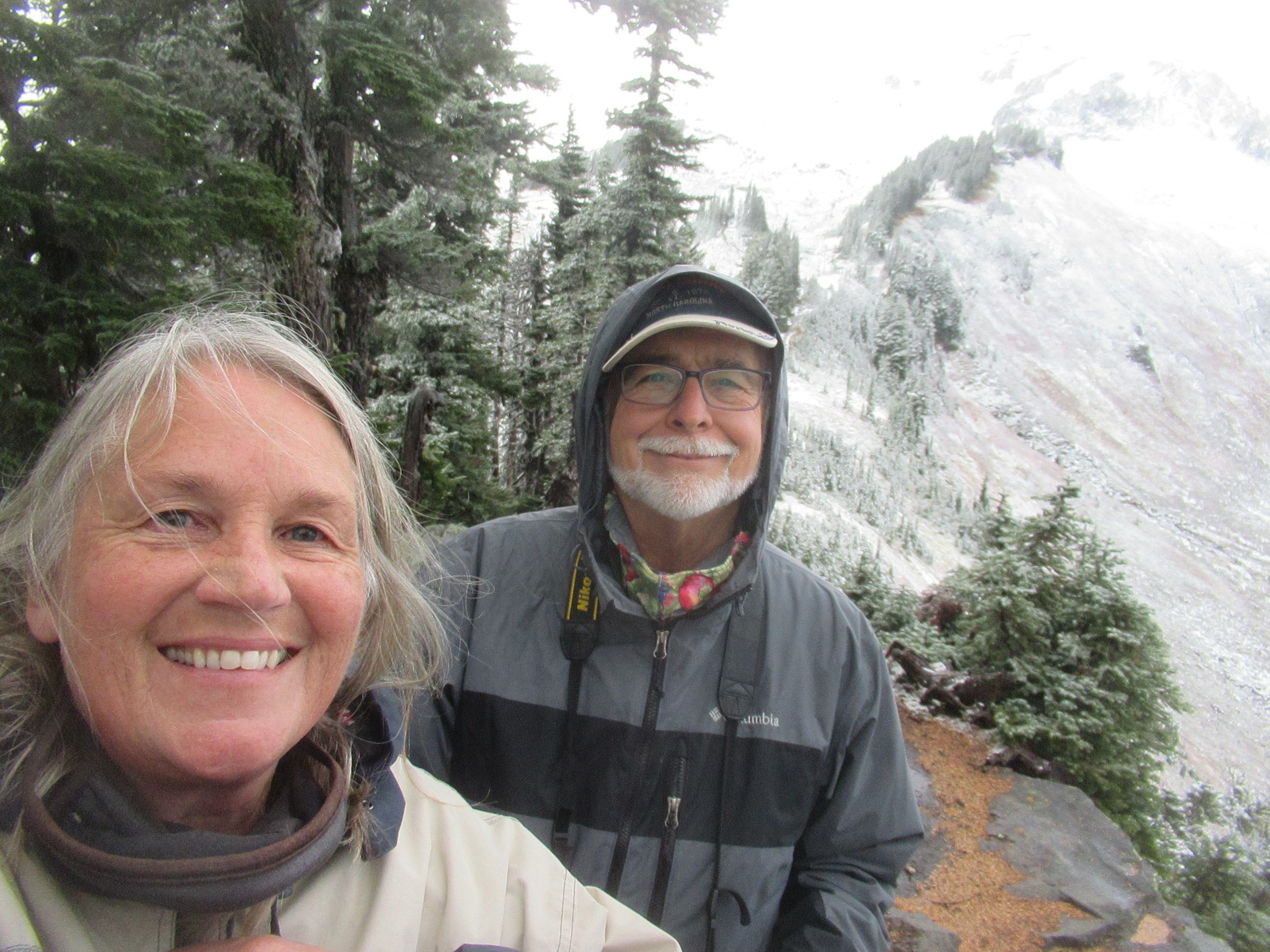
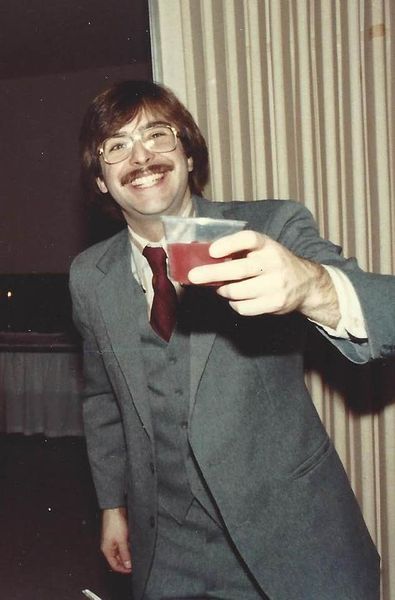
2020: Visiting Dad’s AshesLincoln City, OR, Scott and KarenScott on the day we met. Me as the wedding singer on he day I met Scott. I’m on the left, looking a little nervous.







 Adventures of the Madcap Christian Scientist