Perception and “The Dress”

So this picture of a dress has been going around – you may have seen it – and apparently 74% of people see white and gold. I see blue and black. I’ve tried really hard to see white and gold, but it ain’t happening.

Go here to see the dress: https://www.yahoo.com/health/is-this-dress-blue-and-black-or-white-and-gold-112194158507.html

And here’s an explanation for why people are seeing different things: http://www.wired.com/2015/02/science-one-agrees-color-dress/

This incident with The Dress – and the way people can see the same thing so differently and are so sure they’re right about the way they see it – reminded me of some conversations I’ve had with others about God and Nogod. Many of those dialogues have been frustrating for everyone involved. But there was a dialogue I had on this blog a year ago with Andrey Pavlov, a young medical doctor and atheist, that was one of the most enjoyable conversations I believe I have ever had with another human being regarding “God.” I had met Andrey on the sciencebasedmedicine.org website, and he had kindly joined me on my blog so we could carry on our conversation.

I’d tried to describe to Andrey what “God” is to me. I’d written: And perhaps “God” IS nothing more than my own consciousness of good, really – but I feel this Good as a presence in my life. It’s as real to me as the air I breath. It speaks to me – not in a man-voice – but… it speaks to me as Truth. As Love. In times when I’m scared, I feel this presence of Love and comfort around me – and, again, maybe that’s nothing more than my own thoughts – but whatever it is – whether it’s just my own consciousness – something inside me – or whether it’s something I am inside of – this power I call God has been with me when I’ve been sick, and when I’ve been scared, and when I’ve had to make important decisions in my life – and this presence has helped me.

And Andrey responded with this –

“This is interesting to me. I believe you, I really do. I absolutely believe that you have these experiences and feel the things you do as you say them. And I do not think these are evidence of any sort of psychiatric illness, cognitive dysfunction, or anything someone may call ‘abnormal.’ I don’t really know (nobody does) but there is plenty of evidence to lead us to think that this is simply one of the many fluid ways in which an individual processes the universe around them.

“It is, IMO, important to realize that everything a person sees, feels,experiences in any way is highly processed by the software and hardware of our brains. We (mostly) all agree that an object which reflects electromagnetic radiation with a wavelength of 650nM looks ‘red.’ But how do I know that what you actually experience as ‘red’ is actually what I experience as ‘red’? I can’t know and you can’t know. That is what philosophers refer to as the ‘qualia’ of life – that purely internal subjective processing and experience of life and the universe through the consciousness we have. It raises this interesting idea of ‘p-zombies.’ Dan Dennett has written a fair bit on them and it stems in part from the concept of a Turing test.

“So when you say that you ‘feel’ the presence of Love, Goodness, etc. I believe you. I can’t possibly imagine what that means in the same way I can’t imagine what it means when a synesthetic says that someone’s name is “lime green” in color. But to that synesthetic, it is a consistent, meaningful, and very real experience.”

I really appreciated the way Andrey listened – heard me – and made an effort to understand my perspective and translate it into something he could relate to in some way.

And wouldn’t it be a wonderful thing if we all could do that for each other?

“We must think critically…”

“We must think critically, and not just about the ideas of others. Be hard on your beliefs. Take them out on the verandah and beat them with a cricket bat… Be intellectually rigorous.Identify your biases, your prejudices, your privilege.” – Tim Minchin

I really like the quote above. But it strikes me as a little over-the-top – like we’re marching off into a major war or something, with swords drawn and bludgeons and bats at the ready.

My approach to the art of critical thinking is a little different, I guess. Sometimes I’m a gardener – pulling up the weeds, planting the cheery sunflowers, nurturing and watering the good, plucking out the stuff that’s not so good. And sometimes I approach it as a housekeeper might – adding a little vinegar to the water, and wiping the film and build-up of nonsense off the window panes so I can see clearly again, and so the light can come into my home.

We don’t need to beat the crap out of ourselves – and certainly not out of others – to make progress in our lives. We don’t need to break the windows – we just need to clean them, you know?

So how do we know when we need to spruce up our beliefs? Well, for me it starts with looking at where my beliefs are taking me. If they’re leading me towards hate, fear, anger, bigotry, bullying, greed, and selfishness, then those beliefs have got to go. But if my beliefs are leading me towards love – guiding me to a place of courage and compassion, generosity and hope, joy and kindness and forgiveness and integrity – then those are the beliefs I’m going to nurture.

Are we clearing the gardens of thought by uprooting the noxious weeds of passion, malice, envy, and strife? – Mary Baker Eddy

The way to extract error from mortal mind is to pour in truth through flood-tides of Love. – Mary Baker Eddy

sunflower and bee

photo of sunflower and bee by Karen Molenaar Terrell

An Incident in a Discussion Forum (okay, this is me being cranky)

Asking people about their opinions is a very good way of making friends. Telling them about your own opinions can also work, but not always quite as well. – Douglas Adams

 She arrived in the middle of a discussion upon international politics. “Look at India,” one of the ladies was saying. “Yes, but look at Japan,” urged the other with intense vehemence. Barbara was introduced to the ladies, of course, but she never heard their names. They were already labeled, much more legibly in her retentive memory, as Mrs. Japan and Mrs. India. She was rather crushed at the farsightedness of the two ladies— what did they see when they looked at Japan and India like that? Did their bird’s-eye view take in the whole of these Asiatic countries at a glance? Were India and Japan open before their eyes like a child’s picture book? – D.E. Stevenson

The following was originally a chapter in The Madcap Christian Scientist: All Things New, but I took it out because the voice in this chapter doesn’t fit in with the rest of the book. In this chapter you see me being cranky and a little ticked off. It ain’t pretty…

Have you ever looked back on a period in your life and smiled with amusement and a certain amount of affection for the person you were? That’s how I feel when I look back on the person I was five years ago – during the period when I was spending a lot of my free time on a religion discussion board. I was cute, wasn’t I? – idealistic, naïve, really believing that everyone was on the discussion board for the same reason I was – to learn about other people’s beliefs, share their own, and exchange ideas and thoughts about religion, science, metaphysics, philosophy, literature, music, art.

I learned an awful lot from that discussion board – some of it was awesome, and some of it not so much. I learned there were a lot of people in the world with kind hearts and open minds and good humor. I also learned that there are an awful lot of people who want everyone else to think and believe exactly what they think and believe – and I learned that I wasn’t one of them.

I saw bigotry.

If there’s one thing that toasts my cookies it is bigotry.

At first I found myself mostly coming to the defense of the atheists on the discussion board, who, initially, seemed to be the major target of bigotry. They were told they were going to hell. They were told they were all lacking any kind of moral compass. They were compared to Pol Pot and Stalin. It was all ridiculous and hateful, and I could not let the bigotry slide by without responding to it.

Then for a time the bigotry seemed to be mostly directed towards the “believers”. Those who believe in God were called ignorant, uneducated, unintelligent, superstitious scaredy cats, and blamed for the murders committed during The Crusades, the Spanish Inquisition, and the Salem witch trials. Which… yeah… I’m sitting here now, just shaking my head, as I remember the nonsense.

There were a lot of generalizations made – every atheist was lumped together into one group – as if they all believed, felt, and thought the same about everything; and every Christian was lumped together into another monolithic group. Finger-pointing and blame-laying was rampant. As a Christian Scientist, I was told by many of the Christians that I was going to hell because I didn’t believe in hell, or in a devil, or that Jesus was God. And as someone who identified as a Christian, a number of atheists seemed inclined to assume I held the same beliefs about God that they had learned when they were youngsters attending Christian Sunday Schools – and then judged me for the beliefs that they wrongly attributed to me.

It could all be a little exasperating.

For the first few years the humor, friendship, and intellectual stimulation I got from the discussion forum outweighed the exasperation. I met some really good friends there – people I still continue to call my friends – people who became familiar with my spiritual perspective about life in a way that many of my offline friends never did.

But after several years my interest in the discussion board began to wane. More and more I found myself in these weird dialogues with people who presumed to know what was in my head and heart without giving me the opportunity to tell them myself. More and more I found myself in the unsatisfying position of being treated like a student whose job it was to quietly sit and listen while others threw their great wisdom and knowledge at me. I found myself getting lectured to and preached at a lot, and I do not particularly enjoy being the target of lectures and preaching. Dialogues became one-sided monologues; the exchange of ideas turned into a one-way sermon – people telling me what I should believe, think, and feel, and then getting really agitated with me if I dared to question or voice a thought of my own.

The Grand Finale – the defining moment when I realized I no longer had any interest in serious participation on the discussion board – came for me on a thread titled “Repeal the child abuse for Christian Scientists in Washington State law”. For four pages (100 posts) I read comments, written by my friends (people whose atheism or Christianity I had defended time and again on the forum) about the lunatic Christian Scientists who are “neither Christian nor scientists” (pretty original, right?). For four pages I read comments from people attacking a “strawman” – indignantly pontificating on how wrong it is to legally allow Christian Scientists to abuse their children – when there never was a law or lobby that supported child abuse by Christian Scientists. And then I saw where one of my forum friends had written this: “I just took issue with the thought that the faith healers could be unaware that their ‘healings’ have zero positive effect… I think the fact that the alleged Christian Science lobby feels the need to protect themselves from prosecution tells me that they must know the reality of their faith… He seems to be saying that Christian Scientists aren’t True Christians. The Christian Science people seem to think they are Christians, based on my scanty reading of what they believe.”

SCANTY READING?!!! Oh, for Pete’s sake! I’d been sharing my experiences as a Christian Scientist on that forum for almost seven years – shared wonderful healings I’d had in Christian Science, shared my thoughts about “Christianity” – but my friend hadn’t, apparently, learned anything about my way of life or beliefs from what I’d written on there. It came to me, then, that the only reason some of these people had ever considered me their friend was because I had been a good audience – willing to listen to THEM – but that they hadn’t really been interested in anything I’d had to say.

I wrote a response:

Christian Scientist from Washington State here. I’m sure you are all completely right about me. I mean, you must be, right? I should be, like, locked-up for the good of society. Interned in a camp maybe. I should never have been allowed to marry – and certainly not to a nice, decent liberal man raised by his decent God-loving Methodist parents. I should never have been allowed to have children, and certainly never been allowed to raise them – it’s a miracle that they survived to adulthood and turned out to be such intelligent, healthy, whole, well-adjusted young men, considering their mom was a Christian Scientist. I should not be allowed to share in the rights of citizenship of this land – it’s far too good for the likes of me. I should certainly never have been allowed to vote – and never been allowed to participate in the democratic process. I should never have been allowed to be elected delegate to our state Democratic convention, and should never have been allowed to write letters and donate in support of environmental causes, the ACLU, gay rights, Habitat for Humanity, atheists, Amnesty International, and yes, universal health care (I don’t believe anyone should be denied the health care they feel they need just because they’re poor – health care should be considered a basic human right). I am, of course, just a cardboard cutout of a person – like every other Christian Scientist in the world.

As you know – seeing as how I’ve been on here for ALMOST SEVEN YEARS sharing my beliefs, thoughts, and feelings with you – I am a despicable, ignorant, uneducated, illiterate human being. I should probably be lined up with my fellow CSists against a wall and shot, as was once suggested on a local talk show.

Am I Christian? Nope, probably not (according to the current accepted definition of a “Christian”). Like my fellow CSists, I do not believe Jesus was god. Do not believe in a literal place of hell or heaven. Do not believe in Original Sin. Do not believe the story of Adam and Eve should be taken literally. Do not believe the world was, literally, created in seven days and seven nights. Do not believe in creationism. Do not believe dinosaurs and humans roamed the world at the same time. And, like those familiar with quantum physics, I DO believe matter is pretty much nothing . So shoot me.

My children , by the way, were vaccinated (edit: the topic of vaccinations is probably worth a whole ‘nother blog post), and were taken by me to doctors, when the need arose – which wasn’t often – they were mostly healthy. They also were raised by their parents – as I was raised by mine – to not be quick to make judgments on others, to try to approach the world without bigotry, and to question political and religious dogma, and those in authority (including the medical profession – you do all know that traditional medical practice is the third-leading cause of death in this country according to the JAMA, right? – it shouldn’t be surprising that thinking people might sometimes look for alternatives to it).

Okay. I’m pretty much done here. I’ve been yammering away on this forum for seven years. And apparently no one was listening.

Karen

Weirdly, I got nine out of ten “yes” votes for that post. 🙂 Most gratifying personally, though, was the response that came right after my post from my atheist friend, Conley. I think when I first came onto the forum Conley had had some pre-conceived notions about me as a Christian Scientist, but, like any true critical thinker, Conley had listened and observed and been willing to learn and shift his thinking. I liked and respected him. Following my post, Conley wrote: “Damned well said, Karen. And I was happy to note that you listed about half my favorite causes–which is what I’d have guessed of you. Best regards. -Conley”

I guess it’s because of people like Conley that I still sometimes pop in on the discussion forum. As for the “others” – the close-minded, arrogant, sermonizing, judgmental know-it-alls from the right and the left, the up and the down – both religious and non-religious –  who don’t really want to hear what other people have to say – I guess I just feel really bad for them. They are missing out, ain’t they?

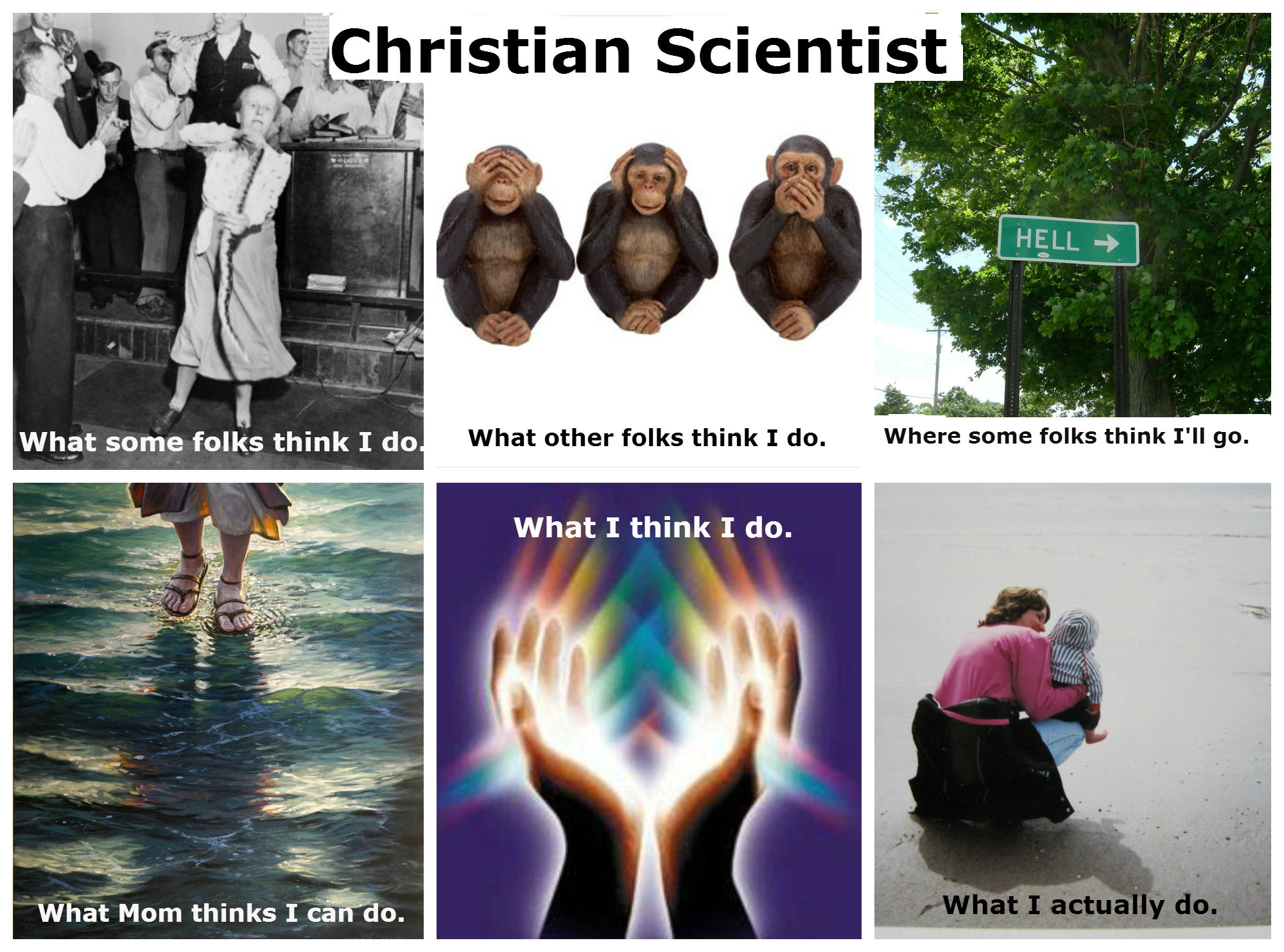
what people think I do


Mary Baker Eddy Had Chutzpah

        Millions of unprejudiced minds – simple seekers forTruth, weary wanderers, athirst in the desert – are waiting and watching for rest and drink. Give them a cup of cold water in Christ’s name, and never fear the consequences.
Mary Baker Eddy, from Science and Health with Key to the Scriptures

I’ve started reading Science and Health with Key to the Scriptures by Mary Baker Eddy again. This is probably the fourth time I’ve read this book. I get something different out of it each time I read it – I come upon lines that, for whatever reason, I never noticed before and that leap out at me and grab my attention. It’s like going on a treasure hunt.

This time what is jumping out at me is the sheer audacity – the unabashed chutzpah – of the book’s author. She doesn’t beat around the bush. She doesn’t try to sugar-coat what she believes to be Truth. She doesn’t write what she believes will make her popular. She doesn’t try to appease anyone else’s ego or try to make her book more palatable to the cynical or worldly. There is a kind of innocent, almost child-like, honesty in her words. I like her. She writes, “The author has not compromised conscience to suit  the general drift of thought, but has bluntly and honestly given the text of Truth.” And she ain’t kidding.

She first published Science and Health in 1875 – almost 140 years ago – and when you think about what the world was like in 1875 – what most religious folks believed at that time, what most scientists believed, what the common thought was regarding spiritual healing – I cannot help but admire the courage it must have taken to publish a book that pretty much went against most peoples’ most cherished beliefs. Her thoughts were progressive then, and they are still progressive today. She writes about atomic power, space travel, evolution, and what today might be classified as ideas found in quantum physics. She went against the common religious beliefs of her day with her thoughts on eternal damnation, heaven, an anthropomorphic god, the story of Adam and Eve, and atonement.

Regarding an anthropomorphic god, Eddy wrote: “The word anthropomorphic, in such a phrase as ‘an anthropomorphic God,’ is derived from two Greek words, signifying man and form, and may be defined as a mortally mental attempt to reduce Deity to corporeality. The life-giving quality of Mind is Spirit, not matter. The ideal man corresponds to creation, to intelligence, and to Truth. The ideal woman corresponds to Life and to Love. In divine Science, we have not as much authority for considering God masculine, as we have for considering Him feminine, for Love imparts the clearest idea of Deity.” (Holy shamoley! Can you imagine how well THAT passage must have flown in a society in which  women didn’t even have the right to vote, yet!)

Regarding heaven and the idea of God sending her children to a place of eternal damnation, Eddy wrote: “Heaven is not a locality, but a divine state of Mind…” and “It would be contrary to our highest ideas of God to suppose Him capable of first arranging law and causation so as to bring about certain evil results, and then punishing the helpless victims of His volition for doing what they could not avoid doing. Good is not, cannot be, the author of experimental sins.” (Even today you’ll find people in “civilized” countries who believe that God sends his own creation to a place of eternal, torturous “time-out” – can you imagine how Eddy’s ideas about heaven and hell must have been received by the general population 140 years ago?!)

Eddy several times referred to the story of Adam and Eve as an “allegory,” she wrote, for example: “In the Scriptural allegory of the material creation, Adam or error, which represents the erroneous theory of life and intelligence in matter, had the naming of all that was material.” (In 1875 the story of creation and Adam and Eve was interpreted as a literal happening by most Christians. Her thoughts about the book of Genesis might have been considered heresy by some. Actually, her interpretation of Genesis might still be considered heresy by some.)

And regarding the atonement and the belief that Jesus died for our sins, Eddy wrote: “ATONEMENT is the exemplification of man’s unity with God, whereby man reflects divine Truth, Life, and Love. Jesus of Nazareth taught and demonstrated man’s oneness with the Father, and for this we owe him endless homage. His mission was both individual and collective. He did life’s work aright not only in justice to himself, but in mercy to mortals,- to show them how to do theirs, but not to do it for them nor to relieve them of a single responsibility.”

Yeah. I am not at all surprised that there were – and still are – people who got all ruffled and riled up by her views. The close-minded, the arrogant, pompous, stodgy and self-righteous, were alive then, just as they are today. They can be found in every group (ahem, even, I am embarrassed to say, amongst those who call themselves “Christian Scientists”). But I don’t think Eddy was at all worried about what those people thought of her. She wrote her book for the other ones – the open-minded, the humble and the honest.

        In the spirit of Christ’s charity, as one who “hopeth all things, endureth all things,” and is joyful to bear consolation to the sorrowing and healing to the sick, she commits these pages to honest seekers for Truth.
– 
Mary Baker Eddy, from the preface to Science and Health with Key to the Scriptures

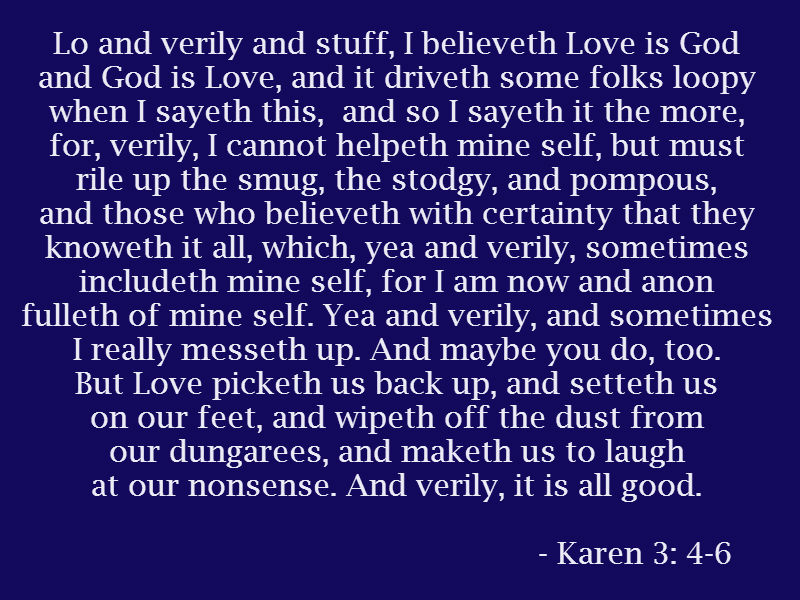
Lo and Verily and Stuff

Image

Lo and verily

(3rd Book) Introduction to The Madcap Christian Scientist: All Things New

(Introduction to The Madcap Christian Scientist: All Things New)

Vonnegut, Stevenson, and Adams Talking in My Head –

In the beginning, God created the earth, and he looked upon it in His cosmic loneliness. And God said, “Let Us make living creatures out of mud, so the mud can see what We have done.” And God created every living creature that now moveth, and one was man. Mud as man alone could speak. God leaned close as mud as man sat up, looked around, and spoke. Man blinked. “What is the purpose of all this?” he asked politely. “Everything must have a purpose?” asked God. “Certainly,” said man. “Then I leave it to you to think of one for all this,” said God. – Kurt Vonnegut

But our early man has a moment to reflect and he thinks to himself, “Well, this is an interesting world that I find myself in,” and then he asks himself a very treacherous question, a question that is totally meaningless and fallacious, but only comes about because of the nature of the sort of person he is, the sort of person he has evolved into, and the sort of person who has thrived because he thinks this particular way. Man the maker looks at his world and says, “So who made this, then?” Who made this? – you can see why it’s a treacherous question. Early man thinks , “Well, because there’s only one sort of being I know about who makes things, whoever made all this must therefore be a much bigger, much more powerful and necessarily invisible, one of me, and because I tend to be the strong one who does all the stuff, he’s probably male.” And so we have the idea of a God. Then, because when we make things, we do it with the intention of doing something with them, early man asks himself, “If he made it, what did he make it for?” – Douglas Adams

Beloved, let us love one another: for love is of God; and every one that loveth is born of God, and knoweth God. He that loveth not knoweth not God; for God is love… God is love; and he that dwelleth in love dwelleth in God, and God in him. I John 4

This year I’ve had the great good privilege of holding conversations with authors Douglas Adams (author of The Hitchhiker’s Guide to the Galaxy series), Kurt Vonnegut (author of Slaughterhouse Five and other equally amazing novels), and D.E. Stevenson (author of the Miss Buncle books). Okay, so I didn’t, like, actually talk to any of them in the person – seeing as how they’re all dead and everything, but I did have the great joy of reading their books for the first time this year, and sort of… well… talking to them in my head.

We all laughed together at the nonsense of life and humankind and ourselves, we chatted about God, and I found kinship with them in our similar views of “Life, the Universe, and Everything” (another of Adams’s books).

Adams and Vonnegut were atheists (I didn’t find any place in her writings where Stevenson actually voices her thoughts regarding a belief in God) and, although I do believe in God, I, too, am an atheist when it comes to an anthropomorphic god who lives in the clouds and zaps his children to hell periodically. I am of the opinion that THAT kind of a god should have long ago gone the way of Zeus and Mars and ridden off into the sunset on his fiery chariot never to be seen again except in the study of ancient cultures and literature.

I wish I would have found Adams, Vonnegut, and Stevenson earlier in my life. I can’t believe it took me so long. I’m sad that I didn’t get to know Adams – who was only five years older than me – when he was walking the earth. I’m sad that his sudden death at the age of 49 didn’t have the significance to me that it would have, had I known him then. I wish I would have understood , then , what his early departure meant to the world . And when I read his last book, The Salmon of Doubt – compiled in the year after his death by his friends and editors – I found myself sobbing when I got to the end of it – knowing there wouldn’t be any more. I felt like I had lost a good friend.

Kurt Vonnegut introduced his readers to the fictitious but way cool religion of Bokononism in his book, Cat’s Cradle, and I will be making periodic references to Bokononism in my book.

And D.E. Stevenson introduced me to the wonderfully enlightened and wise Miss Buncle, who’s brought me laughter and the comforting feeling that I am not alone as I pretend to be a grown-up.

I’m going to bring my new friends into this book with me. They are a part of my life now, and they need to be a part of this book, too.

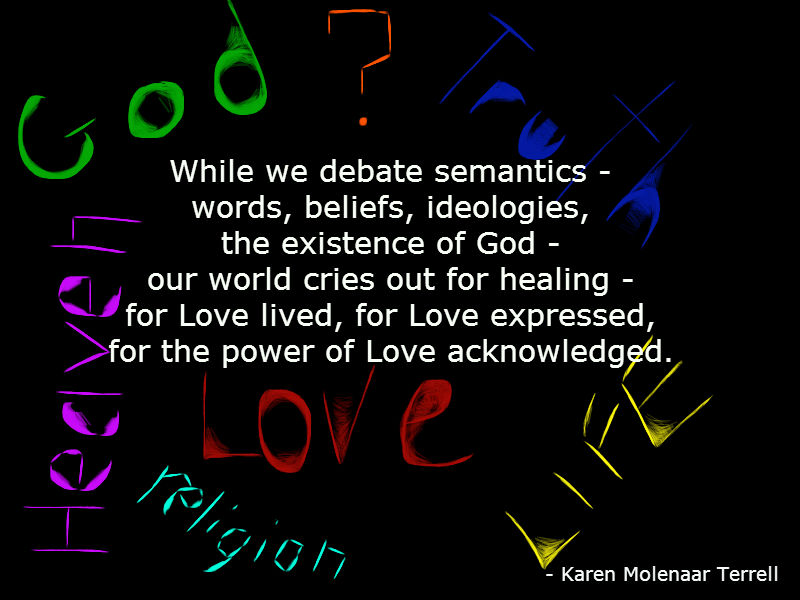
A Matter of Semantics

Image

semantics

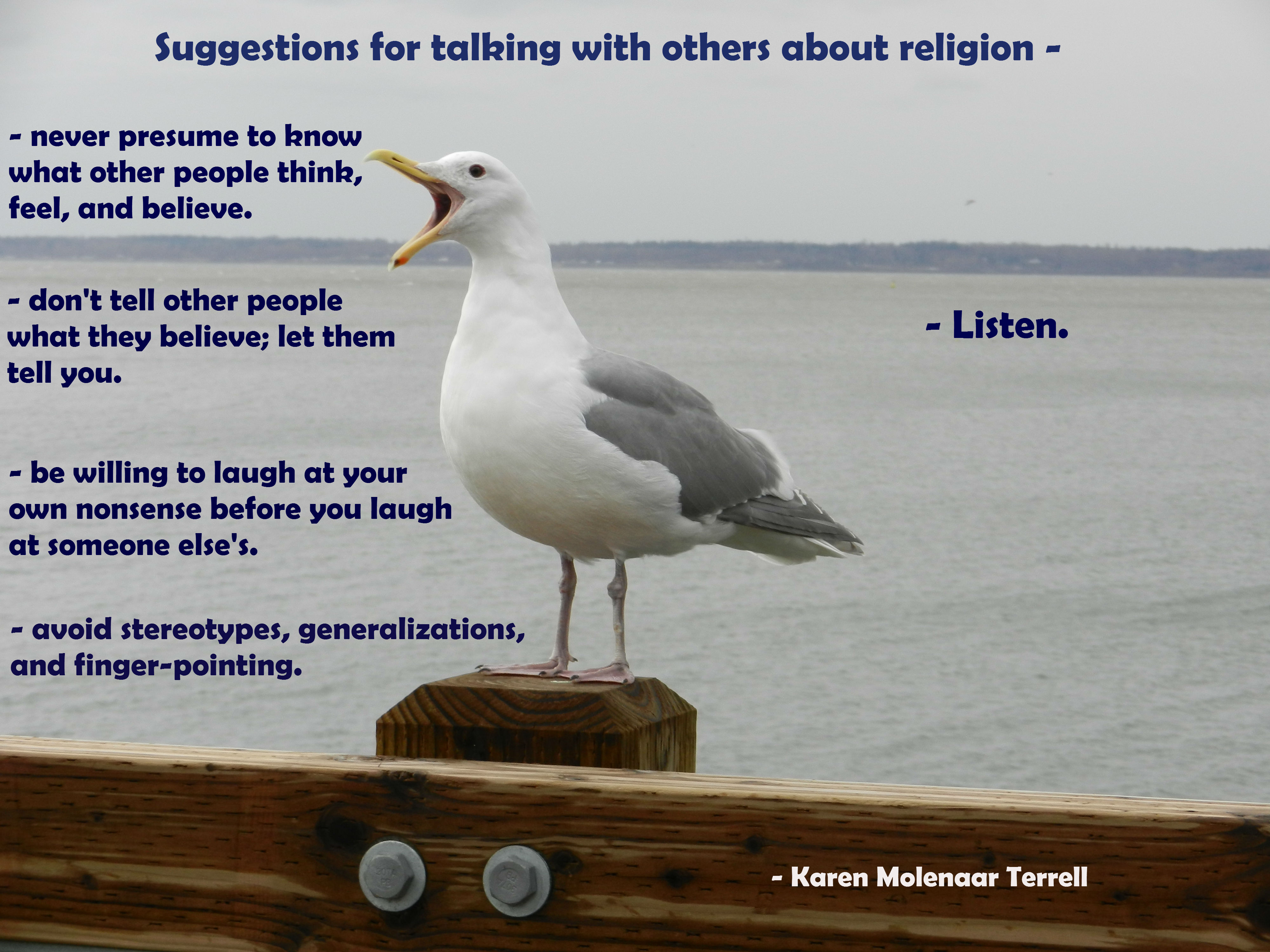
Suggestions for Talking About Religion

If I might offer a few suggestions for talking with others about religion? 🙂

suggestions for talking with

Questions About Religion

Just curious… 🙂

religion

photo of cannon at Fort Ticonderoga by Karen Molenaar Terrell


I Am My Own Flock

So then he says to her, he says, Oh yeah? Well, your flock is responsible for the Crusades, the Salem Witch Trials, and the Spanish Inquisition. And then she says, she says, Well, YOUR flock has Pol Pot and Stalin in it! And then they both accuse the other one of Hitler, and then they both alls of a sudden notice me sitting there, eating my clam, minding my own business,see? And they wanna know which flock I’m in, and I tells ’em, I tells ’em,all serious-like, I no longer feel the need to defend or explain any one else’s behavior or words, for I am my own flock. And I make sure to roll the “r” in “for”because that’s, like, really classy, right?…

he says she says

photo by Karen Molenaar Terrell