The Right for All Consenting Adults to Marry the Person They Love…

wedding photo

Scott and Karen on their wedding day, March 31, 1984 (photo by Bob Harbison)

Happiness is spiritual,born of Truth and Love. It is unselfish; therefore it cannot exist alone, but requires all mankind to share it. – from the chapter titled “Marriage” in Science and Health with Key to the Scriptures by Mary Baker Eddy

I believe that every citizen – regardless of race, ethnicity, social and economic status, religion, non-religion, gender, or sexual orientation – should have the exact same rights as every other citizen – including the right for consenting adults to marry whom they love.

This week my husband and I will celebrate our 31st anniversary.  Every year about this time I find myself thinking back to that happy day and the days leading up to it.

You know those shows you see on television where the bride spends HUGE amounts of time, thought, and bucks choosing just the right ring, dress, caterer, flowers, music, photographer, and reception venue  for her “big day” – those shows where every minute detail  of the wedding production is analyzed, critiqued, and judged for its merits on visual perfection? Where the ceremony is somber and refined and the highlight of the whole shebang is the dress the bride wears?

Yeah. That wasn’t us.

My engagement ring was a little garnet ring I picked out from a small jewelry shop in Pike Place Market in Seattle, and the man who sold it to us was cheerfully, flamboyantly, hilariously gay – he had us cracking up the minute we walked into his shop. My wedding dress was the first dress I tried on from the sales rack at our local Bon Marche. Cost me $120. Our minister was a hoot – we’d met with him for a required counseling session, and when he told us that anything he had to say to us would be pretty much useless at this point – because it’s really only AFTER the wedding that the bride and groom realize what they’ve gotten themselves into (we later learned that he’d just recently been divorced), we immediately recognized the man had a sense of humor, and he was, for sure, the minister we wanted officiating our nuptials. The wedding was a joyful, light-hearted affair in a small Methodist church in Gig Harbor – I remember the minister asking us if we really wanted to hold the service in his church – it was very small – could maybe hold 100 people – and very old (it’s since been torn down and a larger church built in a different location) – but, for our purposes, that little church was perfect – I liked the cozy smallness of it and the stained glass windows – and from the church’s steps we could look out across the water and see Mount Rainier rising above the hills in the distance.  The wedding itself was simple, joyful, and natural. We weren’t too concerned with “perfection” – we just wanted our guests to feel comfortable and loved. The reception was held in my parents’ backyard – with the sound of laughter, and the smell of daffodils and plum blossoms, filling the air. And we played volleyball in the pasture – the groom’s team won, but it was a close game.  The minister came to the reception, and fit right in with our hooligan families and friends. Before he left he told us that sometimes he’s really worried about the future of the newlyweds he marries – they often seem more concerned about the wedding than the actual marriage – but, after watching us yukking it up with our families and friends, he felt good about being a part of our ceremony.  He knew we were going to be alright. We knew how to laugh.

When I think about that day, I can’t imagine why anyone would want to deny other people the right to a wedding, and to a life-long commitment in marriage with the partner they love.  I can’t understand why any heterosexual couple would feel their own marriage is threatened by giving homosexuals the same rights that they have.  I feel a real yearning for other folks who love one another, and are brave enough to make a commitment to each other, to be allowed to have what my husband and I were allowed to have.

***

“Matrimony should never be entered into without a full recognition of its enduring obligations on both sides. There should be the most tender solicitude for each other’s happiness, and mutual attention and approbation should wait on all the years of married life… Kindred tastes, motives, and aspirations are necessary to the formation of a happy and permanent companionship… Marriage should improve the human species, becoming… a centre for the affections. This, however, in a majority of cases, is not its present tendency, and why? Because the education of the higher nature is neglected, and other considerations, – passion, frivolous amusements, personal adornment, display, and pride, – occupy thought… The scientific morale of marriage is spiritual unity… Marriage should signify a union of hearts… Behold the world’s lack of Christianity and the powerlessness of vows to make home happy, the human mind will at length demand a higher affection. There will ensue a fermentation over this as over many other reforms, until we get at last the clear straining of truth… Matrimony, which was once a fixed fact among us, must lose its present slippery footing, and man must find permanence and peace in a more spiritual adherence.”excerpts from the chapter titled “Marriage” in Science and Health with Key to the Scriptures by Mary Baker Eddy  

Memories from Lincoln City, Oregon

(originally posted in 2013)

The time to be happy is now. The place to be happy is here. – Robert Ingersoll, The Great Agnostic

Ocean is more ancient than the mountains, and freighted with the memories and dreams of Time. –  H.P. Lovecraft

I think it would be interesting if old people got anti-Alzheimer’s disease where they slowly began to recover other peoples’ memories. – George Carlin

My husband and I just returned from our most recent trip to Lincoln City, Oregon. We’ve been going there since 1984 – when we discovered the magic of Lincoln City  on our honeymoon.  We were trying to figure out how many times we’ve been there in the last 29 years, and we figured we’ve made a pilgrimage to Lincoln City probably 27 times – every year, with one or two exceptions.

You know how photographers do time lapse photography to show Nature unfolding in quick time? Yeah, I’m thinking if we took the days my family has spent in Lincoln City and sort of condensed them into a time lapse photography kind of deal, we’d see something like this…

There we are in 1984 – young, confident, and hopeful – starting our life together – unaware of the challenges ahead, and unaware of the blessings, either – running on the beach – limbs strong and quick and joints well-oiled. My aunt Junie showed me the art of agate-hunting when I was a youngster, and now I’m teaching my new husband how to pick up the glow of an agate on the beach – how to discern the difference between a bona fide agate and a rough piece of quartz…

1992:  Introducing our firstborn to the ocean for the first time. His baby body rests on my knee, facing out to the sea. His eyes have locked onto the ocean and taken note of it – he’s chewing his lower lip, eyes moving back and forth along the sea’s horizon, taking in the sights and sounds and smells. It’s becoming a part of him.

1994: We have come to Lincoln City as parents of childREN. We are old hands at parenthood now. Today it is our youngest son’s turn to meet the ocean. We take off his booties and lower his toes into the water. It is a sort of ritual baptism of baby feet – a bonding with the Pacific.

1999: The sons are playing with the surf – letting the waves chase them up the beach. The ocean is their comfortable old friend now.

Jump to April, 2008: I am in crisis.   Struggling with severe depression. I am desperate to escape from myself and my constantly-churning thoughts. Oldest son knows I need to get away and asks me if I’d like him to go to Lincoln City with me for Spring Break. How many 16 year-old sons do you know who’d be willing to accompany their moms on a 14-hour (round trip) road trip? I am blest beyond words. On the way to Lincoln City we stop and visit my Aunt Junie, who shares our kinship with the ocean and lives in Depoe Bay, an hour north of Lincoln City.  I confide my struggles to Junie, and the feelings of guilt and unworthiness that seem to be a symptom of my illness. Junie is appalled at my feelings of worthlessness. “All her instincts” tell her that I am a good person, she says.  “There are no unrightable wrongs, no unforgiveable sins, no fatal mistakes, no fatal diseases, only the eternal now.” She is like Yoda.

July, 2008: Still struggling with the  depression. Lincoln City is my respite. I sit on the balcony in the sun and look down on the beach and watch the sons running and cavorting on the sand below.  There have been times lately when I’ve wished myself not born. But, watching my sons, it hits me that if I hadn’t been born, they wouldn’t have been born, either. They give me purpose. And the ocean gives me comfort. We stop in Tilamook on the way home and I am drawn to a garden plaque that quotes The Great Agnostic, Robert Ingersoll: “The time to be happy is now. The place to be happy is here.” On impulse, I buy it. It will sit in a place of honor on our mantel when we return home.

2009:  The family meets on the Oregon coast to celebrate Aunt Junie’s life, and spread her ashes on the ocean.  We will not get as far as Lincoln City this time, but the ocean that she is now a part of will touch the beaches that have provided such solace to me over the years.  And every time I’m near the ocean, I’ll think of Junie – her humor and wisdom and kindness to me.

2010:  Hoping, but not with high expectations, I ask my youngest son, who’s just turned 16, if he’d like to make the same road trip that I made with his older brother two years ago. To my surprise and delight, he says he would! We spend two days at the ocean – flying a kite, looking for agates, running (well, okay, he’s doing most of the running now) along the beach.  Before we leave on our trip I ask Xander if he’s remembered his swimsuit, long pants, shorts, sweatshirt, sneakers, toothbrush, and sandals. He assures me he has. When we arrive at Lincoln City, I realize that am the one who’s left her clothes, laptop, and toothbrush back home. It is all very humbling. But there’s a certain freedom in the forgetting, too. I’m scraped down to the bare essentials. Having no laptop is a good thing.  I have become big into photography in the last couple years, and I have, at least, remembered my camera. Camera, son, ocean, and the clothes on my back – what else does a person really need? 🙂

2013: The sons are all grown-up now. They have jobs and things to do.  For the first time since we became parents, we will be making our Lincoln City pilgrimage alone.  We eat at our favorite eatery there – The Lighthouse Brew Pub – take long walks together, hunt for agates, and remember together who we were when we first found Lincoln City.  Young, strong, confident, hopeful. Our lives stretched out ahead of us.  And we think about all that’s happened in the 29 years since. And it’s all been good. All of it. Even the bad stuff has been good, really. Just like those blossoms unfolding in time lapse photography – our life together has unfolded most wonderfully.

Lesson from a Seagull and a Cormorant

Image

seagull and cormorant

photo by Karen Molenaar Terrell


If you wanted me to think like you…?

If you wanted to convince me that I should see the world in the same way you do, how would you go about doing that? Would you threaten me with hell? Try to out-shout me? Pummel me with your (carefully-chosen) *facts*? Do you think that showing hatred and bigotry towards people who don’t belong to your “team” might persuade me to view the world in the same way you do? Do you think you might so impress and humble me with your keen intelligence that I will want to be just like you?

Intelligence is an awesome tool and I respect people who use their intelligence to find ways to help make the world a safer, kinder, healthier place. Eloquence and wit and humor are all qualities I value highly – and I have great respect for people who use eloquence, wit, and humor to disarm and diffuse haters – on the other hand, I have little respect for those who use their wit to bully others and feed their own egos.

No, if your way of looking at the world doesn’t include love and kindness and generosity, it has – in my opinion – nothing of value to offer me. Facts are cool – I love learning new stuff – but if all you have to offer me are a bunch of facts – well, the internet is full of “facts” and accessible to all of us – I don’t need to convert to your way of viewing the world to get facts. You do not have a monopoly on facts.

Honestly, what attracts me to different perspectives is the kindness I feel from the people with those perspectives – the love I feel coming from them. That is something I recognize as useful to me. If you wanted me to convert to your view of the world – whatever that is – the best way to do that would be to show me the love and good will that come from your way of seeing things.

Of course, the people I MOST enjoy conversing with are those people who don’t have any interest in converting me, or showing off to their buddies, or feeding their egos – the people I most enjoy are the ones I can share with – the people who know how to shut up and listen every now and then, and have the courage to share their own views and insights without thinking their way of looking at the world is the ONLY way of looking at the world.

Love leads

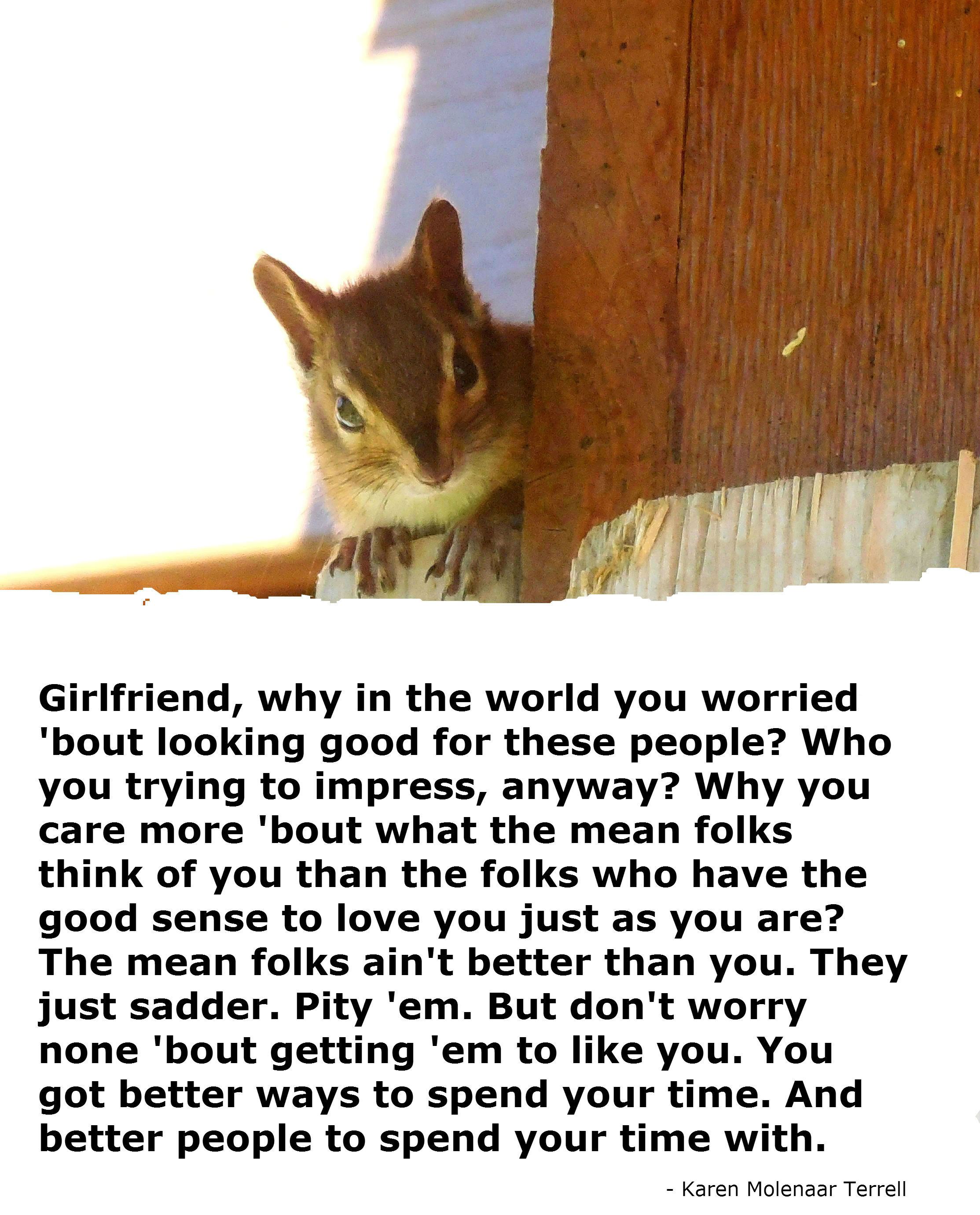
“Why you worried ’bout impressing these people?”

Image

impress

Seeing the Magic…

“And above all, watch with glittering eyes the whole world around you because the greatest secrets are always hidden in the most unlikely places. Those who don’t believe in magic will never find it.”
– Roald Dahl

“Of course there must be lots of Magic in the world,” he said wisely one day, “but people don’t know what it is like or how to make it. Perhaps the beginning is just to say nice things are going to happen until you make them happen.”
– Frances Hodgson Burnett, The Secret Garden

perfect day

photo of butterfly by Karen Molenaar Terrell

The Anger Pandemic and Its Antidote

Hold thought steadfastly to the enduring, the good, and the true, and you will bring these into your experience proportionably to their occupancy of your thoughts.”
– Mary Baker Eddy

I just watched a great video on YouTube (“This Video Will Make You Angry”) about the epidemic spread of anger thought-germs on the internet. This video got my “brain” sparking in all kinds of directions: I thought about some of the internet “conversations” I’ve gotten myself involved in the last several years; took a look at how internet dialogues have changed since I first began participating in them seven or eight years ago; compared some of the thoughts shared in the video with thoughts shared by Mary Baker Eddy back in the late 1800’s – long before the invention of the internet, but, I think, still pertinent today; and began looking around me for some good news – signs of hope and salvation from the anger pandemic that seems to be infecting the globe.

In the video, the narrator tells us: “Anger by-passes your mental immune system…The internet is the best thing to happen to thought-germs…The more they (anger-germs)  are shared they under-go the same process (as biological germs), changing and distorting to become more aggravating. These have a better chance of spreading than their possibly more accurate rivals.”

– Ohmygosh! I’m guessing we can all recognize the truth of those words! According to this video there are two emotions that are highly contagious to humans – anger and awe. Anger and awe are almost irresistible. When anger or awe go hopping by us we are like the dog in Up! and…squirrel!  – we have to look, right?

The narrator in the video continues: “Once everyone agrees (on something), it’s hard to keep talking (about it)… but if there’s an opposing thought-germ then the thinking doesn’t have to stop. The more visible an argument gets, the more by-standers it draws in – which makes it more visible. These thought germs aren’t competing, they’re cooperating… working together they reach more brains… Thought-germs on opposite sides of an argument can be symbiotic… its divisiveness also  grows its symbiotic partner… gaining more allies also gains more enemies… Though the participants think they’re involved in a fiery battle to the death, from the anger germ’s perspective one field is a field of flowers and the other a flock of butterflies… ”

– I suppose most of us would now agree that the earth is roundish. Can you remember the last time you got in an in-depth conversation about the roundishness of the planet? No, right? We don’t generally talk about stuff we all acknowledge as true. But I can guarantee that if there suddenly appeared a large group of people – not outliers, but a mainstream group – that rose up and declared the earth was flat, there’d be a hot fiery debate about it all over Facebook. Flat-earthers would be calling round-earthers arrogant and smug, round-earthers would be calling flat-earthers ignorant and stoopid, and the oblate-spheroid-earthers would be denouncing everyone but themselves as unrealistic fuzzy thinkers.

The narrator continues: “When opposing groups get big they don’t really argue with each other, they mostly argue with themselves about how angry the other group makes them… We can actually graph fights on the internet to see this in action – each becomes its own quasi-isolated internet – sharing thoughts about the other…each group breeds thought-germs about the other…the group almost can’t help but construct a totem of the other so enraging they’ll talk about it all the time…”

– And don’t we see this in politics ALL THE TIME?!! Republicans are this. Democrats are that. Socialists are the other. And don’t even get me started on the Libertarians. 🙂  We take a certain pride in our alliances and our loyalty to our team. And we insulate ourselves from other perspectives and hang out with our own group. We lump everyone who belongs to another group into one monolithic unit – no longer seeing individuals – and rant about the short-comings of everyone who isn’t “us.” In short, we become bigots.

The narrator ends the video with these thoughts: “It’s useful to be aware of how thoughts can use our emotions to spread… If you want to maintain a healthy brain it pays to be cautious of thoughts that have passed through a lot of brains… it’s your brain – be hygienic with it.”  

– And this brings me to the writings of Mary Baker Eddy. In her Miscellaneous Writings, Eddy writes: “Beloved Christian Scientists, keep your minds so filled with Truth and Love, that sin, disease, and death cannot enter them. It is plain that nothing can be added to the mind already full. There is no door through which evil can enter, and no space for evil to fill in a mind filled with goodness. Good thoughts are an impervious armor; clad therewith you are completely shielded from the attacks of error of every sort. And not only yourselves are safe, but all whom your thoughts rest upon are thereby benefited.”

And in Science and Health with Key to the Scriptures, Eddy writes: “The weapons of bigotry, ignorance, envy, fall before an honest heart.”

I have found this to be true. 🙂

 “We should remember that the world is wide; that there are a thousand million different human wills, opinions, ambitions, tastes, and loves; that each person has a different history, constitution, culture, character, from all the rest; that human life is the work, the play, the ceaseless action and reaction upon each other of these different atoms. Then, we should go forth into life with the smallest expectations, but with the largest patience; with a keen relish for and appreciation of everything beautiful, great, and good, but with a temper so genial that the friction of the world shall not wear upon our sensibilities; with an equanimity so settled that no passing breath nor accidental disturbance shall agitate or ruffle it; with a charity broad enough to cover the whole world’s evil, and sweet enough to neutralize what is bitter in it, – determined not to be offended when no wrong is meant, nor even when it is…” – Mary Baker Eddy

Who Am I?

Phrenology makes man knavish or honest according to the development of the cranium; but anatomy, physiology, phrenology, do not define the image of God, the real immortal man. 

– Mary Baker Eddy

Years ago a professional astrologer who found me “an interesting case” asked if she could do an astrological chart on me free of charge. When she reported back to me with her findings, she was sort of shaking her head and looking a little flummoxed. I guess I was not at all what the astrological chart indicated I should be (according to the chart I should have been like a computer – unemotional, unsentimental, incredibly brilliant – which… well, I’m sure my chart was right about the last bit there 🙂 ).  She knew I was a Christian Scientist and mused aloud, “Maybe it’s the Christian Science.”

Whenever I take personality tests, I always end up coming out of them sort of evenly spread out over everything. I’m some of this. I’m some of that. I may be one thing on one day, and another thing on the next. I’ve been INTJ and ENFP. I’ve been labeled an “explorer” and a “counselor”, been told I was serene and calm, energetic and passionate, bookish, physically active, out-going, introspective, solitary, friendly. creative, analytical, timid, and brave.

I don’t take any of that too seriously.

Like probably everyone else, I’ve sometimes found myself asking, “Who am I?” I’ve wondered about my identity and individuality and purpose. I’ve wondered what makes me unique and what makes me special – things probably most of us have thought about now and then. And, for me, the answers to those wonderings and questions have come to me through my study of Christian Science.

In the Christian Science textbook, Science and Health with Key to the Scriptures, Mary Baker Eddy gives this response to the question “What is man?” : “Man is not matter; he is not made up of brain, blood, bones, and other material elements. The Scriptures inform us that man is made in the image and likeness of God. Matter is not that likeness. The likeness of Spirit cannot be so unlike Spirit. Man is spiritual and perfect; and because he is spiritual and perfect, he must be so understood in Christian Science. Man is idea, the image, of Love; he is not physique. He is the compound idea of  God, including all right ideas; the generic term for  all that reflects God’s image and likeness; the conscious identity of being as found in Science, in which man is  the reflection of God, or Mind, and therefore is eternal; that which has no separate mind from God; that which has not a single quality underived from Deity; that which possesses no life, intelligence, nor creative power of his  own, but reflects spiritually all that belongs to his Maker.”

For a while I wondered (and worried) if being the expression of God, with all of God’s other expressions, meant that I was just like everyone else – that maybe we were like The Borg in the Star Trek series – with no individuality or uniqueness of our own. I mean, wouldn’t we all be beautiful and smart and talented in the exact same way, if we were expressions of one Mind? But at some point I realized that Mind has infinite expressions, infinite manifestations, and that all of Her creation is the reflection of that infinity. Eddy writes, “Through spiritual sense you can discern the heart of divinity, and thus begin to comprehend in Science the generic term man. Man is not absorbed in Deity, and man cannot lose his individuality, for he reflects eternal Life; nor is he an isolated, solitary idea, for he represents infinite Mind, the sum of all substance.”

Through discernment of the spiritual opposite of materiality, even the way through Christ, Truth, man will reopen with the key of divine Science the gates of Paradise which human beliefs have closed, and will find himself unfallen, upright, pure, and free, not needing to consult almanacs for the probabilities either of his life or of the weather, not needing to study brainology to learn how much of a man he is.
– Mary Baker Eddy

Absorbed in material selfhood we discern and reflect but faintly the substance of Life or Mind. The denial of material selfhood aids the discernment of man’s spiritual and eternal individuality…
– Mary Baker Eddy
Personality is not the individuality of man. A wicked man may have an attractive personality.
– Mary Baker Eddy

        Material personality is not realism; it is not the reflection or likeness of Spirit, the perfect God.
– Mary Baker Eddy
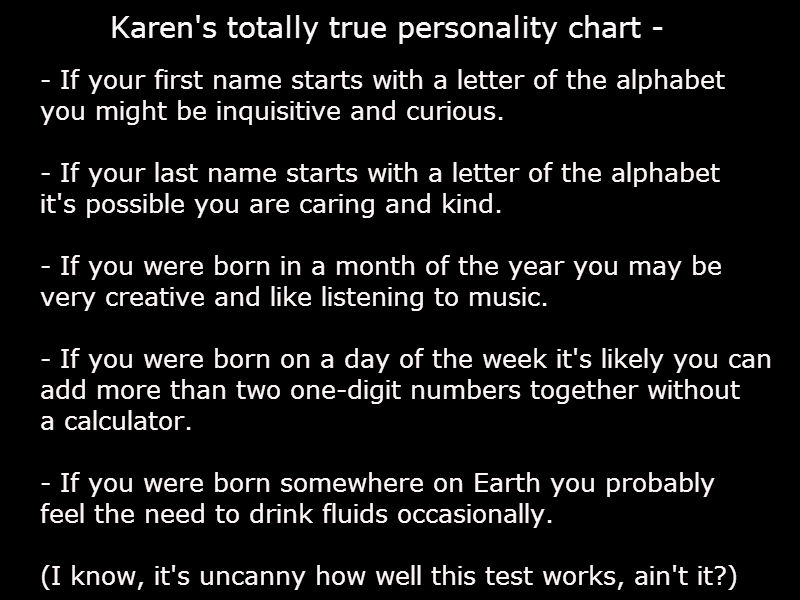
Personality chart

Listening

Image

Listening

Freckle Rose (1998-2015)

I scratch her behind her ears.
She gives a sweet little meow,
and puts her paw on top of my hand
one last time before she moves on…


My cat, Freckle Rose, passed on yesterday. She was almost 17. I guess we recognized she was dying for the last several weeks. There were decisions to make or not to make – should we take her to the vet and let him “put her to sleep” or should we let her die in her own home, in her own time, in her own way? She didn’t seem to be in pain (but who knows with cats, right?) and the last time I’d taken her to the vet she’d been really scared and unahppy – so I decided to keep her home and let her move on in her own way.

She stopped eating. Finally stopped drinking, too. I kept waking up every morning expecting to find she’d died in the night.

Yesterday morning when I went downstairs Scott said he’d found her lying on the floor next to a little stuffed animal that he thinks our dog maybe brought to her. Scott had put her on the couch. He told me he wasn’t sure if she was still with us. I went over to her. She didn’t seem to be moving. I started scratching behind her ears and she stretched – like cats do when they’re enjoying something. She meowed once – but not a grown-up cat meow – it was the same kind of meow she’d had when she was a little kitty – a sweet little meow. And she put her paw on my hand. I sang to her, and told her to look for my Aunt Junie – told her Junie would take care of her – and I told her to look for her mentor-cat, Paws. (She’d loved Paws. When she was still a youngster, she’d seen Paws get run over in front of our house, and had come running to the door to tell me – she’d led me to Paws in the same way that a dog would.)

After awhile I brought her outside into the sunshine – the birds were busy out there and the air was full of birdsong. Freckle meowed three times – really loud – kind of excited – and then her head dropped against my arm. I brought her back inside and laid her back on the couch. Her breaths became gasps with long spaces of nothing in between. I kept my hand on her body and could feel it still pulsing. And then I stopped feeling the life. Her eyes dilated. I think I knew when she was gone – but I’m not sure – it was a very gentle, gradual thing – no definite moment between life and death.

Scott had to go to work, but he said he’d help me bury her when he got home, if I wanted. But I wanted to bury Freckle while the sun was still out and the birds were still singing. So I went out to bury Freckle in my Secret Garden – I was going to do it by myself – I dug a hole and put her in it – but it wasn’t big enough and her little paws were sticking out of it. That was not going to work. So I found another place and started to dig, and then I turned around and my sons had come out to the garden to help me. They dug a nice deep hole for me, and we put Freckle in it and put a spring pansy in it on top of her, and covered her in the good earth.

I think of all Freckle Rose lived through with me. When I got her she was a feral little ball of fluff – only a month or two old. She’d shared most of her entire life with me, and a big chunk of my life: She’d been alive when my youngest had started kindergarten and been alive when he graduated high school; She’d been alive when we moved, and built our new house and moved again; She’d been alive on 9-11-2001;  She’d been alive when I’d lived through my life-changing depression, when I’d published my first book, and my second and third and fourth books; She’d been alive as I’d worked my way through my Master’s program; When my Aunt Junie had passed, Freckle Rose had been here; And when we’d acquired our rambunctious Labradane pup five years ago, Freckle had been alive and might have wondered what in the hell we were thinking. Freckle Rose had lived through a lot.

It’s weird to live in a world with no Freckle Rose.