Immortal Corporeality or Immortal Consciousness?

Life, Love, Truth, is the only proof of immortality.  Man in the likeness of God as revealed in Science cannot help being immortal.
– Mary Baker Eddy

A young friend was conversing with me about the strides science has made towards giving humans immortality. My friend told me that one path science is taking to find immortality is one that would keep the body alive and un-aging. The other path, he told me, is one that would somehow keep our consciousness alive.

A quick google search led me to this story:”At the recent Global Future 2045 International Congress held in Moscow, 31-year-old media mogul Dmitry Itskov told attendees how he plans to create exactly that kind of immortality, first by creating a robot controlled by the human brain, then by actually transplanting a human brain into a humanoid robot, and then by replacing the surgical transplant with a method for simply uploading a person’s consciousness into a surrogate ‘bot.He thinks he can get beyond the first phase–to transplanting a working brain into a robot–in just ten years, putting him on course to achieve his ultimate goal–human consciousness completely disembodied and placed within a holographic host–within 30 years time.”
http://www.popsci.com/technology/article/2012-03/achieving-immortality-russian-mogul-wants-begin-putting-human-brains-robots-and-soon

Another google search took me here: “”The discovery of Turritopsis, along with many other recent observations of longevity, suggests that science may help us find the fountain of youth. With a host of new biological techniques and the rigor of the scientific method, investigators at UC Berkeley and around the world are poised to take the human race closer to everlasting life than we’ve ever been before…”
http://berkeleysciencereview.com/artic…/chasing-immortality/

So I’ve been thinking about all this – about the scientific search for an immortal body and an immortal consciousness – thinking about which of these two scientific methods I’d prefer, if I had to choose, and thinking about immortality as it’s referenced in the textbook for Christian Science, Science and Health with Key to the Scriptures. 

If I had to make a choice between an immortal body and the disembodied immortal consciousness that is Itskov’s goal, I’d opt for Door Number Two. I don’t want to be carrying this corporeality around for eternity. It’s a lot of responsibility. It has to be hydrated, fed, clothed, cleaned – and society has certain aesthetic standards that we are expected to maintain. This body is a lot of work.

Door Number Two sounds kind of cool – but, again, our consciousness would be inside a holograph, and that sounds limiting. I kind of like the idea of not being contained in ANY form – of blending my consciousness in with a collective universal consciousness maybe. I’ve sometimes toyed with the idea that maybe that’s what “God” is – a collective consciousness of Good that we all maintain together.

I really like what Mary Baker Eddy has to say about immortality. She writes that, as ideas and expressions of God, we already ARE immortal. Love and Truth and Spirit are immortal – and she tells us that we are the reflections of Love and Truth and Spirit. Christian Science teaches that our immortality is based on a spiritual foundation, rather than a material one.

If we call the Christian Science idea of immortality Door Number Three, I’ll pick that one over the other two. The other two sound kind of complicated and convoluted and iffy. Both of them are depending on matter. I say let’s forego matter altogether – let’s just skip that part and claim the immortality we already possess and express – the immortality of Love and Truth.

Immortality, exempt from age or decay, has a glory of its own, – the radiance of Soul. Immortal men and women are models of spiritual sense, drawn by perfect Mind and reflecting those higher conceptions of loveliness which transcend all material sense.
– Mary Baker Eddy


Animal Kingdom Discussion Forum

Image

discussion forums

No Endings

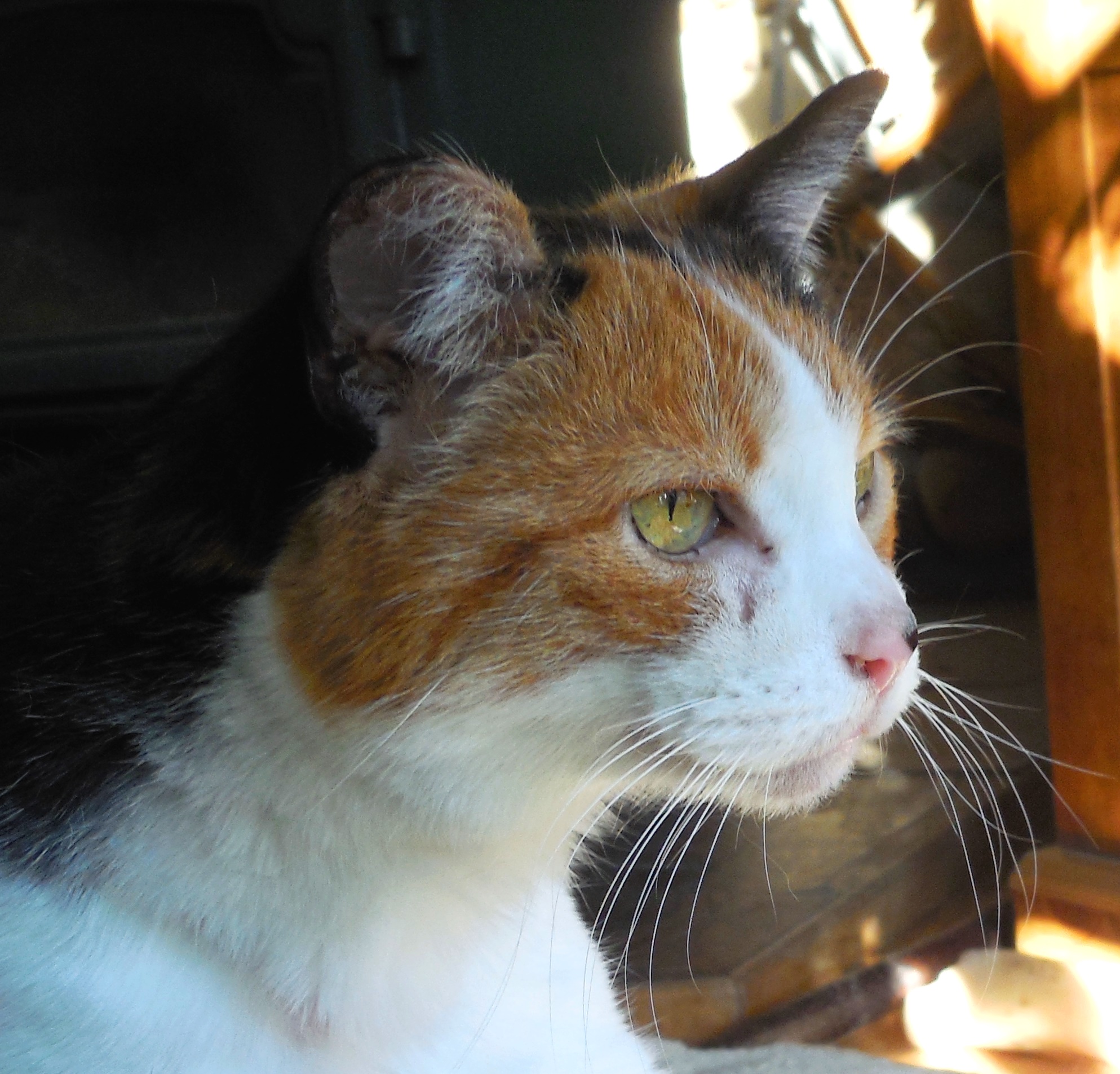
Sitting here with the calico cat on my lap – watching her ears twitch, feeling the breath going in and out of her warm body. She is 16. I’ve had her since she was a four-week old feral kitty – hissing and scratching and scared. I’ve shared almost all her life with her – from the beginning to today. She trusts me now – trusts me enough to jump into my lap and curl up there, and let herself be petted.

Now that she’s older I sometimes find myself thinking about that moment when my calico cat will no longer be with me. I think about death.

This year a lot of people I’ve known and cared for have died. November was especially challenging – a former student, a man who became my friend after he and his wife read one of my books, and a friend of mine from my walks in Bellingham all passed on.  Last week a dear woman in her 90’s with a kind heart, a stalwart faith, and a twinkle in her eyes – a woman who had been a member of our church most of her life – passed on. It’s all gotten me to thinking about the nature of death – what it is and what it isn’t.

The thought came to me the other day that death isn’t really an “event” – that there really aren’t any seams or borders or divisions separating one part of life from another – but that it’s forever flowing in an endless stream.  It’s true that I can’t see the friends that have passed on, but I can tell you there are times when I feel their love. Death can’t end the love we have for one another.

It probably seems weird to connect the insights I’ve had about death to the Superbowl – but that’s where my pointy little noggin went when I contemplated the end of the Seahawks season this morning. If only the game could have gone on a little longer, I thought, the Seahawks might still have been able to pull it off. “But it’s done. Over. Ended. It is what it is. And the magnificent catch by Kearse, the receptions by Matthews, the runs that Lynch made, the colossal efforts of Russell Wilson and his teammates – none of that matters now because they lost.”  Those were my initial thoughts. But when I stopped thinking about the Superbowl as an “Event” – when I started thinking of the game as just a step in an endless progression – a step towards progress – a character-builder – another life-lesson – my feeling about it changed.

I would like to think that all the lessons we’re learning here – the lessons about honesty, compassion, integrity, friendship, courage, perseverance, honor, selflessness, generosity, love – are lessons we can build on and carry with us as we ride the current down the stream. It doesn’t make sense to me that all of that learning can abruptly come to an end at the close of a Superbowl, or a life.

My calico cat is with me in this moment – alive and breathing – and this moment is forever.

??????????

Karen’s calico cat

The continual contemplation of existence as material and corporeal – as beginning and ending, and with birth, decay, and dissolution as its component  stages – hides the true and spiritual Life, and causes our standard to trail in the dust.
– Mary Baker Eddy


An Incident in a Discussion Forum (okay, this is me being cranky)

Asking people about their opinions is a very good way of making friends. Telling them about your own opinions can also work, but not always quite as well. – Douglas Adams

 She arrived in the middle of a discussion upon international politics. “Look at India,” one of the ladies was saying. “Yes, but look at Japan,” urged the other with intense vehemence. Barbara was introduced to the ladies, of course, but she never heard their names. They were already labeled, much more legibly in her retentive memory, as Mrs. Japan and Mrs. India. She was rather crushed at the farsightedness of the two ladies— what did they see when they looked at Japan and India like that? Did their bird’s-eye view take in the whole of these Asiatic countries at a glance? Were India and Japan open before their eyes like a child’s picture book? – D.E. Stevenson

The following was originally a chapter in The Madcap Christian Scientist: All Things New, but I took it out because the voice in this chapter doesn’t fit in with the rest of the book. In this chapter you see me being cranky and a little ticked off. It ain’t pretty…

Have you ever looked back on a period in your life and smiled with amusement and a certain amount of affection for the person you were? That’s how I feel when I look back on the person I was five years ago – during the period when I was spending a lot of my free time on a religion discussion board. I was cute, wasn’t I? – idealistic, naïve, really believing that everyone was on the discussion board for the same reason I was – to learn about other people’s beliefs, share their own, and exchange ideas and thoughts about religion, science, metaphysics, philosophy, literature, music, art.

I learned an awful lot from that discussion board – some of it was awesome, and some of it not so much. I learned there were a lot of people in the world with kind hearts and open minds and good humor. I also learned that there are an awful lot of people who want everyone else to think and believe exactly what they think and believe – and I learned that I wasn’t one of them.

I saw bigotry.

If there’s one thing that toasts my cookies it is bigotry.

At first I found myself mostly coming to the defense of the atheists on the discussion board, who, initially, seemed to be the major target of bigotry. They were told they were going to hell. They were told they were all lacking any kind of moral compass. They were compared to Pol Pot and Stalin. It was all ridiculous and hateful, and I could not let the bigotry slide by without responding to it.

Then for a time the bigotry seemed to be mostly directed towards the “believers”. Those who believe in God were called ignorant, uneducated, unintelligent, superstitious scaredy cats, and blamed for the murders committed during The Crusades, the Spanish Inquisition, and the Salem witch trials. Which… yeah… I’m sitting here now, just shaking my head, as I remember the nonsense.

There were a lot of generalizations made – every atheist was lumped together into one group – as if they all believed, felt, and thought the same about everything; and every Christian was lumped together into another monolithic group. Finger-pointing and blame-laying was rampant. As a Christian Scientist, I was told by many of the Christians that I was going to hell because I didn’t believe in hell, or in a devil, or that Jesus was God. And as someone who identified as a Christian, a number of atheists seemed inclined to assume I held the same beliefs about God that they had learned when they were youngsters attending Christian Sunday Schools – and then judged me for the beliefs that they wrongly attributed to me.

It could all be a little exasperating.

For the first few years the humor, friendship, and intellectual stimulation I got from the discussion forum outweighed the exasperation. I met some really good friends there – people I still continue to call my friends – people who became familiar with my spiritual perspective about life in a way that many of my offline friends never did.

But after several years my interest in the discussion board began to wane. More and more I found myself in these weird dialogues with people who presumed to know what was in my head and heart without giving me the opportunity to tell them myself. More and more I found myself in the unsatisfying position of being treated like a student whose job it was to quietly sit and listen while others threw their great wisdom and knowledge at me. I found myself getting lectured to and preached at a lot, and I do not particularly enjoy being the target of lectures and preaching. Dialogues became one-sided monologues; the exchange of ideas turned into a one-way sermon – people telling me what I should believe, think, and feel, and then getting really agitated with me if I dared to question or voice a thought of my own.

The Grand Finale – the defining moment when I realized I no longer had any interest in serious participation on the discussion board – came for me on a thread titled “Repeal the child abuse for Christian Scientists in Washington State law”. For four pages (100 posts) I read comments, written by my friends (people whose atheism or Christianity I had defended time and again on the forum) about the lunatic Christian Scientists who are “neither Christian nor scientists” (pretty original, right?). For four pages I read comments from people attacking a “strawman” – indignantly pontificating on how wrong it is to legally allow Christian Scientists to abuse their children – when there never was a law or lobby that supported child abuse by Christian Scientists. And then I saw where one of my forum friends had written this: “I just took issue with the thought that the faith healers could be unaware that their ‘healings’ have zero positive effect… I think the fact that the alleged Christian Science lobby feels the need to protect themselves from prosecution tells me that they must know the reality of their faith… He seems to be saying that Christian Scientists aren’t True Christians. The Christian Science people seem to think they are Christians, based on my scanty reading of what they believe.”

SCANTY READING?!!! Oh, for Pete’s sake! I’d been sharing my experiences as a Christian Scientist on that forum for almost seven years – shared wonderful healings I’d had in Christian Science, shared my thoughts about “Christianity” – but my friend hadn’t, apparently, learned anything about my way of life or beliefs from what I’d written on there. It came to me, then, that the only reason some of these people had ever considered me their friend was because I had been a good audience – willing to listen to THEM – but that they hadn’t really been interested in anything I’d had to say.

I wrote a response:

Christian Scientist from Washington State here. I’m sure you are all completely right about me. I mean, you must be, right? I should be, like, locked-up for the good of society. Interned in a camp maybe. I should never have been allowed to marry – and certainly not to a nice, decent liberal man raised by his decent God-loving Methodist parents. I should never have been allowed to have children, and certainly never been allowed to raise them – it’s a miracle that they survived to adulthood and turned out to be such intelligent, healthy, whole, well-adjusted young men, considering their mom was a Christian Scientist. I should not be allowed to share in the rights of citizenship of this land – it’s far too good for the likes of me. I should certainly never have been allowed to vote – and never been allowed to participate in the democratic process. I should never have been allowed to be elected delegate to our state Democratic convention, and should never have been allowed to write letters and donate in support of environmental causes, the ACLU, gay rights, Habitat for Humanity, atheists, Amnesty International, and yes, universal health care (I don’t believe anyone should be denied the health care they feel they need just because they’re poor – health care should be considered a basic human right). I am, of course, just a cardboard cutout of a person – like every other Christian Scientist in the world.

As you know – seeing as how I’ve been on here for ALMOST SEVEN YEARS sharing my beliefs, thoughts, and feelings with you – I am a despicable, ignorant, uneducated, illiterate human being. I should probably be lined up with my fellow CSists against a wall and shot, as was once suggested on a local talk show.

Am I Christian? Nope, probably not (according to the current accepted definition of a “Christian”). Like my fellow CSists, I do not believe Jesus was god. Do not believe in a literal place of hell or heaven. Do not believe in Original Sin. Do not believe the story of Adam and Eve should be taken literally. Do not believe the world was, literally, created in seven days and seven nights. Do not believe in creationism. Do not believe dinosaurs and humans roamed the world at the same time. And, like those familiar with quantum physics, I DO believe matter is pretty much nothing . So shoot me.

My children , by the way, were vaccinated (edit: the topic of vaccinations is probably worth a whole ‘nother blog post), and were taken by me to doctors, when the need arose – which wasn’t often – they were mostly healthy. They also were raised by their parents – as I was raised by mine – to not be quick to make judgments on others, to try to approach the world without bigotry, and to question political and religious dogma, and those in authority (including the medical profession – you do all know that traditional medical practice is the third-leading cause of death in this country according to the JAMA, right? – it shouldn’t be surprising that thinking people might sometimes look for alternatives to it).

Okay. I’m pretty much done here. I’ve been yammering away on this forum for seven years. And apparently no one was listening.

Karen

Weirdly, I got nine out of ten “yes” votes for that post. 🙂 Most gratifying personally, though, was the response that came right after my post from my atheist friend, Conley. I think when I first came onto the forum Conley had had some pre-conceived notions about me as a Christian Scientist, but, like any true critical thinker, Conley had listened and observed and been willing to learn and shift his thinking. I liked and respected him. Following my post, Conley wrote: “Damned well said, Karen. And I was happy to note that you listed about half my favorite causes–which is what I’d have guessed of you. Best regards. -Conley”

I guess it’s because of people like Conley that I still sometimes pop in on the discussion forum. As for the “others” – the close-minded, arrogant, sermonizing, judgmental know-it-alls from the right and the left, the up and the down – both religious and non-religious –  who don’t really want to hear what other people have to say – I guess I just feel really bad for them. They are missing out, ain’t they?

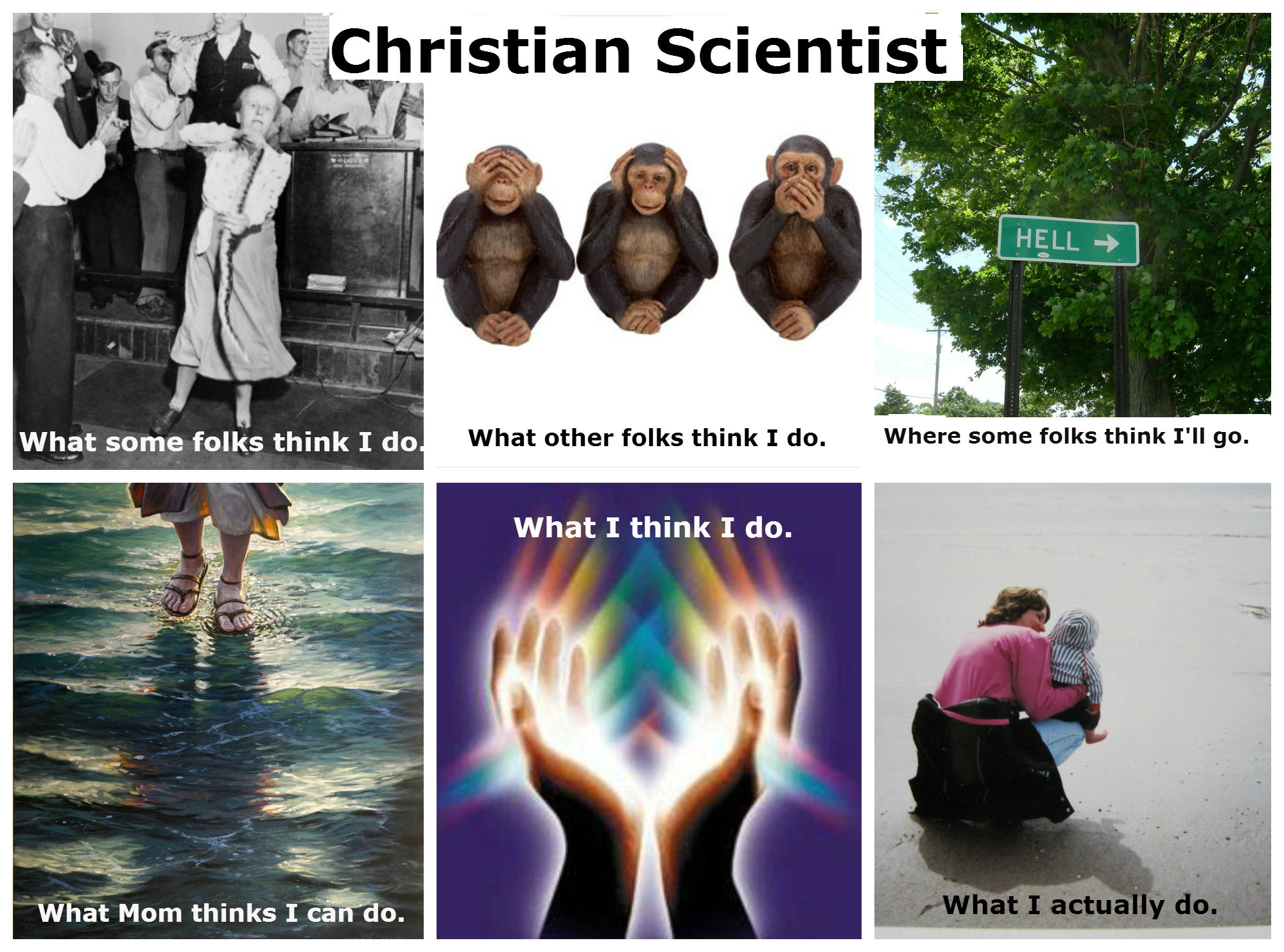
what people think I do


What It Means to be a Teacher

What it means to be a teacher… 🙂

Karen Molenaar Terrell's avatarThe Rambling Schoolmarm

teacher

View original post

Happy for the Fun of It

Happy for the fun of it…:)

happy for the fun

I love this clip of a happy penguin that came through Facebook today – there he is, hopping around in the snow while the grown-ups stand there watching him. No one else is joining him in his frolic – but he doesn’t care if he’s hopping around alone. He doesn’t need any reason to be happy. He doesn’t need others to be happy with him.  He’s just happy for the sheer fun of it…


Reality and Simulation

(Author’s note: This is one of those posts that I hesitate to publish. It’s… well it’s my “pondering stuff” voice, I guess.  But what the hell, right? What’s the worst thing that can happen here? No one reads it? P’shaw! I ain’t ascared. of having no audience for this one. In fact, that might be a good thing. 🙂 )

“Simulation is the imitation of the operation of a real-world process or system over time… Historically, simulations used in different fields developed largely independently, but 20th century studies of systems theory and cybernetics combined with spreading use of computers across all those fields have led to some unification and a more systematic view of the concept… Simulation is extensively used for educational purposes… Virtual simulations represent a specific category of simulation that utilizes simulation equipment to create a simulated world for the user. Virtual simulations allow users to interact with a virtual world.” – http://en.wikipedia.org/wiki/Simulation

I’m reading Mary Baker Eddy’s Science and Health with Key to the Scriptures again. Every time I read this book I notice things I never noticed before. This time one of the things that has popped out at me is Eddy’s use of the word “simulate”. I probably didn’t notice this word the first time I read Science and Health – back in 1980 or so – because it wasn’t as commonly used as it is today. I wouldn’t have been able to relate it to anything in my own experience back then.

Eddy seems to have, once again, made a leap into the future with her use of the word “simulate” in Science and Health. Though her book was first published in 1875 – almost a century and a half ago – it makes mention of space travel, atomic power, and what today might be called quantum physics. So I probably shouldn’t have been surprised when I came upon the word “simulate”.

Contrasting  the creation of Adam in the second chapter of Genesis with the creation described in the first chapter, Eddy writes: “Beginning creation with darkness instead of light, – materially rather than spiritually, – error now simulates the work of Truth, mocking Love and declaring what things error has done.” She writes, “Close your eyes, and you may dream that you see a  flower, – that you touch and smell it. Thus you learn that the flower is a product of the so-called mind, a formation of thought rather than of matter. Close your eyes again, and you may see landscapes, men, and women. Thus you learn that these also are images, which mortal mind holds and evolves and which simulate mind, life, and intelligence.” A little further into Science and Health, and the author writes, “When we put off the false sense for the true, and see that sin and mortality have neither Principle nor permanency, we shall learn that sin and mortality are without actual origin or rightful existence. They are native nothingness, out of which error would simulate creation through a man formed from dust… Sin, sickness, and death are comprised in human material belief… They have neither Principle nor permanence, but belong, with all that is material and temporal, to the nothingness of error, which simulates the creations of Truth.”

It has been very helpful to me to see material existence as just a simulation – maybe one of those training simulators – providing me with the opportunity to practice separating the true from the false, to practice recognizing the real and eternal, and to practice translating all the good and beautiful we see represented  in the “simulator” back into its spiritual form.

“Nature voices natural, spiritual law and divine Love, but human belief misinterprets nature. Arctic regions, sunny tropics, giant hills, winged winds, mighty billows, verdant vales, festive flowers, and glorious heavens, – all point to Mind, the spiritual  intelligence they reflect. The floral apostles are hieroglyphs of Deity.” – Mary Baker Eddy

“I Prefer to Sing a Song”

Now I’ve been cryin’ lately,
Thinkin’ about the world as it is.
Why must we go on hating?
Why can’t we live in bliss?
– Cat Stevens, Peace Train

This morning I was looking on YouTube for that wonderful old Cat Stevens song, Peace Train, and stumbled upon a documentary of the songwriter that I found really thought-provoking. I’d known Cat Stevens had converted to the Islam religion many years ago, but I hadn’t really known much about Yusuf Islam’s (Cat Stevens’s) spiritual life beyond that. I’d heard rumors that he had supported the fatwa against Salman Rushdie, and I remember reading about Yusuf Islam  being suspected of terrorism and detained at an American airport when trying to enter the U.S. a decade ago. But the music he’d given us as Cat Stevens in the 70’s didn’t correlate in my mind with terrorism and religious extremism – it did not compute – so I’d just pretty much ignored all the rumors and kept the old Cat Stevens and his music alive and well in my thoughts. Basically, I took what was useful to me – what touched me and inspired me in his music – and ignored the other stuff.

Then this morning, as I was looking for Peace Train, I found a 51-minute documentary on Yusuf Islam’s life. Fifty-one minutes. In internet time, where we are used to bits and pieces and snatches and soundbites, 51 minutes is a LOT of minutes to invest on one YouTube clip, right? But I was interested enough that I figured I would go ahead and start the clip for myself and when I got bored I’d just turn it off and go on to something else.

I pushed “play” and began to watch the documentary. Before I knew it I was already 35 minutes into it, then 40, and then it was done! And I found the entire 51 minutes fascinating! So interesting, in fact, that I started scribbling down quotes for myself, to remember later.

The documentary addresses Cat Stevens’s career as a musician, his conversion to the Islam religion and changing his name to “Yusuf Islam”, the Salman Rushdie fatwa, and Yusuf Islam’s detention for suspected terrorism. Through the entire documentary Yusuf Islam comes across, to me, as sincere and genuine, intelligent and well-spoken. He says he never supported the fatwa against Rushdie and I believe him – I figure he doesn’t have a whole lot to gain by denying his support for the fatwa, and he might actually be risking a fatwa on his own life by saying he doesn’t support the fatwa on Rushdie’s. He claims he’s never been a part of any extremist Muslim terrorist activities, and, again, I believe him – from my own observation, terrorists (whether Muslim or otherwise) seem to be pretty proud of their terrorist activities and don’t spend their time denying what they’ve done. And when, in the documentary, we see Yusuf Islam addressing a gathering of Muslim leaders he’s not inciting fanatical extremism, but is telling them, instead: “We need inspired leadership to guide us back to the elevated path of wisdom and away from the temple of politics and ignorance.”

As someone who identifies as a Christian Scientist, I have now and then felt the sting of prejudice that comes from ignorance and fear. Maybe that’s why I’m able to feel some empathy for Yusuf Islam. In the documentary he puts it like this: “I was being painted in the same colors as all this often kind of political stuff.”

Islam says, “There’s certainly a change in the wind… There’s a chance for a new understanding of the moderate middle path of Islam because the extremes have been exposed. A lot of people have missed the whole point – including some Muslims who have gone off on their own strategy of trying to improve the world through some kind of devious means.”

I, for one, am glad that Cat Stevens converted to Islam. He believes he was led by God to do so. I believe God, Love, leads us all down our own unique path – and I believe every path leads to Love, in the end. Maybe every religion and non-religion needs adherents with reasonable voices – voices that speak of peace. Maybe the Islam religion needs the voice of Yusuf Islam speaking and singing for it and helping lead the way towards Love.

“I don’t really want to get involved in politics,” Yusuf Islam says, “I prefer to sing a song.”

Now, I’ve been happy lately,
Thinkin’ about the good things to come
And I believe it could be;
Something good has begun.
Cat Stevens, Peace Train

Of all Cat Stevens’s songs Peace Train is the one that has most inspired me. Here’s the Youtube clip for Peace Train that I was looking for this morning:

And here’s a link to the documentary:

I bet Grizwald never took down his Christmas lights…

Karen Molenaar Terrell's avatarhumoristianity

We are now in our after-Christmas mode, and I’m wondering – how long are people allowed to keep up their Christmas lights before it’s considered tacky? I’m only asking because… well… I kind of like my Christmas lights. Also, it’s going to take a lot of time and effort to get those suckers down.

It occurred to me yesterday, as I contemplated our own Christmas lights, that Christmas Vacation never actually shows Grizwald removing the Christmas lights from his house.

I don’t think this was an oversight on the movie director’s part.

In fact, I think the fact that we never see Grizwald taking down his lights makes room for a nice sequel to the movie – because surely a full-length movie could be made just about taking down those lights. This one could star Grizwald’s neighbors  – the yuppy couple that lived next door – and their efforts to…

View original post 174 more words

O Christmas Tree!

I took down the Christmas tree today – removed layers of ribbon, gauze, sparkle, and nostalgia.  The sparkle and gauze are easy to take off. But taking down the sons’ grade school popsickle creations, the ornaments my students have given me through the years, and the Christmas tree decorations that we bought on family trips and adventures – those are harder for me to wrap up and stow away for another year.

Our tree was really beautiful this year – a Turkish fir that we cut down at the local tree farm. On the day we cut it down, I promised that little tree that I would plant the seeds from its one cone and try to nurture its offspring. into fine sturdy evergreens.  I planted the seeds in a pot a few days later. I tried to find information on the best way to plant Turkish fir seeds, but couldn’t find anything.  I’m really hoping I’ll see little seedlings sprouting up next spring, though.

Years ago, when one of our sons was maybe six or seven, he started crying when we cut down a tree for Christmas. He was really angry that we’d cut down a perfectly fine tree for no other reason than to drag it into our house and decorate it.  We saw his point, and for a few years bought living trees in pots that we later replanted in the backyard. The problem with that, though, was that the living trees were always pretty small, and we had to make sure they didn’t dry out in the house. After the living trees we put up an an artificial tree for a few years. What was cool about the artificial tree was that we could bend its wire branches to keep the ornaments on it. But… well… it was a fake tree. It didn’t smell like an evergreen – it smelled like fire repellent. It didn’t bring life into the house, it brought man-made chemicals.  After we’d had it a few years, it was looking pretty tattered and bedraggled, and the husband and I decided it was time to go back to real trees.

Our annual sacrificial evergreen always has a place of honor in the house. We decorate it and make it sparkle, and appreciate the beauty it brings into our home.

And this year I’m going to do what I can to keep our Turkish fir’s offspring growing. It’s the least I can do, right?

christmas tree 2015