“I was surprised by how painless it was…”

When I got to Dad’s place I learned a friend had just sent him the obituary for author Ruth Kirk. Ruth had been a dear friend of Dad’s and Dad had tears in his eyes when I arrived to visit with him. He was having a hard time of it. He’d told the care-giver that he’d illustrated some of Ruth’s books, and the care-giver had tried to find one of Ruth’s books on Dad’s bookshelves – but hadn’t been able to find one – so, instead, she’d pulled out Dad’s book, The Challenge of Rainier and they were looking through Dad’s illustrations in his book when I got there.

His care-giver made room for me to sit next to Dad so we could talk. Dad shared how sad he was about losing his friend, Ruth. I told him that this had been a rough year, and we talked about other friends he’d lost. He said at this point whenever he gets a card in the mail he expects to find an obituary for one of his friends inside it.

Some people he remembered were gone – climber Fred Beckey, and his brother, K (although he thought K had just passed away a couple years ago, when actually he’s been gone since 1994). He was surprised to learn that other friends were gone – “I wondered why I hadn’t heard from them,” he said. I think he was wondering why no one had told him about his friends’ passing – so I let him know that we’d shared these passages with him, but that he’d forgotten. I suggested that maybe he forgot because it was too traumatic for him to process – and I told him that would be understandable. He seemed to accept this.

I always follow my intuition in these conversations – sometimes I don’t bring up Mom’s passing, and sometimes – like today – it seems the right time to talk about it. I know talking about Mom’s passing is very hard for him – but… there are times when I think it’s helpful to him, too. So I held his hand and shared with him, again, Mom’s last week with us – I told him that he’d been able to say good bye to her in the hospital before they brought her to my home; told him she’d died peacefully in her sleep while I slept on the couch next to her; told him I felt her presence brush passed me as she left – I felt her love and joy. I told him that she’d loved him very much – that she still loves him – and that we’d promised her we’d take care of him. Dad nodded and wept quietly.

I observed that when you live to be 100 you lose a lot of people along the way. “But fortunately,” I said, “you have a lot of friends who are younger than you.” He smiled and nodded.

I asked him if he’d ever expected to live to be 100. He said he’d never thought about it.

Then – “Is it time for a drive?” he asked, hopefully. So his care-givers helped me get him ready – got him in his sweater, put shoes on his feet – and I put his alpine hat on his head – and we loaded him up in my car. I asked him if he’d like me to take him for a root beer float, and he nodded his head.

On the drive to the Sisters Espresso…
Dad: I’ve been thinking this week that I needed to get out of here and get back home to Mom. But now I realize she’s gone.
Karen: Yeah. That place where you’re living is your home now.

As we turn onto old Hwy 99…
Dad: Now we’re heading north. Parallel to the Pacific coast.
Karen: Yup.
Dad: How are the boys?
Karen: They’re both graduated from university now.
Dad: (taking this in) Time goes fast. I was in school a lot longer than them. Or… that’s how it feels, anyway.

As we turn onto Chuckanut Drive…
Dad: Last month when I thought I was dying I was surprised by how painless it was. It’s just getting sleepy…
Karen: You thought you were dying last month?
Dad: What?
Karen: (louder) You thought you were dying last month?
Dad: What? I can’t hear you. Let’s talk when we get to where we’re going.

I pull into the Sisters Espresso…
Dad: (smiling) I remember this place!
Karen: (turning off the car and speaking into Dad’s ear) Did you think you were dying last month?
Dad: I dreamed I was. I was surprised by how painless it was. It was just like going to sleep.
Karen: Do you feel like you’re dying now?
Dad: No. I’m good.
Karen: Good!

I get him his root beer float and hand it to him. He thanks me and begins drinking it. I head the car back to his home. As we pass a field bursting with little yellow flowers (maybe mustard seed flowers?)…
Karen: I love you, Daddy. (I’m not sure he can hear me, but I feel the need to say it.)
Dad: (turning to me) And I love you!

We pull into the driveway and next to the front door, and I help Dad get out of the car and up the stairs. The care-giver helps him get situated in the living room in Mom’s old chair.
Karen: I love you, Daddy.
Dad: I love you! Thank you!
Karen: Thank YOU!

They Got You Through the Winter

They got you through the winter, Karen
They got you through the grey, the rain, the cold
They got you through dreary days and showed
you beauty in the muck, grace in the mud
And now it’s just dawning on you that they’re gone
they’ve left your valley, returned to their summer
homes. As the fruit blossoms bloom and bud
and the earth grows green again with new life
and you celebrate the joys of spring, there’s a part
of you still feels a little the loss of them. But they’ll
return when the nights grow long again, when
the earth freezes and hardens and loses color
They’ll get you through the winter, Karen.
– Karen Molenaar Terrell

Snow geese and trumpeter swans in Skagit County, Washington. Photos by Karen Molenaaar Terrell.

Epic Afternoon

Epic afternoon. Dad (Dee Molenaar, aged 99 and 10/12) was visited by three of his old mountaineering buddies – Tom Hornbein, Jim Wickwire, and Bill Sumner – extraordinary climbers all. Dad arm-wrestled Tom (Tom and Willi Unsoeld were the first men to ascend Everest from the West ridge), looked at a K2 book with Jim (Jim and Louis Reichardt were the first Americans to ascend K2), and had a good laugh with Bill (who was a member of the expedition that included the first one-legged person to reach the top of Denali). They talked about old friends, old climbs, and the Mountaineers Lifetime Achievement Award Tom is going to receive tonight. (Tom picked up the award for Dad last spring when Dad was in the hospital, and says that helped him prepare for accepting his own award tonight.)

Watching these old pals reunite – men who have shared adventures together that most people probably can’t even imagine – men who are living pieces of history – brought tears to my eyes. What a privilege to be there with them…


What a Miracle to Be

What a miracle to wake and discover the planet’s still here
we’re still alive
and there’s still opportunity to do some good in the world
to make a difference
to change course
to sing
to write
to create
to be kind
to find beauty
to laugh
to learn
to love
to be.

To reflect the beauty of Love…
Karen Molenaar Terrell

Flipped Tulip Reflection

Flipped tulip reflection. Skagit County, Washington. Photo by Karen Molenaar Terrell.

“…Love is reflected in love.”
– Mary Baker Eddy


Day 446

We’re 446 days in. I’m starting to feel a little detached –
like a spectator watching a farce unfold on a stage – a show –
as if this has nothing to do with me or my world.
And the tragicomedy unfolds in front of us now –
simultaneously pitiful and horrifying and maddening
and over-the-top wacky – Dr. Strangelove on ergo-
genic acids. The audience makes its predictions about
what will  happen next. What new woe will he sow?
Will he fire more people? Will he put himself above the law?
Will he start World War III? Will our debt continue to grow?
Will our environment go down the toilet? Will we lose
our social security? Will he twitter us some new foe?
“He certainly believes he has the power to do so.”
And the audience waits with ‘bated breath to see
what will happen next in our very own unreality expo.
A train wreck in slow motion. Slim Pickens riding
the bomb in Earth’s last rodeo.
Once we had the chance to save our planet.
But we let it go.
– Karen Molenaar Terrell


“…keep moving forward.”

On the 50th anniversary of Martin Luther King, Jr.’s assassination:

“Free at last, Free at last, Thank God almighty we are free at last.”

“If you can’t fly then run, if you can’t run then walk, if you can’t walk then crawl, but whatever you do you have to keep moving forward.”

“Darkness cannot drive out darkness; only light can do that. Hate cannot drive out hate; only love can do that.”
– Martin Luther King, Jr.

“Progress is the law of God…”

“Rise in the strength of Spirit to resist all that is unlike good. God has made man capable of this, and nothing can vitiate the ability and power divinely bestowed on man.”

“… there is never a retrograde step, never a return to positions outgrown.” 
– Mary Baker Eddy

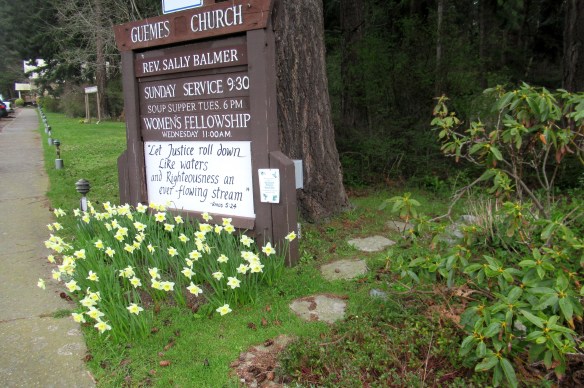
“…let judgment run down as waters, and righteousness as a mighty stream.”
– Amos 5:24

Guemes church 2


Driving to the Daffodils with Dad

Dad was resting in his bed when we got there.

Karen: Do you want to go for a drive?
Dad: Yes. Am I allowed to leave here?
Karen: (laughing) Of course! Are you ready to go?
Dad: Yes!

(Scotty and I situate Dad in the front passenger seat and I sit behind Dad in the back seat. I reach forward and pat Dad’s shoulder and he reaches for my hand and holds it.)
Scott: Where should we go first?
Karen: Sisters Espresso.
(Scotty heads for the Sisters Espresso. As we pull into the parking lot…)
Dad: Good! (smiling) Karen takes me here all the time when we go on our drives…
(I order the usual ice cream float for Dad, and a couple coffees for Scott and myself. I hand Dad his float through the car window…)
Dad: Thank you!
Karen: Is it good?
Dad: (gives the thumbs up)

We head out to the daffodil fields.
Dad: This is beautiful country. (Thinking) I used to be stationed out here – in the Coast Guard… Have you ever been to the Big Four Inn? They turned it into a Coast Guard place during the war. (Note: Dad had also been stationed in the South Pacific during The War – but today he wanted to talk about the Big Four Inn.)
Karen: (to Scott from the back seat) We went up there with Dad, remember? The Inn burnt down – there was just a foundation there.
Scott: (remembering) Yeah. (turns to Dad) We hiked up there together, remember? We went hiking with Pete Schoening to the Ice Caves.
Dad: (nods, remembering)
Scott: (talking to me) That was one of the last hikes Pete Schoening went on, wasn’t it? Do we still have the picture of Pete with the boys?
Karen: Yes. I think I have it on Facebook.
(The daffodil fields appear on the right.)
Karen: (pointing) Look at the daffodils!
Dad: The field is glowing.
(Scotty pulls over so I can snap some quick photos.)

Dad: What are we doing for New Year’s tonight?
Karen: It’s April. We’re looking at the April daffodils.
Dad: Oh. (Pause) When did I think it was?
Karen: I don’t know.
Dad: (to Scott) I used to live at the Big Four Inn. Have you ever been to the Big Four Inn? The Coast Guard took it over during the war. Where did you live during the war?
Scott:(smiling) I didn’t live anywhere. I wasn’t born, yet.
Dad: (starts laughing) Oh. Yeah.

(We pass Tulip Town…)
Dad: There’s going to be a lot of traffic here when the tulips bloom. You’ll want to avoid this area when it’s tulip time. When do the tulips get ripe?
Scott: Another couple weeks, probably.
Dad: (making an observation) It’s easier to see things when it’s raining. There’s not as much shadow.
(As we reach our turn-around point on our drive…)
Karen: Wayne said he was going to visit you. Did he stop by?
Dad: Yeah. We had a nice visit.
Karen: Did his wife visit you, too?
Dad: Yeah, she was there, too. It was nice.
Karen: Some more of your friends are going to visit in a couple weeks – Tom Hornbein, Bill Sumner, and Jim Wickwire.
Dad: (smiling) Good! That gives me something to look forward to!

(We head for Dad’s home, and pass a retirement community where one of his friends used to live…)
Karen: Norma used to live there, remember?
Dad: Oh… yeah. We visited her there once, didn’t we?
Karen: Yes.
Dad: I think she lived in the house right there – right next to the fence.
Karen: Yes, I think so.
Dad: This was the best time to go for a drive. I wouldn’t want to be driving around on a weekend when the tulips are blooming.
Karen: This was a nice drive, wasn’t it?
Dad: Yes, it was. A nice drive.
(We turn into the driveway of Dad’s home.)
Dad: I recognize this place. There’s that long bedroom…
(We help Dad out of the car, up the stairs, and into Moz’s old recliner in the living room.)
Karen: Thank you for going on a drive with us, Daddy.
Dad: Thank you for the drive!
Karen: I love you, Daddy.
Dad: I love you!

Death Doesn’t Get the Last Word

I learned today that you’d passed away
this last week, and I felt such an odd
mixture of emotions. Shock. Sadness.
Regret when I remembered the last time
I’d seen you was ten years ago. Had it
really been that long since I’d heard
your voice? And I felt anger, too.
Anger towards death. Anger that made
me want to rise up and live bigger,
fuller, freer, more fiercely. For you.
For me. For all of us on this planet.
Death won’t have the last word in your life.
Or in mine. Death doesn’t win. Ever.
– Karen Molenaar Terrell

Spent Easter on a little island in the Pacific Northwest. On impulse, attracted by the rainbow welcome sign on the front of the building, we attended the Easter service at a small non-denominational church on the island. Here are some of the words to one of the hymns we sang at the service (if you want to hear it performed by a choir on youtube, click here) – the love in it filled me all up with inspiration:

Now the green blade rises from the buried grain,
Wheat that in the dark earth many years has lain;
Love lives again, that with the dead has been:
Love is come again, like wheat that springs up green.
John MacLeod Campbell (J.M.C.) Crum

death doesnt get the last word

Butterfly in the North Cascades. Photo by Karen Molenaar Terrell.

“O death, where is thy sting? O grave, where is thy victory?”
– I Corinthians 15:55

“Life and goodness are immortal.”
Mary Baker Eddy

“Let us sing of Easter gladness
That rejoices every day,
Sing of hope and faith uplifted;
Love has rolled the stone away.
Lo, the promise and fulfillment,
Lo, the man whom God hath made,
Seen in glory of an Easter
Crowned with light that cannot fade.”
Frances Thompson Hill

Guemes church 2

“A Union of Hearts”

wedding photo

Happiness is spiritual,born of Truth and Love. It is unselfish; therefore it cannot exist alone, but requires all mankind to share it. – from the chapter titled “Marriage” in Science and Health with Key to the Scriptures by Mary Baker Eddy


You know those shows you see on television where the bride spends HUGE amounts of time, thought, and bucks choosing just the right ring, dress, caterer, flowers, music, photographer, and reception venue  for her “big day” – those shows where every minute detail  of the wedding production is analyzed, critiqued, and judged for its merits on visual perfection? Where the ceremony is somber and refined and the highlight of the whole shebang is the dress the bride wears?

Yeah. That wasn’t us.

My engagement ring was a little garnet ring I picked out from a small jewelry shop in Pike Place Market in Seattle, and the man who sold it to us was cheerfully, flamboyantly, hilariously gay – he had us cracking up the minute we walked into his shop. My wedding dress was the first dress I tried on from the sales rack at our local Bon Marche. Cost me $120. Our minister was a hoot – we’d met with him for a required counseling session, and when he told us that anything he had to say to us would be pretty much useless at this point – because it’s really only AFTER the wedding that the bride and groom realize what they’ve gotten themselves into (we later learned that he’d just recently been divorced), we immediately recognized the man had a sense of humor, and he was, for sure, the minister we wanted officiating our nuptials.

The wedding was a joyful, light-hearted affair in a small Methodist church in Gig Harbor – I remember the minister asking us if we really wanted to hold the service in his church – it was very small – could maybe hold 100 people – and very old (it’s since been torn down and a larger church built in a different location) – but, for our purposes, that little church was perfect – I liked the cozy smallness of it and the stained glass windows – and from the church’s steps we could look out across the water and see Mount Rainier rising above the hills in the distance.  The wedding itself was simple, joyful, and natural. We weren’t too concerned with “perfection” – we just wanted our guests to feel comfortable and loved.

The reception was held in my parents’ backyard – with the sound of laughter, and the smell of daffodils and plum blossoms, filling the air. And we played volleyball in the pasture – the groom’s team won, but it was a close game.  The minister came to the reception, and fit right in with our hooligan families and friends. Before he left he told us that sometimes he’s really worried about the future of the newlyweds he marries – they often seem more concerned about the wedding than the actual marriage – but, after watching us yukking it up with our families and friends, he felt good about being a part of our ceremony.  He knew we were going to be alright. We knew how to laugh.

When I think about that day, I can’t imagine why anyone would want to deny other people the right to a wedding, and to a life-long commitment in marriage with the partner they love.  I can’t understand why any heterosexual couple would feel their own marriage is threatened by giving homosexuals the same rights that they have.  I feel a real yearning for other folks who love one another, and are brave enough to make a commitment to each other, to be allowed to have what my husband and I were allowed to have.

I believe that every citizen – regardless of race, ethnicity, social and economic status, religion, non-religion, gender, or sexual orientation – should have the exact same rights as every other citizen – including the right for consenting adults to marry whom they love.

(originally published in 2013)

***

“Matrimony should never be entered into without a full recognition of its enduring obligations on both sides. There should be the most tender solicitude for each other’s happiness, and mutual attention and approbation should wait on all the years of married life…  Kindred tastes, motives, and aspirations are necessary to the formation of a happy and permanent companionship…   Marriage should improve the human species, becoming… a centre for the affections. This, however, in a majority of cases, is not its present tendency, and why? Because the education of the higher nature is neglected, and other considerations, – passion, frivolous amusements, personal adornment, display, and pride, – occupy thought… The scientific morale of marriage is spiritual unity… Marriage should signify a union of hearts… Beholding the world’s lack of Christianity and the powerlessness of vows to make home happy, the human mind will at length demand a higher affection. There will ensue a fermentation over this as over many other reforms, until we get at last the clear straining of truth… Matrimony, which was once a fixed fact among us, must lose its present slippery footing, and man must find permanence and peace in a more spiritual adherence.”
– excerpts from the chapter titled “Marriage” in Science and Health with Key to the Scriptures
by Mary Baker Eddy


Lincoln City Memories

The time to be happy is now. The place to be happy is here.
– Robert Ingersoll, The Great Agnostic

Ocean is more ancient than the mountains, and freighted with the memories and dreams of Time.
–  H.P. Lovecraft

I think it would be interesting if old people got anti-Alzheimer’s disease where they slowly began to recover other peoples’ memories.
– George Carlin

My husband and I just returned from our most recent trip to Lincoln City, Oregon. We’ve been going there since 1984 – when we discovered the magic of Lincoln City  on our honeymoon.  We were trying to figure out how many times we’ve been there in the last 29 years, and we figured we’ve made a pilgrimage to Lincoln City probably 27 times – every year, with one or two exceptions.

You know how photographers do time lapse photography to show Nature unfolding in quick time? Yeah, I’m thinking if we took the days my family has spent in Lincoln City and sort of condensed them into a time lapse photography kind of deal, we’d see something like this…

There we are in 1984 – young, confident, and hopeful – starting our life together – unaware of the challenges ahead, and unaware of the blessings, either – running on the beach – limbs strong and quick and joints well-oiled. My aunt Junie showed me the art of agate-hunting when I was a youngster, and now I’m teaching my new husband how to pick up the glow of an agate on the beach – how to discern the difference between a bona fide agate and a rough piece of quartz…

1992:  Introducing our firstborn to the ocean for the first time. His baby body rests on my knee, facing out to the sea. His eyes have locked onto the ocean and taken note of it – he’s chewing his lower lip, eyes moving back and forth along the sea’s horizon, taking in the sights and sounds and smells. It’s becoming a part of him.

1994: We have come to Lincoln City as parents of childREN. We are old hands at parenthood now. Today it is our youngest son’s turn to meet the ocean. We take off his booties and lower his toes into the water. It is a sort of ritual baptism of baby feet – a bonding with the Pacific.

1999: The sons are playing with the surf – letting the waves chase them up the beach. The ocean is their comfortable old friend now.

Jump to April, 2008: I am in crisis.   Struggling with severe depression. I am desperate to escape from myself and my constantly-churning thoughts. Oldest son knows I need to get away and asks me if I’d like him to go to Lincoln City with me for Spring Break. How many 16 year-old sons do you know who’d be willing to accompany their moms on a 14-hour (round trip) road trip? I am blest beyond words. On the way to Lincoln City we stop and visit my Aunt Junie, who shares our kinship with the ocean and lives in Depoe Bay, an hour north of Lincoln City.  I confide my struggles to Junie, and the feelings of guilt and unworthiness that seem to be a symptom of my illness. Junie is appalled at my feelings of worthlessness. “All her instincts” tell her that I am a good person, she says.  “There are no unrightable wrongs, no unforgiveable sins, no fatal mistakes, no fatal diseases, only the eternal now.” She is like Yoda.

July, 2008: Still struggling with the  depression. Lincoln City is my respite. I sit on the balcony in the sun and look down on the beach and watch the sons running and cavorting on the sand below.  There have been times lately when I’ve wished myself not born. But, watching my sons, it hits me that if I hadn’t been born, they wouldn’t have been born, either. They give me purpose. And the ocean gives me comfort. We stop in Tilamook on the way home and I am drawn to a garden plaque that quotes The Great Agnostic, Robert Ingersoll: “The time to be happy is now. The place to be happy is here.” On impulse, I buy it. It will sit in a place of honor on our mantel when we return home.

2009:  The family meets on the Oregon coast to celebrate Aunt Junie’s life, and spread her ashes on the ocean.  We will not get as far as Lincoln City this time, but the ocean that she is now a part of will touch the beaches that have provided such solace to me over the years.  And every time I’m near the ocean, I’ll think of Junie – her humor and wisdom and kindness to me.

2010:  Hoping, but not with high expectations, I ask my youngest son, who’s just turned 16, if he’d like to make the same road trip that I made with his older brother two years ago. To my surprise and delight, he says he would! We spend two days at the ocean – flying a kite, looking for agates, running (well, okay, he’s doing most of the running now) along the beach.  Before we leave on our trip I ask Xander if he’s remembered his swimsuit, long pants, shorts, sweatshirt, sneakers, toothbrush, and sandals. He assures me he has. When we arrive at Lincoln City, I realize that am the one who’s left her clothes, laptop, and toothbrush back home. It is all very humbling. But there’s a certain freedom in the forgetting, too. I’m scraped down to the bare essentials. Having no laptop is a good thing.  I have become big into photography in the last couple years, and I have, at least, remembered my camera. Camera, son, ocean, and the clothes on my back – what else does a person really need? 🙂

2013: The sons are all grown-up now. They have jobs and things to do.  For the first time since we became parents, we will be making our Lincoln City pilgrimage alone.  We eat at our favorite eatery there – The Lighthouse Brew Pub – take long walks together, hunt for agates, and remember together who we were when we first found Lincoln City.  Young, strong, confident, hopeful. Our lives stretched out ahead of us.  And we think about all that’s happened in the 29 years since. And it’s all been good. All of it. Even the bad stuff has been good, really. Just like those blossoms unfolding in time lapse photography – our life together has unfolded most wonderfully.

(originally posted in 2013)