June Perfume
Locust trees and lupines
and pungent pine pollen and wild
roses growing along the river
and green grass just-cropped
send their sweet scent
wafting on gentle winds
past my nose.
-Karen Molenaar Terrell

June Perfume
Locust trees and lupines
and pungent pine pollen and wild
roses growing along the river
and green grass just-cropped
send their sweet scent
wafting on gentle winds
past my nose.
-Karen Molenaar Terrell
I discovered something the other day –
I was sitting in a cranky, put-upon place
stewing in my own impatience –
and then – I shut it off. Put it behind me.
The troubles from the moment before
were no longer relevant to me.
And a laughing lightness –
a joyful presence – just wrapped itself
around me in a happy hug and –
instantly! – I felt whole and free
and at peace with the world.
I discovered I can let go of then.
I discovered I can live in now.
-Karen Molenaar Terrell
(Photo by Karen Molenaar Terrell.)

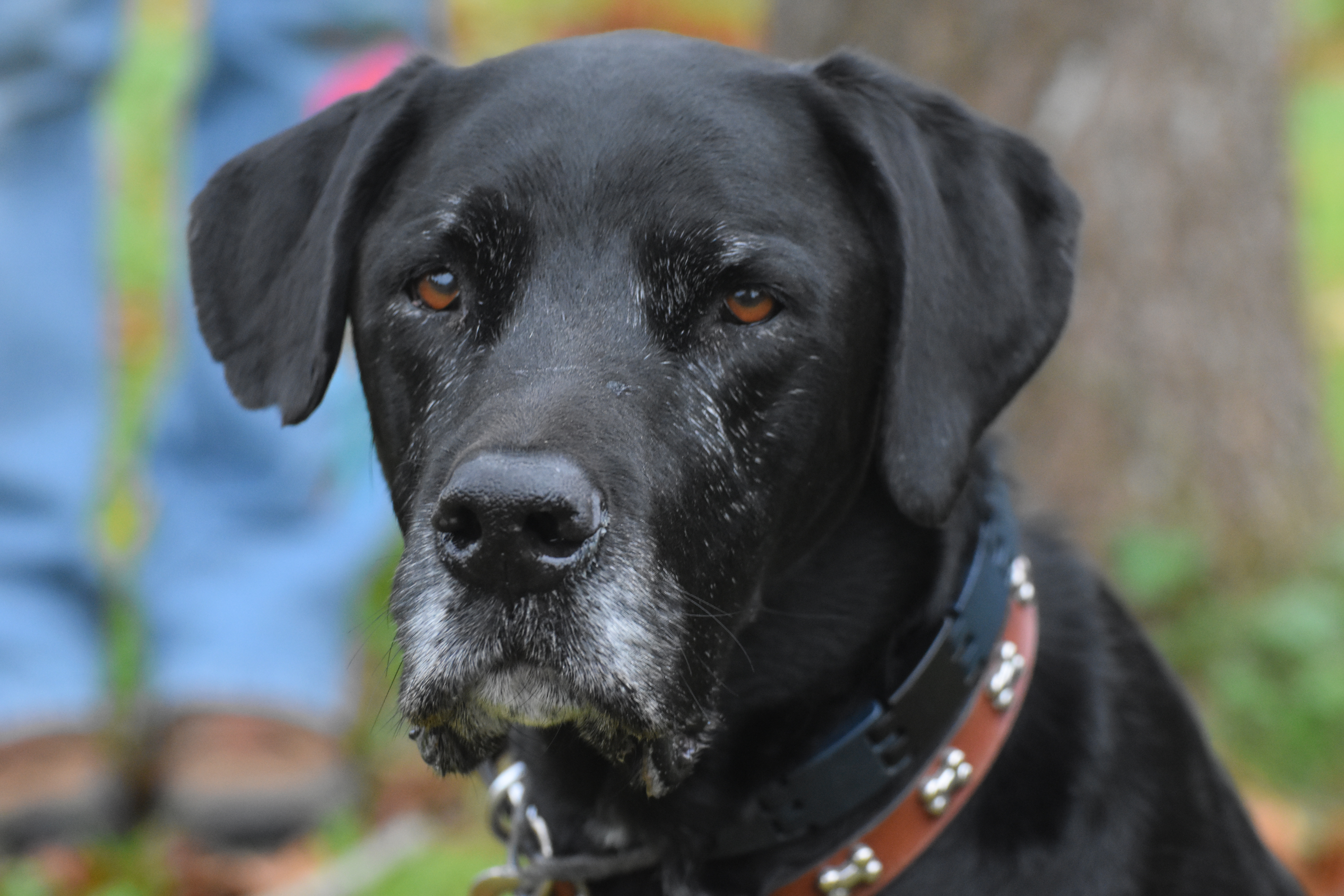
I expect to see her at the door
tail wagging
on our walks
nostrils quivering
one paw raised mid-stride
nose covered in dirt
from her latest hole
unaware of her own beauty
sleek and shiny as a black panther,
but goofy as a Disney character
exhausting
exuberant
extraordinary
friendlly, fetching frisbees and finding –
like magic! –
every tennis ball that ever landed off a trail.
It was a gift she had.
Her first night with us she ate a chunk
out of our ottoman – which we will now call
“The Samantha Terrell Memorial Ottoman.”
Then she went through an “electronics”phase –
the cellphone (chomp),
the remote control (crunch).
Sam loved her neighbors –
the dogs and their humans –
and her walks
around the neighborhood
included frisky, friendly greetings –
dog greetings and human greetings.
And now the neighbors
send us flowers and notes:
“She was a good girl.”
Our neighbors were good friends
to Samantha and their notes
make me smile – seeing the love.
I miss our Samantha
the Wonder Dog.
-Karen Molenaar Terrell




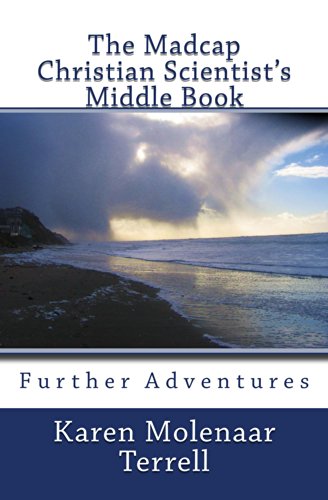
(Excerpt from The Madcap Christian Scientist’s Middle Book.)
At the age of 51 I went insane. I did not like it so much. But I learned a lot from it.
Eckhart Tolle tells us: “Life will give you whatever experience is most helpful for the evolution of your consciousness.” He asks, “How do you know this is the experience you need? Because,” he says, “this is the experience you are having at this moment.” I really like how he puts that. My thought is that something is only a challenge to us when there’s a lesson to learn from it. Two people, in other words, might find themselves in identical situations – and one of those people might coast through the situation, and the other might stumble through it – depending on where each individual is in her spiritual progress.
I did a lot of stumbling during The Year of Insanity, and I learned a whole lot of lessons. It was, in essence, my last hurrah – my final experience with the lessons of “callow youth” and ego, before I could move on to the next stage in my development.
During The Year of Insanity it seemed I was confronted with temptation at every turn. I had to come face-to-face with ego, vanity, pride, insecurity, and addiction to praise. It was a really difficult time for me. It felt like I was at the bottom of a deep, dark pit, and I didn’t know how I was going to get out of there. I lost weight, couldn’t sleep, had a constant dialogue going on inside my head about the past and the future, had to keep moving – trying to get away from myself, I guess – and had an actual physical heartache from the sadness I felt. There were times when I just wanted to hide myself away from the world, and not have to deal with this stuff anymore. There were times when I was so full of guilt about the feelings I was having that I just wanted to kill myself, and be done with it. There was a constant battle going on inside me, and it was really wearing.
If somebody had tried to talk to me about mental illness before I’d had this experience, I wouldn’t have had a clue what they were going on about. Mental illness was something that happened to “other” people. Mental illness was not something a madcap Christian Scientist would ever know anything about, right?
Yeesh.
I might have chosen, with good reason, to seek professional help during this time. I might have chosen, again with good reason, to take anti-depressant medications. And after having been through this experience, I can tell you – without any hesitation – that I do not fault anyone, at all, for seeking professional help and using medication if they think it’ll help them get through the kind of thing I went through during that year. And I can also understand why it might be hard for people to cogitate why I didn’t do those things in an effort to help myself.
All I can tell you, really, is that there was some part of me that felt I needed this experience – that I needed to feel the full depth and breadth of it – and there was a part of me that believed if I could survive this, I would come out of it much wiser and stronger than before I went into it. I guess I calculated the costs and rewards and decided the rewards would be worth it. If I could survive.
I give credit to Christian Science, and to my Father-Mother God, for getting me through this time. I absolutely know I wouldn’t have been able to make it without the understanding of God, Good, I’d gained through my study of Christian Science.
I also need to give thanks to three authors whose writings meant a great deal to me while I was working my way through that year. I’ve already quoted one of them – Eckhart Tolle – a contemporary thinker who’s had his own experience with depression, and has generously shared his wisdom and insights about that in several recent best-sellers. The second of the three authors was a liberal Christian minister of the late 1800’s named Henry Drummond. His book, The Greatest Thing in the World, was chock full of wise and wonderful thoughts on love – “the greatest thing in the world.” The third author was a man named Edward A. Kimball, an inspiring and mentally-rousing Christian Science lecturer and teacher during the late 1800’s and early 1900’s.
Regarding my desire to hide myself away from temptation, Henry Drummond had this to say to me: “Above all, do not resent temptation; do not be perplexed because it seems to thicken round you more and more, and ceases neither for effort nor for agony nor prayer. That is your practice. That is the practice which God appoints you, and it is having its work in making you patient, and humble, and generous, and unselfish, and kind, and courteous.” Drummond goes on to say: “Therefore keep in the midst of life. Do not isolate yourself. Be among men and among things, and among troubles, and difficulties, and obstacles… Talent develops itself in solitude – the talent of prayer, of faith, of meditation, of seeing the unseen; character grows in the stream of the world’s life. That chiefly is where men are to learn love.”
Drummond’s admonition to “keep in the midst of life” was really helpful to me. His words helped me look at the challenges I was facing as blessings and needed lessons in my path towards progress, rather than as proof of my weakness, or a reason to feel guilty.
Edward A. Kimball, too, was helpful to me in dealing with the feelings of guilt that seemed to be a symptom of the depression. In his book, Lectures and Articles on Christian Science, Kimball writes, “It won’t do you a particle of good to enter upon a career of self-condemnation. Remorse never got anybody into heaven. A sense of regret and all that sort of thing is not the process. The process is reform; it is change; it is correction…”
Kimball writes, “…a purely human giving up endeavor does not give up, but does involve the scientist in a sense of greater fear. Evil is never disposed of as though it were something. It cannot be given up as though it were something…Try to realize that through Christian Science, you are constantly gaining that which will do everything for you, and that you will succeed according to the gaining process.”
This thought helped bring me peace – the insight that trying to fight an addiction by turning it into A Big Obstacle and using human will to force myself to “give it up” wasn’t the way for me to be healed – but that I needed to fill up the holes and emptiness I felt in my life by gaining an understanding of what constitutes true happiness and filling my life up with that. As my friend, Sabra, pointed out to me, we don’t remember the last time we laid down our dollies and moved on to other joys – giving up my toys was not a Major Event or something I had to force upon myself – it was a natural step in my forward way. And it can be that way with every forward step we take – we aren’t so much “giving up” something, as we are gaining something.
Here’s some of what I gained during this time: a new understanding and appreciation of love; a greater sense of gratitude for the power of a moment, and of a good, deep breath; a greater appreciation for choice; renewed gratitude for all the beauty in Nature and mankind; greater humility, empathy and compassion; and a greater commitment to my own spiritual journey. I’d entered The Year of Insanity an untested “youth” – gliding through life’s challenges on a kind of cavalier, simple joy, without really having to put much work or effort into my mental frame of mind. By the time I exited that year I had a much deeper understanding of God, and who I am, as God’s expression.
(Originally published June 10, 2019.)
Something really magical happened in Bellingham this morning – actually, many magical things happened in Bellingham this morning, but let’s start with THIS one:
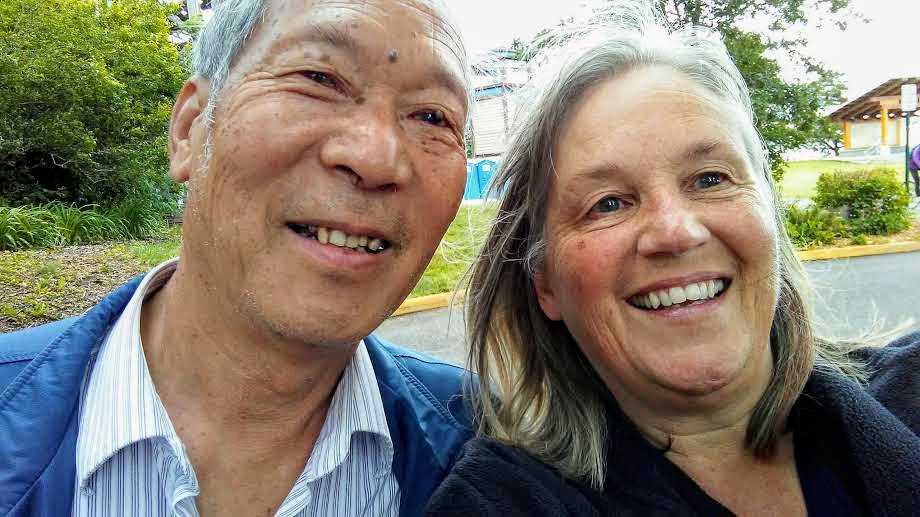
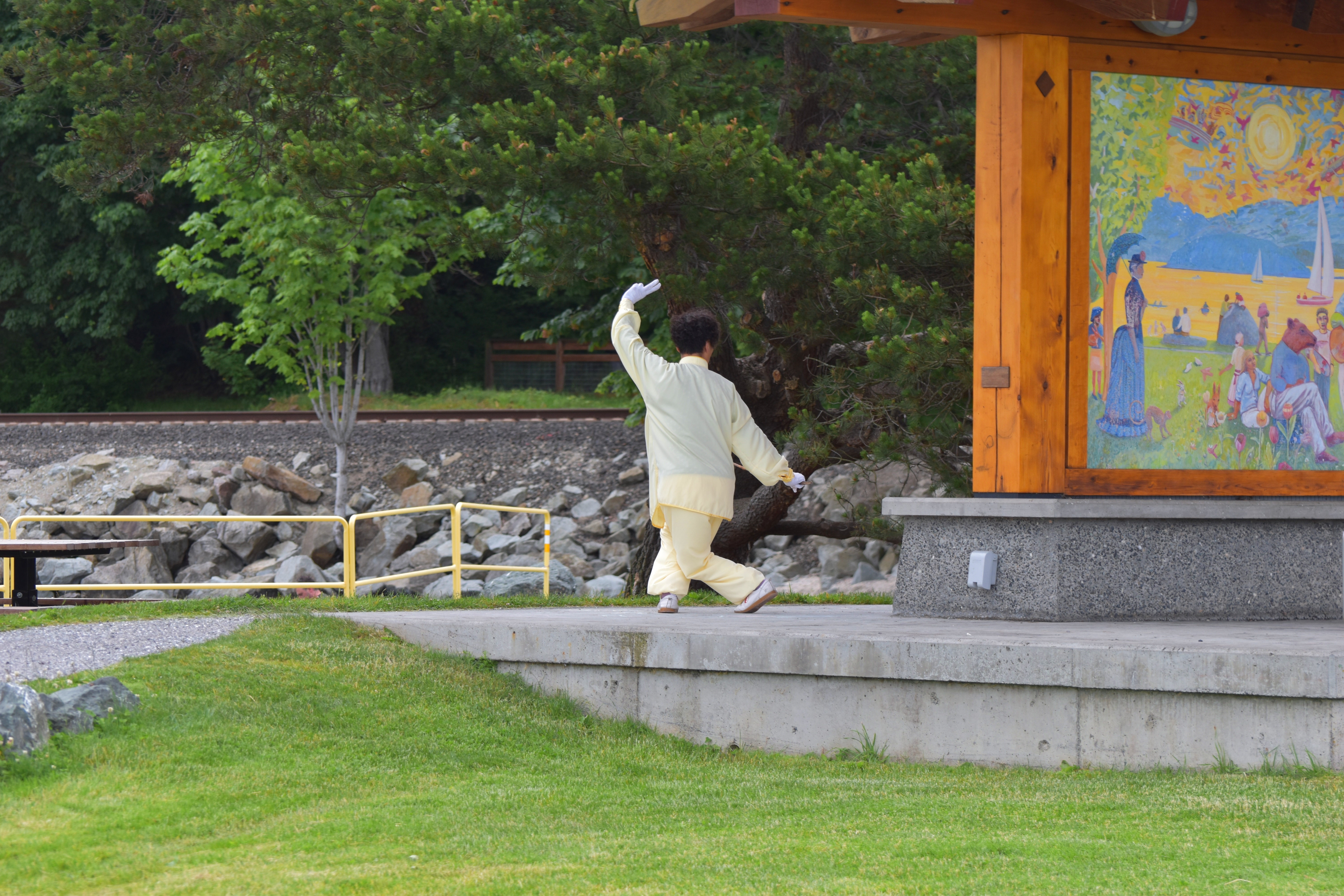
As I was walking along the shore in Boulevard Park I looked across the green and saw a man on the other side, in the parking lot, moving in a way that made me think he was maybe doing tai chi. I love how people move when they’re doing tai chi and I’d like to learn how to do that myself – so I started trying to follow his movements – I raised my arm when he raised his arm, I turned when he turned – and at some point he recognized what I was doing and we smiled at each other across the park. When I walked around the park to the other side I thanked him and then… I’m not sure how this happened, exactly – but the next thing I knew he’d raised his hand to mine and we were dancing! In the parking lot. At Boulevard Park. That’s what he’d been doing all along – he’d been dancing! I could hear the music then – it sounded like an Asian waltz – I know I’m not explaining this well, but… the notes were D, F, G, B flat, G… for those of you who have a scale in your head. (“A Scale in Your Head” would make a great title for a book, wouldn’t it?)
It was cosmic!. We danced around the parking lot for a few minutes. And then I thanked him – he smiled – I don’t think he spoke English – and let me take a picture of us together.
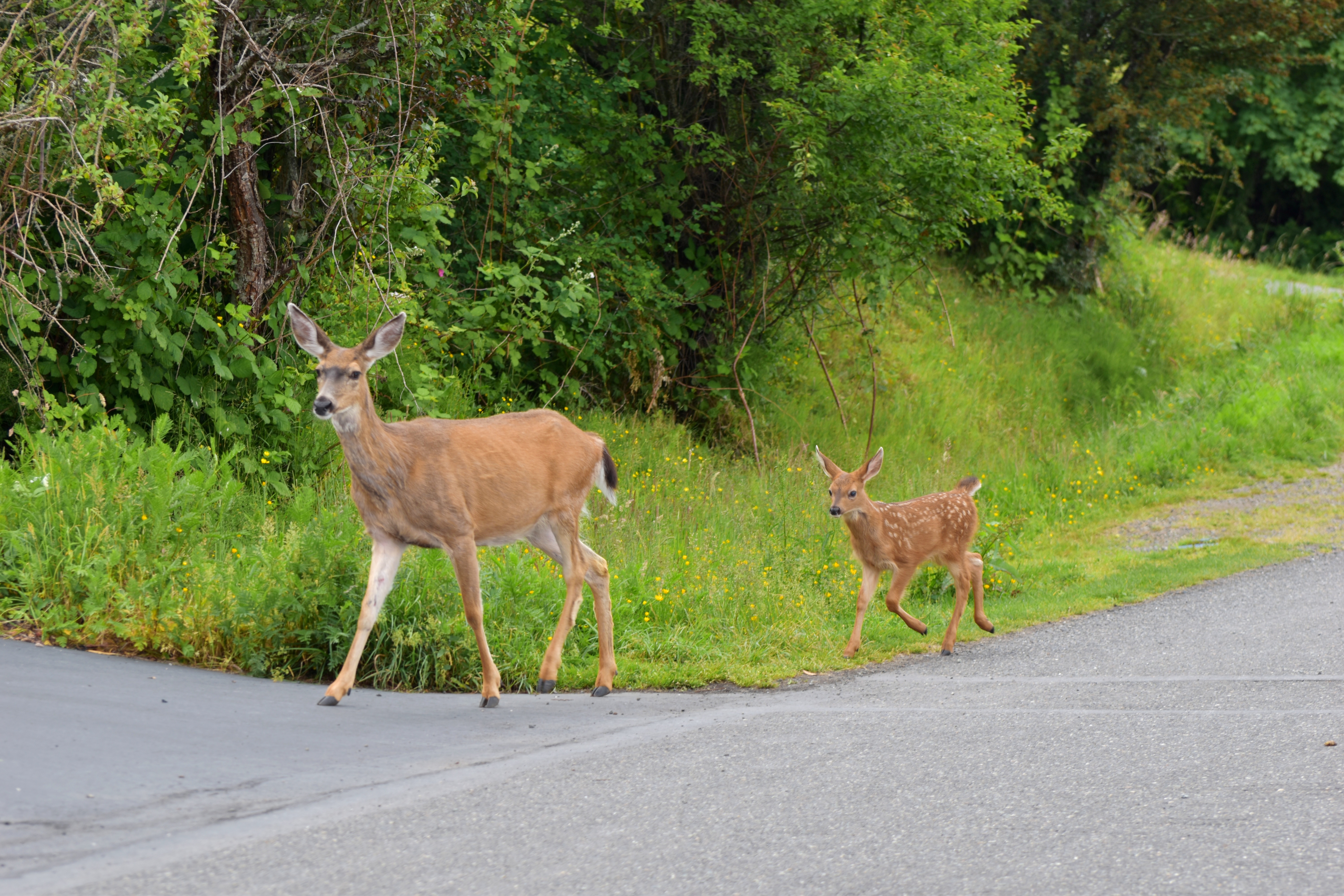
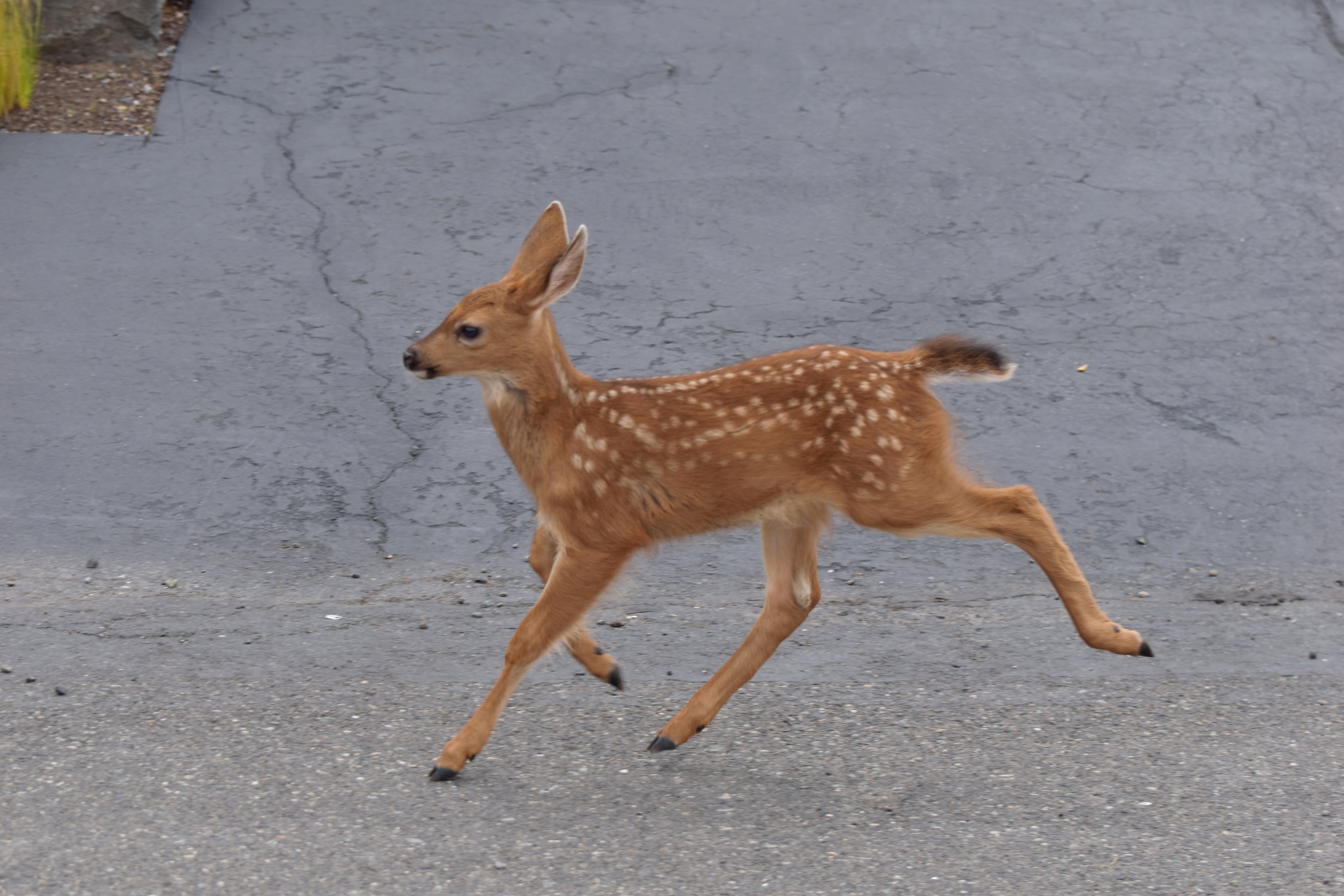
I was still thinking about my waltz in the park when I got to the parking lot above the boardwalk. And then this deer walked across the road – and a little spotted fawn suddenly appeared, too, skipping along behind her. All of us who were walking along the road just stopped and watched them pass. “Well, THAT was magic,” I said. And this man smiled at me and said, “Isn’t that a great way to start the day?!”
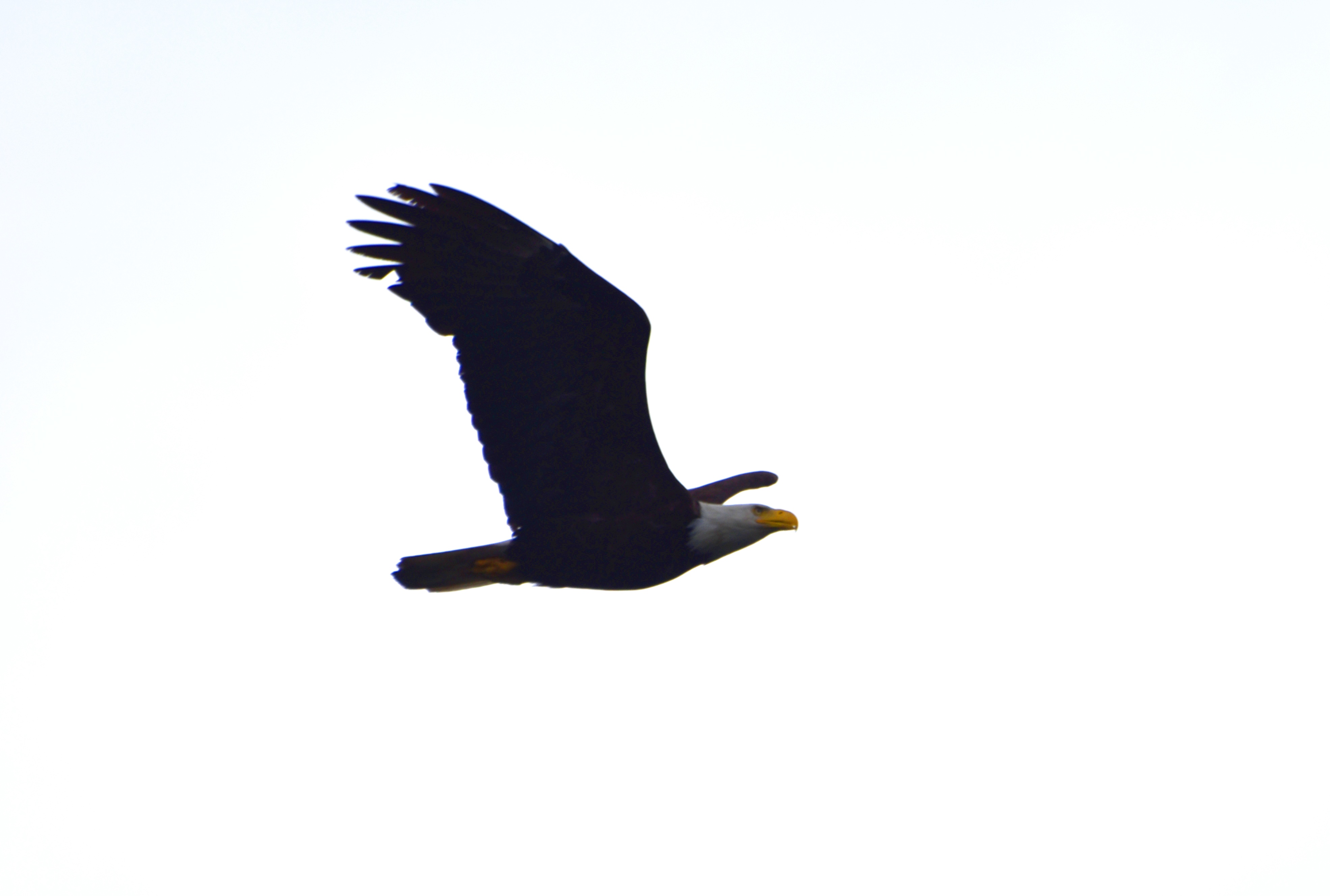
And there was an eagle – soaring right above me! And… and… well, here are some pictures from my morning…
– Karen Molenaar Terrell

Thoughts upon a reading a dialogue between two of my friends:
Jeepers. Let’s give each other grace
and space
and the opportunity to grow
at our own pace
None of us is stuck in one place
mentally
We’re all evolving, changing,
re-arranging
moment by moment by moment.
No need to judge here.
No need to preach
all sanctimonious to each
other.
The person I was yesterday is gone
and so is the person you were
and so is the person next to you –
and what’s the point
of judging a person who
no longer exists?
-Karen Molenaar Terrell
(Photo by Karen Molenaar Terrell.)

(Excerpt from Are You Taking Me Home Now? Adventures with Dad)
Dad (Dee Molenaar, 99) is still in bed at noon.
Karen: Do you just want to stay in bed and rest today?
Dad: (looking up at me, hopefully) Unless somebody wants to go for a drive.
Karen: Do you want to go for a drive?
Dad: Yeah.
A half an hour later Gwen has Dad dressed and fed, and we load him into my car. I head south on I-5.
Dad: When you and Scott retire are you going to travel the world?
Karen: That sounds fun!
Dad: I’ve seen a lot of the world. (This is an understatement.) I can tell you where NOT to go.
Karen: Where should we not go?
Dad: New York City.
(I’ve been to New York City and enjoyed it – but I’m wondering when Dad went and what he experienced there.)
Karen: Where else should we not go?
Dad: Well, you’re on the freeway. Any place from the freeway is fine. It’s easy to go anywhere from here.
Dad: Where are you taking me?
Karen: I thought we’d go south and see if we can see Rainier. It might be kind of hazy today, though. There’s a forest fire in Canada.
Dad: Rainier’s too far. Baker will be all clouded in today. (We pass a sign for LaConner.) Let’s go to the old waterfront part of LaConner.
Karen: You want to go to LaConner?
Dad: Yeah.
(As we’re driving through the countryside towards LaConner, Dad is taking note of what he sees.)
Dad: This area looks a lot like the midwest, except for the hills in the background.
(We pass a sign with a Dutch name on it and I point to it.)
Dad: Roozengarde – there’s a Dutch name. We could be driving through the Netherlands – except for the mountains in the background.
(We get to LaConner and Dad decides he wants to go to a museum. I’ve wanted to take Dad to the Skagit Historical Museum since he moved up here a year ago. Maybe today is the day this will happen. I drive to the museum and park maybe 30 yards from it. I don’t realize there are a lot of parking spaces closer to the museum, but, when I park where I park, 30 yards doesn’t seem like much of a walk. I am wrong. We unload Dad and his walker, and begin the walk to the museum. After about ten yards Dad says he needs to sit down, and we find a place for him to sit on a little wall.)
Karen: Let me go see if they have wheelchairs in there. Stay here. Are you alright?
Dad: (nodding) Okay.
(I go into the museum to see if they have wheelchairs. They don’t. A rolling chair seems promising, though. I ask if I can use it to get Dad around, and Ann, the woman tending the counter, says sure. I bring the chair down to where Dad is sitting, and help Dad get into the rolling chair. A nice couple about to go into the museum approaches us to help. Steve says he can push Dad from the back, and Danielle guards Dad from the side, and I pick up Dad’s feet so they don’t drag on the concrete. When we get Dad inside he decides he wants to use his walker in there. He heads into the room that displays a history of technology.)
Dad: That looks just like my first car!
Karen: Your first car was a Model-T Ford?
Dad: Yeah. Model-T Ford. 1925.
(I am grinning now. I love that I’m walking through an historical museum with a walking piece of history. Dad is starting to get tired again, and we bring back the rolling chair for him to sit in. We head into the World War II exhibit. Dad served in the Coast Guard in World War II and he seems fascinated by what he sees in there. He notes that the Coast Guard doesn’t seem to be represented in there, but says that’s okay – the Coast Guard was more in the South Pacific, and this exhibit is more about the campaign in Europe.)
(Danielle, the woman who helped Dad earlier, approaches Dad to tell him she looked him up in Wikipedia and wants to thank him for his service during the war. Dad thanks her and asks her if she was in the Coast Guard. Danielle says no, but her brother was. Dad likes that. I get a picture of Dad with Steve and Danielle. Dad asks me their names, and I introduce them. He shakes their hands. He has just met two new friends.)
(Dad is tired now. He’s ready to go home. With colossal effort he manages to use his walker to get himself back to the car – which I have now parked right next to the door. He asks where we’re going now, and I tell him I’m going to get him a root beer float and then take him home. He nods his head in agreement. I stop for his root beer float.)
Karen: You really earned this one.
(Dad nods his head in complete agreement, and then we head to his home. Dad looks completely exhausted. He has sucked down his root beer float by the time we get to his place. I open the passenger door for him, and inch by inch he turns himself around in his seat.)
Dad: Every little movement takes so much energy now. And I need to rest after every movement. (He closes his eyes and sighs and leans back to rest for a few moments, before making another movement to get out of the car.) You have a doddering old Dad.
Karen: No. I have a mountain-climbing Dad.
Dad: That was a long time ago. (He looks up at the house.) I think I’m going to take a little nap when I get in there.
Karen: I love you, Daddy. I’m proud to be your daughter.
Dad: I love you, too, and I’m proud to have you for a daughter.


All people want to be heard
and acknowledged and seen
and valued and not discounted
or ignored or pushed off to the side
as insignificant or irrelevant.
We all want a voice.
We all want to be heard –
no matter the color of our skin
or our gender
or our age
or our sexual orientation.
And I don’t think we should be ashamed
of wanting that and needing it.
You matter.
You are important to the world.
-Karen Molenaar Terrell
“Each individual must fill his own niche in time and eternity.”
-Mary Baker Eddy (Retrospection and Introspection, p. 70)
“Beloved children, the world has need of you…”
-Mary Baker Eddy

 Adventures of the Madcap Christian Scientist